

By Nkechi Eze
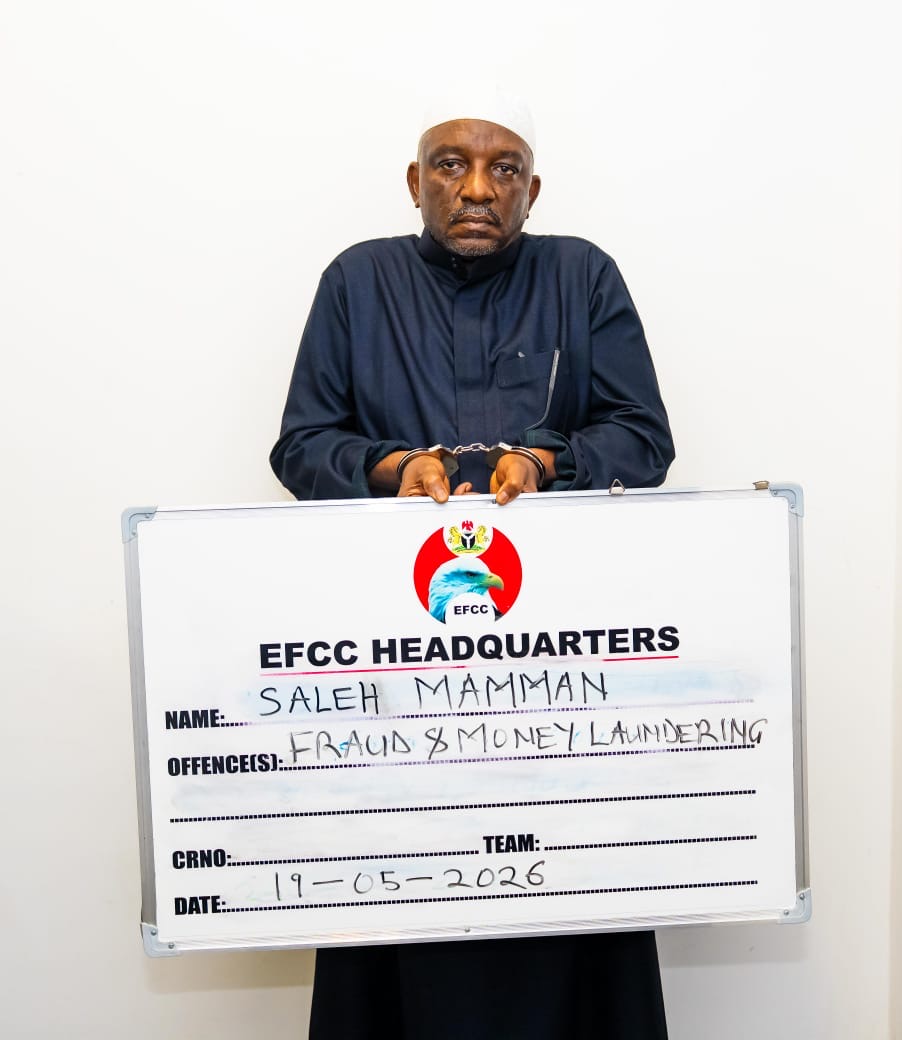
The Economic and Financial Crimes Commission (EFCC) has intensified its post-conviction enforcement drive with the arrest of a former Minister of Power, Mr Saleh Mamman, who was declared a fugitive following his conviction and sentencing by the Federal High Court in Abuja over large-scale corruption involving major national power projects.
The arrest, which marks a significant development in the enforcement of a landmark judgment in Nigeria’s anti-corruption jurisprudence, was carried out in the early hours of Tuesday, May 19, 2026, at the Rigasa area of Kaduna State following weeks of intelligence-led surveillance operations by operatives of the Commission.
According to the EFCC, Mamman had gone underground after the Federal High Court, presided over by Justice James Omotosho, convicted him on May 7, 2026, on 12 counts bordering on the diversion of funds allocated to critical national infrastructure projects, including the Zungeru and Mambilla hydroelectric power projects.
Addressing journalists on the arrest, the Executive Chairman of the EFCC, Mr Ola Olukoyede, confirmed that the former minister was apprehended after sustained tracking operations aimed at ensuring that convicted persons serve their sentences in line with judicial pronouncements.
He stated that the Commission deployed extensive intelligence resources to locate and arrest Mamman following his disappearance after conviction.
“For us, getting the convict to serve his jail terms is extremely important in view of the seriousness with which we are tackling corrupt practices. It is this resolve that made us deploy intelligence to tracking and arresting the convict. We will process his transmission to the Correctional Centre accordingly,” he said.
Court records indicate that Justice Omotosho, in his judgment delivered on May 7, 2026, found Mr Mamman guilty on all 12 counts, holding that the prosecution had successfully proved beyond reasonable doubt that he participated in the diversion of not less than N22 billion earmarked for critical power infrastructure projects.
The court further established that the funds intended for the execution of the Zungeru and Mambilla hydroelectric power projects were siphoned through proxy companies and associates allegedly linked to the former minister. The judge described the conduct as a gross abuse of public trust and a direct assault on national development priorities.
Justice Omotosho, in the judgment, also noted that the defence failed to present credible evidence capable of dislodging the prosecution’s case, thereby affirming the EFCC’s position that the funds were systematically diverted.
Mamman, who served as Minister of Power between 2019 and 2021 under the administration of former President Muhammadu Buhari, oversaw key segments of Nigeria’s electricity reform agenda and major hydroelectric initiatives, including the Mambilla and Zungeru projects, both of which have been at the centre of prolonged controversies over funding and execution delays.
Following his conviction, the court ordered that he be produced for sentencing on May 13, 2026. However, he failed to appear in court on the scheduled date, prompting the judiciary to proceed with sentencing in his absence.
Justice Omotosho subsequently imposed multiple custodial sentences on the former minister, including seven years imprisonment on each of Counts 1, 2, 3, 6, 7, 8, 9, 10, 11 and 12 without an option of fine. He also sentenced him to three years imprisonment on Count 4 with an option of a N10 million fine, and two years imprisonment on Count 5 without an option of fine.
The court ordered that the sentences run consecutively, resulting in a cumulative 75-year jail term.
In addition to the concluded proceedings, Mamman is also facing a separate corruption trial before the Federal Capital Territory High Court in Abuja over an alleged N31 billion fraud. In that matter, Justice Maryanne Anenih had on May 11, 2026, issued a bench warrant for his arrest following his failure to appear in court alongside seven other defendants.
Security sources confirmed that the EFCC had been monitoring the former minister’s movements after he went underground, leading to his eventual arrest in Kaduna after weeks of sustained surveillance operations.
The Commission is expected to conclude administrative processes and facilitate his transfer to a correctional facility to commence the execution of his sentence, while also ensuring his appearance in other pending cases before various courts.
The development marks one of the most consequential enforcement actions by the EFCC in recent months, underscoring its renewed focus on ensuring that court judgments in high-profile corruption cases are fully executed without delay or evasion.