


By Nkechi Eze
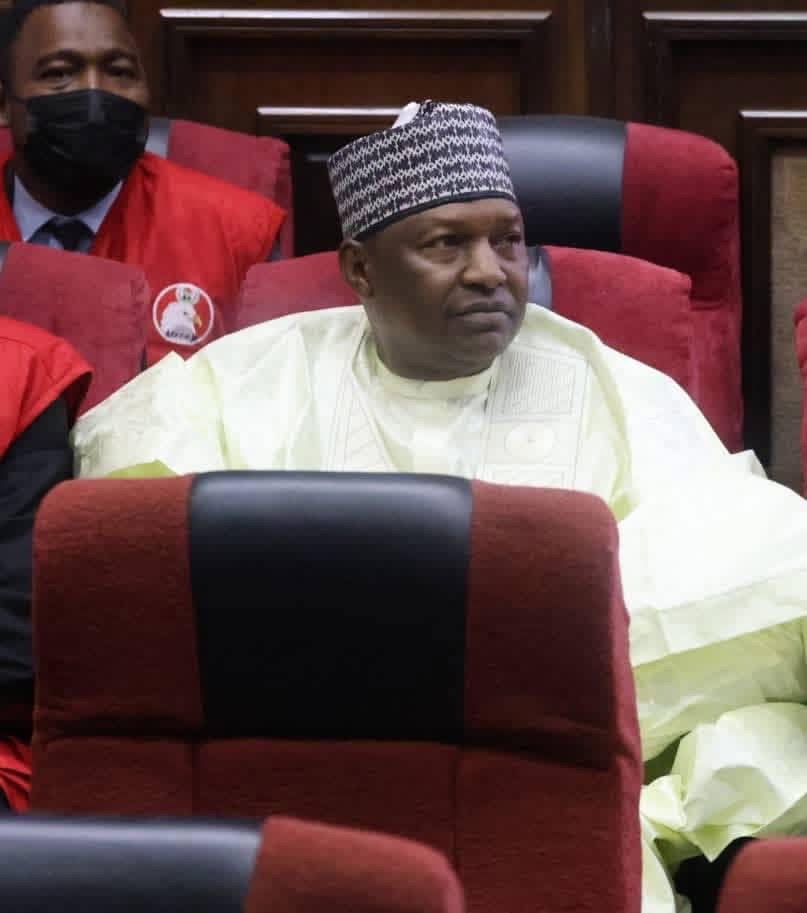
The Economic and Financial Crimes Commission (EFCC) on Tuesday, December 30, 2025, formally arraigned the immediate past Attorney-General of the Federation and Minister of Justice, Abubakar Malami, SAN, alongside his wife, Hajia Bashir Asabe, and their son, Abubakar Abdulaziz Malami, before the Federal High Court sitting in Maitama, Abuja, over alleged money laundering offences involving the sum of N8,713,923,759.49.
The defendants appeared before Justice Emeka Nwite on a 16-count charge bordering on conspiracy, procuring, disguising, concealing and laundering proceeds of alleged unlawful activities, contrary to the provisions of the Money Laundering (Prevention and Prohibition) Act, 2022.
At the commencement of proceedings, prosecution counsel, Ekele Iheanacho, SAN, informed the court that the matter was scheduled for arraignment. “My Lord, this matter is for the arraignment of the defendants on a 16-count charge dated and filed on December 23, 2025. We humbly pray that the charge be read to the defendants and their pleas taken,” Iheanacho told the court.
Counsel to the defendants, J. B. Daudu, SAN, raised no objection, following which Justice Nwite ordered that the charge be read to the defendants.
According to the charge, the EFCC alleged that Malami and his son, Abubakar Abdulaziz Malami, between July 2022 and June 2025 in Abuja, procured Metropolitan Auto Tech Limited to conceal the unlawful origin of the sum of N1,014,848,500 lodged in a Sterling Bank Plc account, when they reasonably ought to have known that the funds constituted proceeds of unlawful activities. The offence was said to be contrary to Section 21(c) of the Money Laundering (Prevention and Prohibition) Act, 2022, and punishable under Section 18(3) of the same Act.
In another count, the EFCC alleged that Malami, his son and his wife, Hajia Bashir Asabe, described in the charge as an employee of Rahamaniyya Properties Limited, sometime in September 2024 in Abuja, conspired to disguise the unlawful origin of an aggregate sum of N1,049,173,926.13 paid through the Union Bank Plc account of Meethaq Hotels Limited, Jabi, between November 2022 and September 2024. The alleged offence was said to be contrary to Section 21 of the Act and punishable under Sections 18(2)(a) and 18(3).
The commission further alleged that Malami and his son, between November 2022 and October 2025, indirectly took control of the sum of N1,362,887,872.96 paid through the Union Bank Plc savings account of Meethaq Hotels Limited, when they reasonably ought to have known that the funds constituted proceeds of unlawful activities, contrary to Section 18(2)(d) and punishable under Section 18(3) of the Act.
After the charges were read, the defendants took their pleas, following which the prosecution indicated its readiness to proceed to trial. Iheanacho informed the court that the prosecution had been served with a bail application by the defence a day earlier and requested time to respond.
In response, defence counsel, Daudu, SAN, urged the court to grant bail to the defendants orally, arguing that the offences alleged were bailable. “My Lord, having listened carefully to the 16-count charge, this is a proper case for an oral application for bail,” he submitted, citing the decision in Abiola v. FRN. He added that Section 216 of the Administration of Criminal Justice Act does not mandate that an application for bail must be made in writing.
Opposing the application, Iheanacho urged the court to discountenance the oral request for bail, arguing that the authority relied upon by the defence was inapplicable. “My Lord, we oppose the oral application for bail. The case of Abiola v. FRN relied upon by learned silk is inapplicable,” he said.
He further submitted that the court must be guided by affidavit evidence, stressing that oral submissions could not substitute for evidence. “This is a court of record. Submissions of counsel, no matter how brilliantly presented, do not amount to evidence and cannot replace affidavit evidence,” Iheanacho argued, warning that granting the oral application would amount to ambushing the prosecution.
The prosecution also urged the court to consider public interest, noting the gravity of the allegations. “The charge before this Honourable Court borders on serious economic crimes involving complex financial networks, and public interest must be taken into account,” Iheanacho submitted, adding that the high office previously occupied by the first defendant did not entitle him to preferential treatment before the law.
In his ruling, Justice Nwite held that the prosecution was entitled to adequate opportunity to respond to the bail application. “Having listened to the submissions of learned counsel, the prosecution must be allowed adequate opportunity to respond,” the judge ruled.
He consequently ordered that the defendants be remanded at the Kuje Correctional Centre and adjourned the matter to January 2, 2026, for the hearing of the bail application.