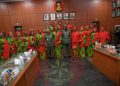
The Federal Road Safety Corps (FRSC) on Thursday launched the National Movement for Safe Loading and Safe Roads at a National Breakfast Policy Dialogue in Abuja, rallying government, industry and civil society behind a new push to end vehicle overloading and the unsafe loading practices blamed for a wide share of Nigeria’s road carnage.
Speaking at the event, organised in partnership with BusinessDay Media Limited under the theme “Ending Overloading, Saving Lives: A National Commitment to Safer Roads and Responsible Transportation in Nigeria,” Corps Marshal Shehu Mohammed, mni, said the gathering was meant to build national consensus and secure practical commitments to eliminate practices that threaten lives, damage infrastructure and undermine the country’s transportation economy. He described overloading not as a mere traffic offence but as a road safety, infrastructure, logistics and economic development issue, warning that excessive loads compromise braking, steering and vehicle stability, hasten vehicle deterioration and accelerate the destruction of Nigeria’s roads.
Mohammed said the danger went beyond weight alone, pointing to the risks posed by improperly mixed cargo, incompatible or dangerous materials, and loads that are poorly secured or unevenly distributed. He singled out the haulage and logistics sector, where pressure to maximise every trip can tempt operators into unsafe practices, insisting that no commercial gain justifies the loss of human life. Nigeria’s economy, he said, depends on the safe movement of agricultural produce, raw materials, manufactured goods, fuel and other essential commodities, making a safe transport system a foundation for development rather than an obstacle to it.
The Corps Marshal outlined the human and economic toll of overloading, noting that government bears the cost when roads are damaged, operators bear it when vehicles are damaged, and businesses and consumers bear it through delays, while fatal crashes leave Nigerian families to bear losses no amount of money can replace. He said enforcement alone could not solve the problem and called for shared responsibility across the entire transportation value chain, from cargo owners and shippers who must declare weights accurately, to operators who must maintain vehicles and comply with weight limits, to drivers who must refuse unsafe or improperly secured loads, to regulators who must strengthen weighing infrastructure, axle-load management and data sharing. For its part, he said, the FRSC would deepen enforcement, public education, stakeholder engagement and the use of technology and intelligence-led operations to shift the Corps from reactive enforcement toward preventive road safety.
Mohammed said the dialogue would culminate in the signing of the Abuja Declaration 2026, which he insisted must be more than ceremonial, describing it as a national compact that should carry clear responsibilities, measurable commitments, timelines and mechanisms for monitoring progress. He said the true measure of the movement’s success would not be the quality of speeches or the number of signatures on the declaration, but visible change on Nigeria’s roads, fewer overloaded vehicles, accurately declared cargo weights, the elimination of mixed and incompatible loads, and a decline in crashes and fatalities.
In a goodwill message, the Director-General and Chief Executive Officer of Voice of Nigeria, Mallam Jibrin Baba Ndace commended Mohammed’s leadership of the FRSC and praised the Corps’ Public Education Officer, Deputy Corps Commander Ohaeri Osondu Joseph, a Fellow of the Nigerian Institute of Public Relations, for his team’s work in strengthening public enlightenment on road safety. Ndace said road safety was fundamentally about protecting human lives, drawing on personal experiences of road accidents to argue that behind every crash is a family, a parent, a child or a community whose lives change within seconds.
He warned against overconfidence among experienced drivers, arguing that long years on the road or familiarity with a route should make drivers more careful rather than more reckless, since speeding, dangerous overtaking, sudden lane changes and impatience can prove fatal regardless of experience. He called for courtesy, patience and mutual respect to become part of Nigeria’s road culture, urging drivers, transport operators and motorists to show consideration for pedestrians, cyclists, motorcyclists and other vulnerable road users, and stressing that arriving a few minutes earlier is never worth risking another person’s life.
Ndace also urged a shift in how Nigerians respond to road accidents, criticising the tendency to gather around crash scenes to take pictures or record videos instead of offering help. He called on Nigerians to move from being spectators to becoming responsible citizens willing to assist victims, alert authorities and create space for emergency responders, describing accident victims not as objects of public curiosity but as someone’s father, mother, brother, sister, child or friend deserving compassion and dignity. He said the national road safety campaign must go beyond warning against overloading and traffic violations to also teach Nigerians how to respond when accidents occur, promoting a culture in which the first instinct is to save a life and call for help.
Ndace pledged that Voice of Nigeria would continue to play a complementary role alongside the FRSC in public education, using well-designed and consistently communicated messaging to change behaviour and promote road safety both to Nigerians and the international community. He urged all stakeholders to support the National Movement and ensure that Thursday’s commitments translate into measurable action on Nigeria’s roads.