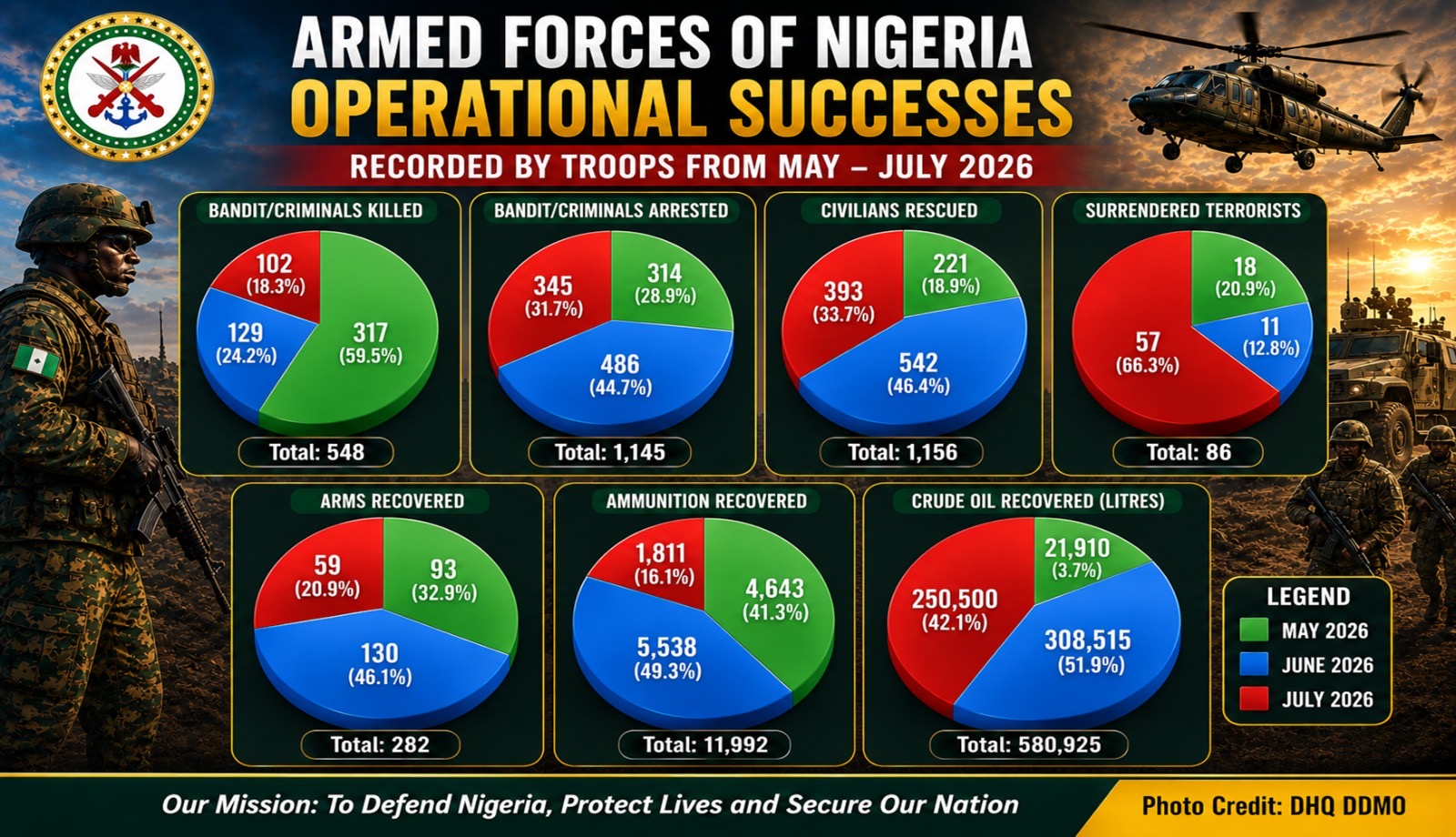
Every month, the Armed Forces of Nigeria release operational figures that quickly become headlines: terrorists neutralised, suspects arrested, kidnap victims rescued, weapons recovered and illegal refining sites dismantled. For many Nigerians, the statistics have become familiar markers of a country locked in an unrelenting battle against insurgency, banditry, kidnapping, oil theft and violent separatism.
But numbers alone rarely tell the whole story.
The 102 terrorists and other criminal elements neutralised in July, the 345 suspects arrested, the 393 kidnap victims rescued and the 57 insurgents who surrendered are only the visible outcomes of a much broader security campaign. Behind those figures lies a military strategy increasingly focused on dismantling the ecosystems that sustain insecurity rather than merely confronting gunmen on the battlefield.
July’s operations demonstrated this shift with remarkable clarity.
Across the North-East, troops not only eliminated dozens of Boko Haram and ISWAP fighters but struck at the insurgents’ command, logistics and financial architecture. The killing of Abu Salim al-Barnawi described by the military as a senior ISWAP commander and propaganda chief deprived the terrorist group of a key operational and information strategist. Offensive operations destroyed terrorist enclaves at Wulgo, Hausari and Danbaure, while sustained raids intercepted logistics suppliers transporting solar panels, construction materials and other supplies intended to sustain insurgent camps. Troops also arrested a foreign fighter from Sudan, an illegal immigrant from Ghana, suspected terrorist collaborators, kidnappers and arms couriers, underscoring the transnational dimension of the conflict.
Perhaps even more telling was the growing wave of defections. Among the 57 insurgents and family members who surrendered was the self-styled Chief Finance Officer of ISWAP’s Jubillaram enclave, who emerged with weapons, ammunition, cash and two children after weeks of sustained military pressure. Other surrendered fighters admitted they had received specialised training as gunboat operators and anti-aircraft gunners before abandoning the battlefield, suggesting that persistent land and air offensives are steadily eroding both the operational capability and morale of the insurgency.
In the North-West, the operational gains extended well beyond the neutralisation of 33 terrorists. Operation FANSAN YAMMA rescued an extraordinary 191 kidnapped victims through intelligence-led rescue missions stretching across Kaduna, Katsina, Kebbi, Zamfara and parts of Kano State. Troops dismantled terrorist camps, intercepted improvised explosive device components before they could be deployed, arrested wanted collaborators and disrupted planned attacks. The rescue of the Rector of Federal Polytechnic Kaura Namoda, Dr Aminu Yusuf, prominent businessman Alhaji Azaria and scores of other captives illustrated the military’s growing emphasis on denying kidnappers the freedom to hold victims for ransom.
Across the North-Central, Operations SAVANNAH SHIELD, ENDURING PEACE and WHIRL STROKE combined offensive operations with intelligence-driven policing to dismantle kidnapping syndicates, arrest ammunition couriers, intercept illegal firearms and recover ransom proceeds. Several notorious criminal leaders, including the Benue-based kingpin known as Puuga, were neutralised, while troops destroyed terrorist camps, foiled kidnapping attempts before victims could be taken away and arrested logistics couriers and informants whose support networks often make such crimes possible.
The campaign in the Niger Delta reflected another dimension of national security. Operation DELTA SAFE dismantled 18 illegal refining sites, uncovered multiple illegal bunkering camps, intercepted vehicles transporting suspected stolen crude oil and recovered more than 250,500 litres of stolen petroleum products. Beyond protecting critical national assets, troops also employed forensic technology to track and arrest a notorious kidnap kingpin and his accomplice, demonstrating how intelligence and digital investigations are increasingly complementing conventional military operations.
Meanwhile, Operation UDO KA sustained pressure on violent separatist groups, kidnappers and arms traffickers across the South-East. Troops arrested suspected IPOB and ESN members, dismantled illegal bunkering infrastructure, recovered assault rifles, G3 rifles, Lee-Enfield rifles, explosives-related materials and ammunition, while exposing criminal hideouts allegedly used to coordinate kidnappings and attacks on security personnel.
The gains were equally evident in the air. Precision air interdictions enabled kidnapped victims to escape captivity in Niger State and destroyed terrorist groups advancing towards vulnerable communities after persistent Intelligence, Surveillance and Reconnaissance missions confirmed hostile movements. Increasingly, battlefield success is being shaped as much by intelligence fusion, surveillance and precision targeting as by direct ground engagements.
Yet perhaps the most overlooked gains came away from the battlefield.
Military formations mediated disputes between oil companies and host communities in the Niger Delta, facilitated peace meetings among rival communities in Benue and Nasarawa States, supported cholera containment efforts in Borno, partnered with health authorities and civil society organisations on public health campaigns, and completed infrastructure projects ranging from schools and town halls to solar-powered boreholes and electrification schemes across several states. These initiatives reflected a recognition that lasting security cannot be achieved solely through military force but must also be reinforced through public trust, humanitarian support and community engagement.
It was against this backdrop that the Director of Defence Media Operations, Major General Michael Onoja, presented the Armed Forces’ operational review for July. Beyond the casualty figures lay a broader narrative, one of a military increasingly focused on dismantling criminal networks, disrupting terrorist financing, rescuing civilians, protecting strategic economic assets and strengthening cooperation with other security agencies and local communities. The operational gains recorded during the month suggest that success is no longer measured simply by the number of enemies eliminated, but by the extent to which the structures sustaining insecurity are systematically degraded before they can regenerate.