

By Nkechi Eze
Chinese Foreign Minister Wang Yi has called for urgent reforms to strengthen the United Nations system, defend multilateralism, and advance global cooperation amid rising international tensions and geopolitical instability.
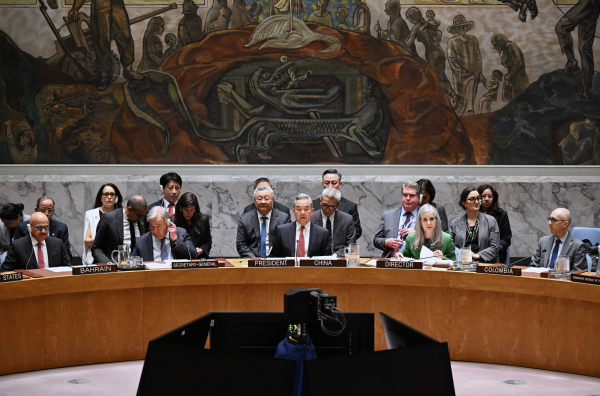
Speaking at the United Nations Security Council High-Level Meeting on “Upholding the Purposes and Principles of the U.N. Charter and Strengthening the U.N.-centered International System” in New York on Tuesday, Wang Yi warned that the world is facing some of the most profound challenges since the end of the Second World War, stressing that the global community must unite to protect peace, justice, and international law.
Addressing delegates at the meeting attended by U.N. Secretary-General António Guterres, the Chinese foreign minister said the resurgence of conflict, unilateralism, and power politics poses grave threats to global stability.
“The dark clouds of war keep gathering and the law of the jungle is resurging,” Wang Yi said, adding that humanity has reached a critical crossroads requiring collective global action.
He stressed that the principles of the U.N. Charter remain relevant and indispensable, arguing that current global instability stems not from the Charter being outdated, but from failures to uphold its provisions and the international norms governing state relations.
Wang Yi urged all member states to recommit themselves to sovereign equality, non-interference in internal affairs, peaceful dispute resolution, and adherence to international law. He also cautioned major powers against applying double standards or pursuing selective interpretations of international norms.
The Chinese minister further emphasized the need to strengthen the authority and effectiveness of the U.N. Security Council, describing it as the core pillar of the international collective security system.
According to Wang Yi, Security Council membership carries responsibilities rather than privileges, noting that members must rise above narrow national interests and act in the broader interest of global peace and stability.
He criticized unilateral military actions conducted without Security Council authorization and condemned sanctions imposed outside the framework of U.N. resolutions, declaring such measures illegitimate.
On global development, Wang Yi called for increased support for developing nations, particularly countries in the Global South, through expanded funding, technological assistance, and intellectual cooperation. He urged developed countries to fulfill their commitments on development financing and warned against protectionism, economic coercion, and the politicization of trade and technology.
The Chinese foreign minister also advocated reforms within international financial institutions such as the International Monetary Fund and the World Bank to improve the representation and influence of developing countries.
Speaking on emerging global challenges, Wang Yi called for stronger international governance mechanisms covering artificial intelligence, cyberspace, outer space, climate change, and polar regions, warning that new technological and strategic frontiers must not become arenas of unchecked competition.
He reiterated China’s support for multilateralism and the central role of the United Nations in global governance, while backing ongoing reforms aimed at improving the organization’s efficiency and responsiveness.
Highlighting China’s contributions to the United Nations over the past 55 years since the restoration of the People’s Republic of China’s lawful seat at the U.N., Wang Yi said Beijing has consistently supported peacekeeping operations, global development initiatives, humanitarian assistance, and multilateral cooperation.
He disclosed that China has mobilized more than $23 billion under its Global Development Initiative, supported over 1,800 cooperation projects, delivered more than 10,000 capacity-building programs, and trained over 200,000 professionals from developing countries.
Wang Yi also noted China’s ongoing support for African countries responding to Ebola outbreaks, particularly in the Democratic Republic of Congo and Uganda, where Chinese medical teams are currently assisting local authorities.
The Chinese foreign minister reaffirmed Beijing’s commitment to global peace, dialogue, and international cooperation, saying China would continue to promote the vision advanced by Chinese President Xi Jinping of building “a community with a shared future for humanity.”
He stated that China would continue working with other nations to strengthen multilateralism, reform global governance systems, and promote a more equitable and inclusive international order.