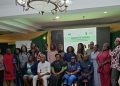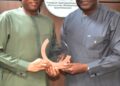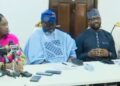


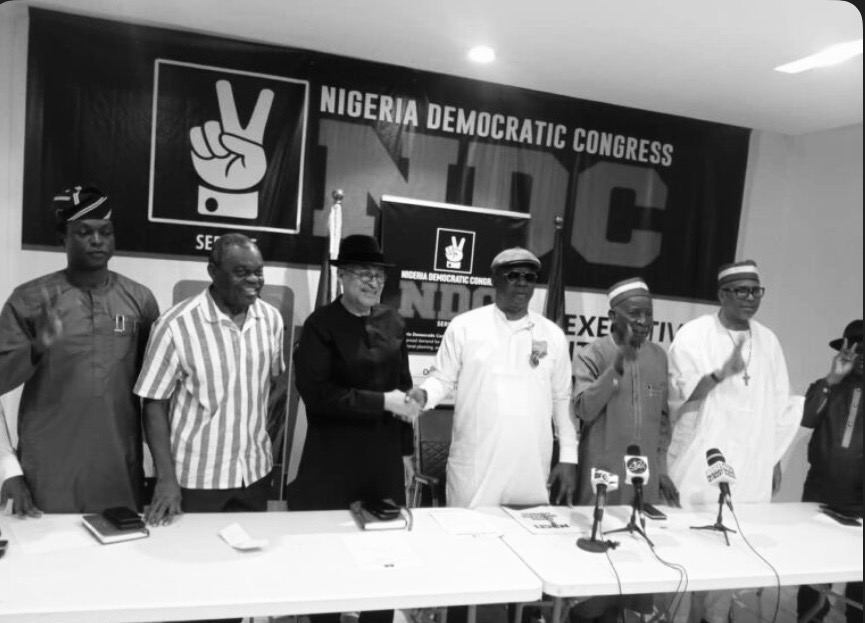
The Nigeria Democratic Congress (NDC) has appointed renowned economist and political activist, Professor Pat Utomi, and veteran politician, Engineer Buba Galadima, to lead its newly inaugurated National Reconciliation Committee in a strategic move aimed at healing internal divisions and positioning the party for a united campaign ahead of the 2027 general elections.
Professor Utomi will serve as chairman of the committee, while Galadima will function as co-chairman, leading a team mandated to reconcile aggrieved party members, resolve disputes arising from the party’s internal electoral processes and strengthen cohesion across the party’s structures nationwide.
Inaugurating the committee, National Chairman of the NDC, Senator Cleopas Moses Zuwogwe, described the composition of the panel as a demonstration of the party’s commitment to fairness, inclusiveness and internal democracy.
He explained that the committee became necessary following grievances generated during the party’s ward, local government and state congresses, national convention, primary elections and candidate nomination processes.
According to Zuwogwe, despite being registered only a few months ago, the NDC successfully conducted membership registration, congresses, a national convention and primary elections within the timelines prescribed by the Independent National Electoral Commission (INEC), a feat he said reflected the party’s organisational capacity.
He, however, acknowledged that the highly competitive nature of the primaries inevitably left some aspirants dissatisfied.
The NDC chairman disclosed that the party leadership had carefully reviewed appeals and petitions from across the country, consulted widely with stakeholders and considered various concerns before submitting the names of its candidates to INEC.
He noted that while some members had sought legal redress, the party respected their constitutional rights and remained committed to resolving disagreements through dialogue.
Charging the Utomi-led committee, Zuwogwe said its responsibility extended beyond settling disputes.
“Your assignment is not merely to settle disputes. It is to rebuild confidence, restore trust, strengthen unity and reassure every member that the Nigeria Democratic Congress remains one united family where justice, fairness, equity and inclusion shall continue to prevail.”
He appealed to all aggrieved aspirants and stakeholders to cooperate fully with the committee, stressing that every member remained important to the party’s future irrespective of the outcome of the primaries.
“The fact that only one candidate emerged in each contest does not diminish the leadership capacity or political value of others. Many of those who did not secure nominations remain indispensable as we prosecute our campaigns and, by the grace of God, form government in 2027.”
Zuwogwe directed the committee to complete its assignment and submit its report to the National Working Committee (NWC) on or before August 22, 2026.
Responding after his inauguration, Professor Pat Utomi described the assignment as a patriotic responsibility that would determine not only the future of the NDC but also its ability to offer Nigerians a credible political alternative in the 2027 elections.
He said genuine reconciliation was indispensable for any political party seeking public confidence, insisting that unity must take precedence over personal ambitions.
“The tendency to focus on self has prevented us from remembering who we are as Africans. We all have the possibility of thriving because the collective thrives.”
Utomi urged dissatisfied party members to embrace reconciliation and continue contributing to nation-building through the party, noting that political relevance was not limited to elective offices.
“There is nobody who has entered this process that will not have a place in building this country. Some who did not receive nominations may become even greater champions in the future.”
The respected political economist also disclosed that the NDC was developing a youth-centred manifesto that would prioritise employment, innovation, entrepreneurship and governance reforms aimed at empowering Nigeria’s young population.
“Nigeria’s future belongs to its young people. Our responsibility is to create a platform where they can lead, innovate and drive national transformation.”
Also speaking, Engineer Buba Galadima acknowledged that reconciling aggrieved members would not be an easy task but expressed confidence that the committee possessed the experience and credibility required to achieve lasting peace within the party.
He attributed many of the disputes witnessed during party primaries across Nigeria to provisions of the Electoral Act, which he said often make candidate selection highly contentious, especially among opposition political parties.
Galadima nevertheless assured party members that the committee would be guided by justice, fairness and patriotism throughout its assignment.
“Reconciliation requires patience, sincerity and sacrifice. We are determined to ensure that every aggrieved member is heard and treated fairly.”
He appealed to disappointed aspirants to place national interest above individual ambitions and rally behind the party’s collective objective.
“We will be resolute and patriotic and make sure we persuade all those who feel aggrieved to look at the larger picture of Nigeria rather than individual ambition.”
The committee has been tasked with reconciling aggrieved aspirants and stakeholders, reviewing complaints arising from the primaries, engaging party leaders across the states, promoting inclusiveness and recommending measures that will strengthen internal democracy as the NDC intensifies preparations for the 2027 general elections.
Political observers view the appointment of Professor Pat Utomi and Engineer Buba Galadima, two respected figures with decades of experience in Nigeria’s political landscape as a significant effort by the NDC to consolidate its internal structures, restore confidence among party faithful and present a united front as it seeks to emerge as a major contender in the next electoral cycle.