


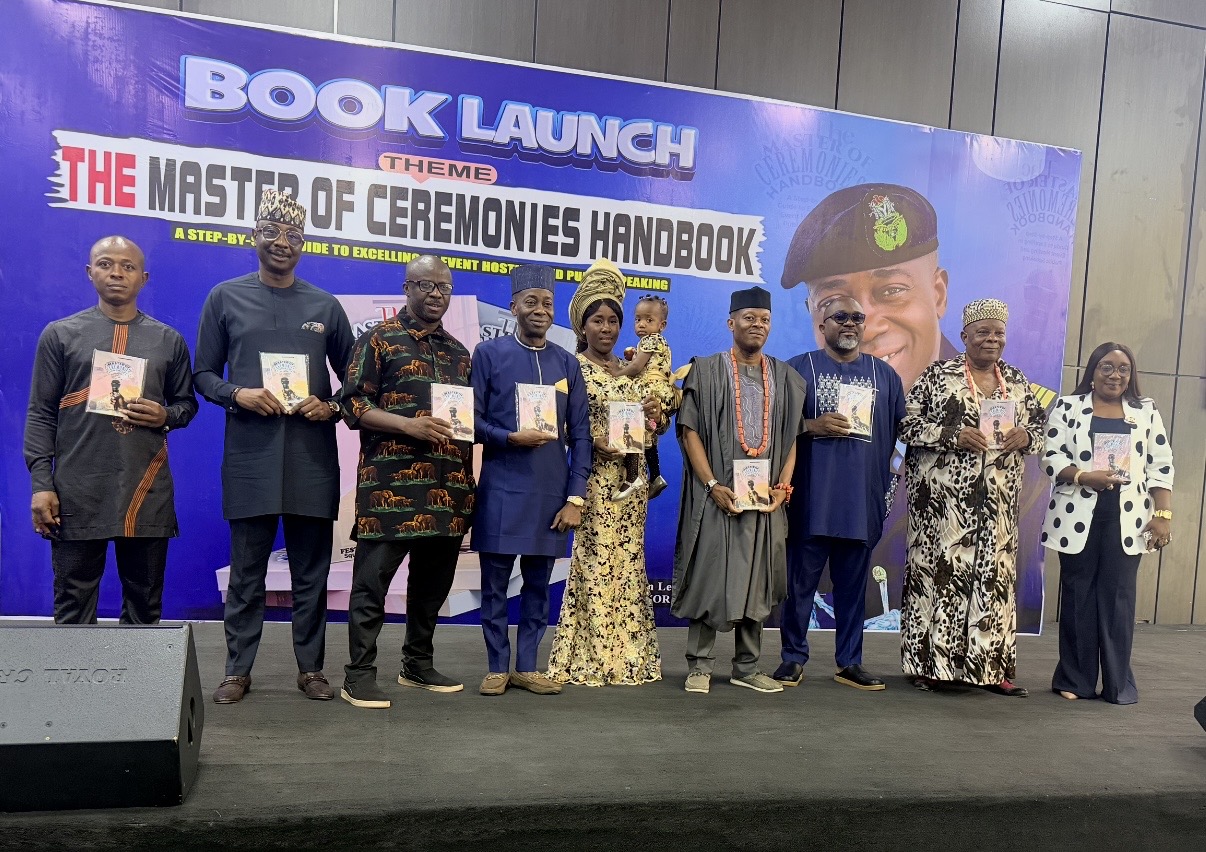
The Nigerian Air Force (NAF) has reaffirmed its commitment to promoting scholarship, research and professional development among its personnel as Squadron Leader Festus C. Ezenyi formally launched The Master of Ceremonies Handbook: A Step-by-Step Guide to Excelling in Event Hosting and Public Speaking in Abuja.
The commitment was reiterated by the Chief of the Air Staff (CAS), Air Marshal Sunday Kelvin Aneke, during the public presentation of the handbook held on Saturday, 4 July 2026, at the NAF Conference Centre and Suites, Kado, Abuja. The CAS was represented by the Director of Peace Support Operations, Nigerian Air Force, Air Vice Marshal Sampson Eyekosi.
Speaking on behalf of the CAS, Air Vice Marshal Eyekosi described the publication as a testament to the Nigerian Air Force’s resolve to nurture intellectually vibrant officers who contribute not only to operational excellence but also to national development through research, innovation and knowledge sharing.
He congratulated Squadron Leader Ezenyi on the publication, describing the accomplishment as one that reflects vision, discipline, perseverance and intellectual commitment, qualities the Service seeks to cultivate in its officers.
The representative of the CAS noted that although the handbook focuses on event hosting and public speaking, its relevance extends to military leadership, where effective communication remains indispensable to mission success.
“Effective communication remains a critical component of military leadership and operational success. Leaders communicate intent. Commanders inspire confidence. Institutions build credibility through clear, accurate and professional communication.”
He further stressed that strategic communication has become a force multiplier in today’s information environment.
“Beyond our aircraft, platforms and operational capabilities, the effectiveness of the Nigerian Air Force is also reflected in how we communicate our mission, engage our stakeholders and project our values. Every public engagement, briefing, ceremony and official event presents an opportunity to reinforce public confidence in our institution through effective and well-packaged strategic communication.”
The CAS disclosed that his decision to write the foreword to the handbook reflected the Service’s commitment to encouraging personnel to document their professional knowledge for posterity.
“I hope this handbook will inspire more personnel to document their knowledge and professional experiences for the benefit of future generations. Strong institutions are built not only by operational achievements but also by the documented knowledge they preserve for future generations.”
He commended Squadron Leader Ezenyi for drawing from years of experience in military public relations, protocol and event management to produce a practical reference material that would benefit masters of ceremonies, protocol officers, public relations practitioners, students and professionals across both the public and private sectors.
The CAS thereafter formally presented the handbook to the military community, corporate organisations, educational institutions, the public service and the general public.
Earlier, the Director of Public Relations and Information, NAF, Air Commodore Ehimen Ejodame, described the event as a celebration of intellectual enterprise, professional development and the enduring value of effective communication.
He expressed appreciation to the Chief of the Air Staff for fostering an environment that encourages officers and airmen to pursue intellectual development through research, innovation and knowledge sharing.
Air Commodore Ejodame said the publication underscored the Nigerian Air Force’s commitment to building not only operationally capable personnel but also officers equipped to contribute to national development through scholarship.
“In contemporary military operations, strategic communication is an indispensable capability. It shapes public perception, strengthens institutional credibility, enhances civil-military relations and supports mission accomplishment.”
He noted that Squadron Leader Ezenyi had successfully transformed years of practical experience into a comprehensive handbook that would serve as a valuable reference for masters of ceremonies, public speakers, protocol officers, public relations practitioners, event managers, students and professionals across diverse sectors.
Reviewing the book on behalf of the Chief of Civil-Military Relations, Air Vice Marshal Edward Gabkwet, Group Captain Rose Bello described the publication as the first comprehensive handbook of its kind on the art of master of ceremonies (MC), noting that it serves as a practical, step-by-step guide to excelling in event hosting and public speaking.
She emphasized that the success of any memorable event depends largely on effective communication, with the master of ceremony laying a central role in coordinating proceedings, maintaining protocol, inspiring confidence, and ensuring seamless transitions throughout an event. In military ceremonies especially, she noted that an MC must possess a thorough understanding of military regimentation, decorum, and protocol to achieve the strategic objectives of such events.
Group Captain Bello commended the author for drawing from years of practical experience rather than theory. She highlighted his distinguished career in public relations and communication, noting that his appointments to increasingly responsible positions, including serving as a Press Officer to the Chief of the Air Staff, reflected his professionalism, credibility, and communication expertise.
She observed that the handbook is organised into 10 well-structured chapters that take readers from foundational concepts to practical application. The book clearly distinguishes the role of a professional master of ceremonies from that of a comedian, while addressing essential qualities such as preparation, confidence, adaptability, emotional intelligence, audience engagement, professionalism, and situational awareness.
According to her, one of the book’s greatest strengths is its practical orientation, featuring ready-to-use scripts for military and social events, comprehensive event-hosting checklists, guidance on handling formal and informal ceremonies, presentation skills, personal branding for MCs, overcoming the fear of public speaking (glossophobia), and strategies for managing mistakes and maintaining audience engagement.
She particularly praised the chapters on professional packaging and institutional image, stressing that effective event hosting contributes significantly to organisational credibility and strategic communication. She also noted that the glossary of military terms, references, and professional reflections further enhance the book’s value as a long-term reference resource.
Beyond reviewing the publication, Group Captain Bello challenged communication professionals, particularly within the Armed Forces, to document their knowledge and professional experiences instead of allowing them to be lost upon retirement. She noted that emerging realities such as digitalisation, artificial intelligence, and social media have made continuous learning and strategic communication more important than ever.
She strongly recommended the handbook to public relations officers, communication professionals, masters of ceremonies, educators, students, military personnel, government institutions, communication academies, and training establishments, describing it as an invaluable resource for developing communication competence and refining event management skills.
Concluding her remarks, she reflected that many senior public relations officers had to learn the craft of public speaking and event hosting through trial and error, often making embarrassing mistakes due to the absence of structured guidance. She said today’s generation is fortunate to have a practical, experience-driven handbook that captures years of professional learning, describing the publication as a significant contribution to the body of knowledge in communication and public speaking deserving of widespread recognition.
The author, Squadron Leader Festus Chike Ezenyi, said the inspiration for the handbook came from his conviction that communication remains an essential pillar of leadership and institutional success, particularly within the military profession.
“While many associate the military with aircraft, operations and the defence of our nation, there is another critical domain that contributes immensely to institutional success, the domain of communication. Effective communication shapes perceptions, inspires confidence and conveys leadership intent.”
He explained that the handbook was written to bridge the practical gap in event hosting and public speaking across the military, government institutions, corporate organisations, educational institutions, religious bodies and social gatherings.
According to him, the publication draws extensively from years of practical experience, observation, study and professional engagement.
“This handbook provides practical guidance drawn from my years of experience, observation, study and professional engagement. My hope is that it will serve as a useful guide for present and future generations of masters of ceremonies, public relations practitioners, protocol officers, public speakers and leaders.”
Squadron Leader Ezenyi expressed profound appreciation to the Chief of the Air Staff, Air Marshal Sunday Kelvin Aneke, for writing the foreword to the book and for his unwavering commitment to the professional and intellectual development of Nigerian Air Force personnel.
He also acknowledged the mentorship of the immediate past Chief of the Air Staff, Air Marshal Hassan Bala Abubakar (Rtd), under whose leadership the idea for the publication was conceived and much of the research undertaken, as well as other senior officers and mentors who contributed to his professional growth.
The author further thanked his family, colleagues, sponsors and members of the organising committee for their support throughout the writing and publication process, describing the book as his humble contribution to knowledge, professionalism and human capital development.
Delivering the vote of thanks, the Chairman of the Organising Committee, Group Captain ET Iheoma, expressed gratitude to the Chief of the Air Staff for his fatherly support and unwavering commitment to the professional and intellectual development of Nigerian Air Force personnel, including writing the foreword to the handbook.
He also appreciated the Chief Host, Governor Hope Uzodimma of Imo State, the Mother of the Day, Mrs. Ngozi Aneke, the Chief Launcher, Engr. Prince Arthur Eze, the immediate past Chief of the Air Staff, Air Marshal Hassan Bala Abubakar (Rtd), distinguished guests, sponsors, donors, partners and members of the organising committee for their invaluable contributions to the success of the event.
He further congratulated the author on what he described as an outstanding achievement, expressing confidence that the publication would make a lasting contribution to the practice of public speaking, protocol, event hosting and strategic communication while serving as a valuable resource for professionals across generations.