By Nkechi Eze
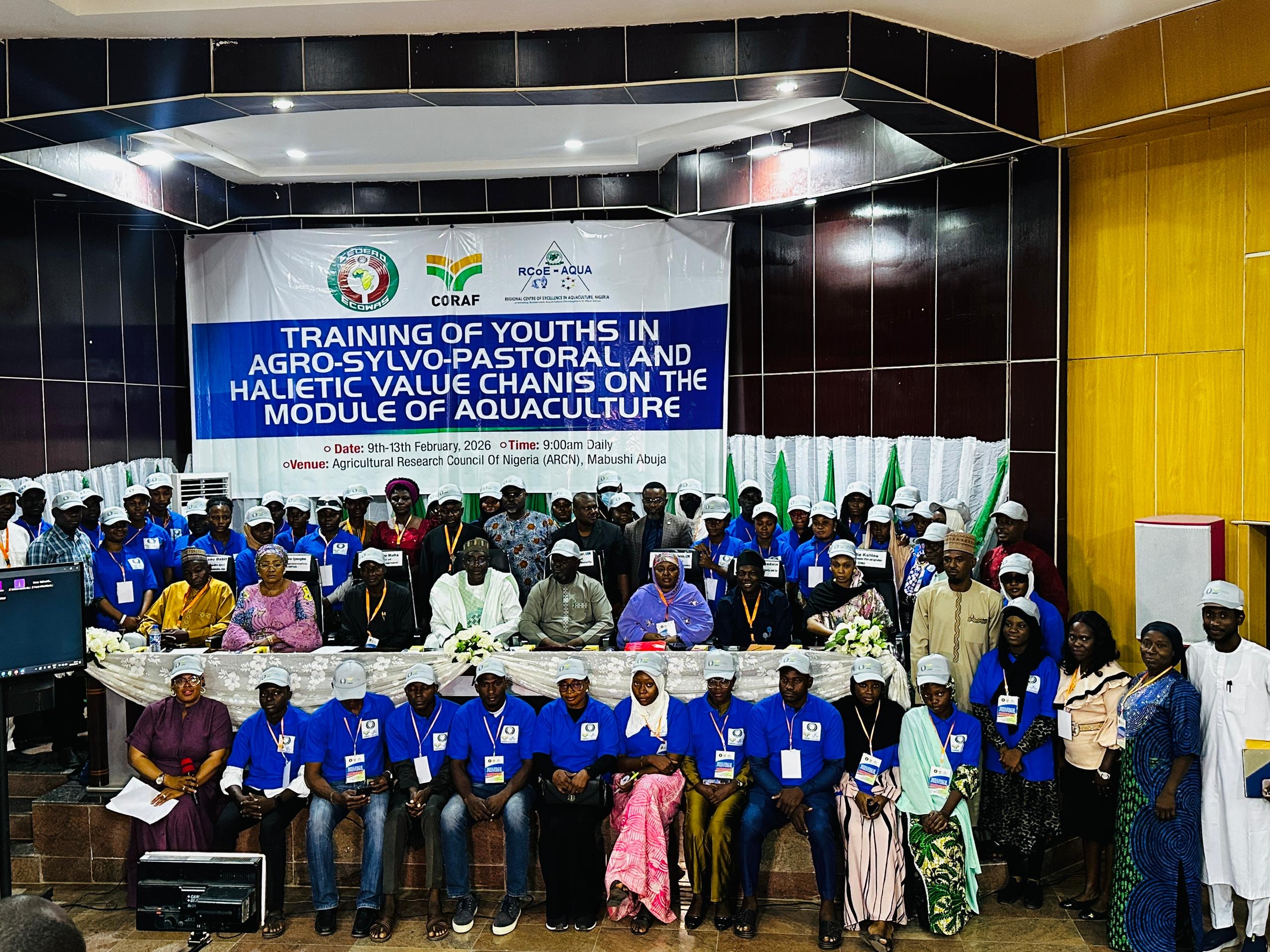
The quest to position aquaculture as a catalyst for youth employment, food security and sustainable economic growth in West Africa gained renewed momentum on Monday as the Executive Secretary of the Agricultural Research Council of Nigeria (ARCN), Dr. Abubakar Adamu Dabban, formally declared open the Nigerian edition of the 2026 Training of West African Youth in Aquaculture in Abuja.
Speaking at the ARCN Auditorium, Dr. Dabban described the programme as a deliberate investment in the region’s most valuable asset, its youth while highlighting aquaculture as a strategic sector capable of absorbing labour, generating wealth and closing Africa’s persistent fish supply gap. “This training is not just about skills acquisition,” he said. “It is about empowering a new generation of innovators, entrepreneurs and employers who will drive food security and sustainable economic growth across West Africa.”
The training, organised through a collaboration between the Economic Community of West African States (ECOWAS) and ARCN, is the third in a series designed to enhance youth employability and innovation in aquaculture. Dr. Dabban explained that ARCN, as Nigeria’s apex agricultural research institution, is mandated to manage, supervise and regulate agricultural research, training and extension activities of 16 National Agricultural Research Institutes and 18 Federal Colleges of Agriculture, making it well positioned to drive such regional capacity-building initiatives.
He noted that the 2026 theme, “Sustainable Fish Farming Using Black Soldier Fly Larvae (BSFL),” reflects emerging global best practices and regional priorities. “The choice of this theme is both strategic and forward-looking,” Dr. Dabban said. “It aligns with our collective goals of youth employment, environmental sustainability and the development of a circular bioeconomy within the aquatic food sector.”
According to him, the programme builds on the success of the first two editions, which trained and empowered 230 young people across the region. This year, he disclosed, 200 youth will undergo concurrent training across four specialised institutions, the Agricultural Research Council of Nigeria, the National Institute for Freshwater Fisheries Research, the Nigerian Institute for Oceanography and Marine Research, and the Nigerian Stored Products Research Institute. “This multi-institutional approach guarantees comprehensive exposure, from production systems and feed innovation to post-harvest management and agribusiness development,” he said.
Dr. Dabban explained that the training modules were deliberately structured along the aquaculture value chain, covering Black Soldier Fly Larvae production, freshwater, brackish and marine fish farming, fish processing and value addition, as well as aquaculture economics and business plan development. “Our objective is to ensure that participants leave here not only as skilled producers but as entrepreneurs with the financial and managerial capacity to build viable enterprises,” he added.
Placing the initiative within a broader socio-economic context, the ARCN boss underscored the urgency of targeted youth interventions, noting that West Africa remains one of the youngest regions in the world. “With over 60 per cent of Sub-Saharan Africa’s population under 25 and millions of young people entering the labour market annually, this demographic reality presents a historic opportunity,” he said. “But it can only be transformed into an advantage if we deliberately invest in market-driven, innovation-oriented skills.”
He lamented that youth unemployment and underemployment continue to disproportionately affect young people across the region, describing aquaculture as one of the sectors with the potential to reverse that trend. Citing Food and Agriculture Organization figures, Dr. Dabban noted that aquaculture now supplies more than half of the aquatic animals consumed globally, yet Africa still faces significant fish deficits. “Rising fish demand in Nigeria and across West Africa presents a clear opportunity for youth-led agribusiness expansion, value addition and import substitution,” he said.
Addressing one of the sector’s major constraints, he pointed out that feed costs account for as much as 60 to 70 per cent of aquaculture production expenses. He described BSFL technology as a game-changer, noting that insect-based protein offers a sustainable alternative to conventional fishmeal and soybean meal. “Black Soldier Fly Larvae production promotes waste recycling, reduces pressure on wild fish stocks, lowers environmental footprints and improves profitability for fish farmers,” Dr. Dabban explained. “It is a practical application of circular economy principles within the aquaculture value chain.”
He further disclosed that the programme is being implemented by ECOWAS through its youth employability and agricultural development initiatives, leveraging technologies generated by the Regional Centre of Excellence in Aquaculture in Nigeria. According to him, Centres of Excellence across the ECOWAS region play a critical role in strengthening research, innovation dissemination and regional capacity building, with Nigeria’s centre providing leadership in aquaculture technology development.
Turning to the participants, Dr. Dabban charged them to see themselves as agents of change. “You are not just trainees,” he said. “You are future employers, innovators and leaders in the aquaculture sector. I encourage you to participate actively, build networks and replicate these technologies in your communities for the benefit of the wider region.”
He expressed appreciation to ECOWAS, the West and Central African Council for Agricultural Research and Development (CORAF), the implementing institutions, facilitators and other stakeholders for their sustained commitment to youth empowerment and agricultural transformation.
On a concluding note, Dr. Dabban formally declared open the Nigerian edition of the 2026 Training of West African Youth in Aquaculture, reaffirming ARCN’s resolve to support initiatives that position aquaculture at the heart of West Africa’s food security and youth employment agenda.