

By Nkechi Eze
The National Drug Law Enforcement Agency (NDLEA) has strengthened the operational capacity of its Canine Unit through a specialised refresher training for dog handlers facilitated by German technical experts.
According to an official statement signed by Femi Babafemi, Director, Media and Advocacy, NDLEA, the training was organised in collaboration with the German Bundeskriminalamt (BKA) and held at the Agency’s Canine Unit Facility in Lagos.
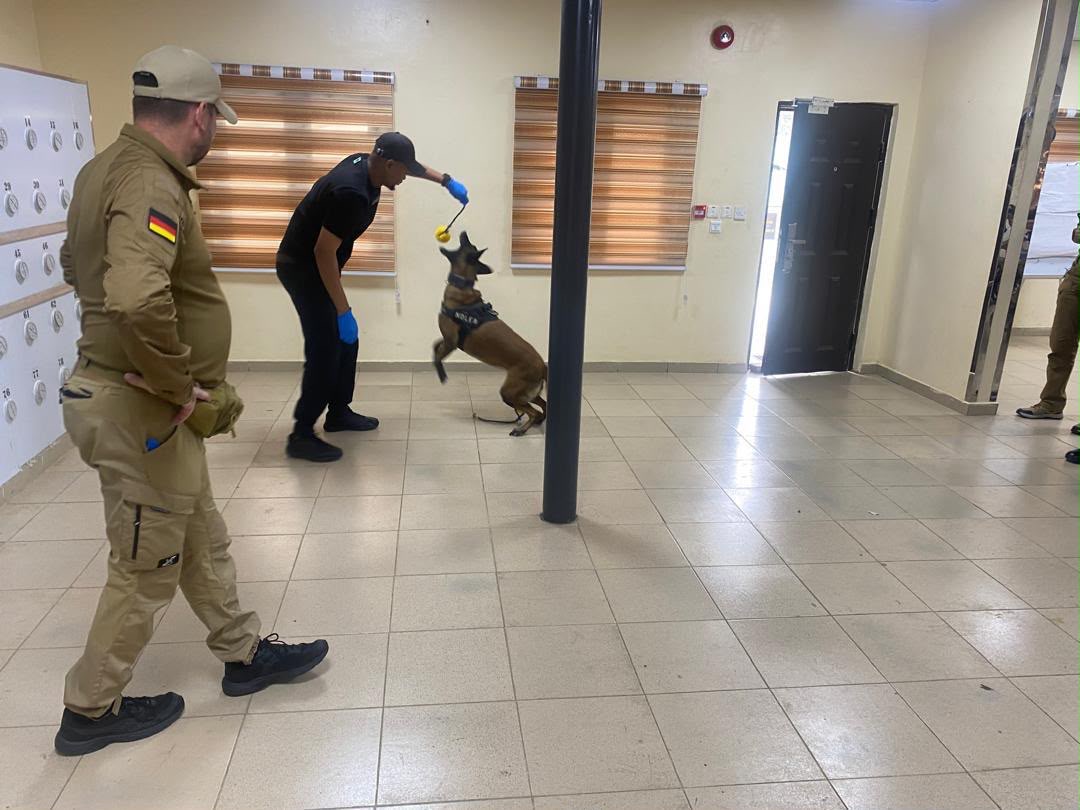
The exercise was conducted by two German technical dog-handling experts, Mr. Andreas Roscher and Ms. Jacqueline Shüler, who trained Nigerian handlers on international best practices in narcotics detection and canine operations.
Eleven personnel of the Canine Unit, comprising the Unit Commander, two veterinary doctors and eight dog handlers, alongside their service dogs, participated in the training. Five other officers from NDLEA Commands in Lagos also joined the exercise as prospective Canine Unit personnel.
The training covered advanced obedience and control, narcotics detection techniques, scent imprinting, search patterns, handler safety and the deployment of canine assets in high-risk environments.
Participants also underwent practical simulation exercises at the Murtala Muhammed International Airport baggage hall, APM Terminals Apapa and the MMIA NAHCO export shed.
The NDLEA Chairman and Chief Executive Officer, Brig. Gen. Mohamed Buba Marwa (Rtd), described the exercise as part of the Agency’s efforts to maintain a highly skilled workforce capable of responding to increasingly sophisticated drug trafficking methods.
“Our canine teams remain one of the most potent assets in our detection and interdiction efforts, and this is why we will continue to invest in their retraining and welfare,” Marwa said.
He noted that the Agency’s successes in intercepting concealed narcotics at airports, seaports and border points were partly attributable to the capabilities of its sniffer dogs and handlers.
Marwa said the partnership with the German counterparts would further strengthen the Agency’s narcotics detection capacity and align its operations with global best practices.
The NDLEA boss also acknowledged manpower and logistics gaps within the Canine Unit, including the need for additional service dogs, personnel and boarding facilities to adequately cover the country’s seaports, international airports and land borders.
He said plans were underway to address the identified gaps, in line with recommendations that the specialised refresher training be sustained as an annual exercise.