

By Nkechi Eze
The Commander of the Nigeria Security and Civil Defence Corps (NSCDC) Mining Marshals, Assistant Commandant Attah John Onoja, has disclosed that the operation has arrested at least 850 illegal mining operators since its establishment, contributing to a significant increase in revenue generated from the mining sector.
Onoja also revealed that revenue from mining activities had increased from approximately ₦6 billion annually before the intervention to ₦37 billion within its first year, reaching ₦101 billion in less than two and a half years.
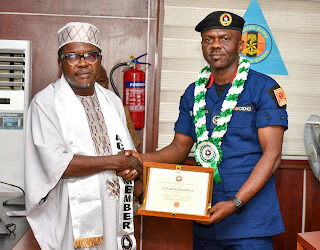
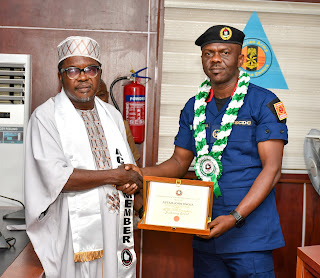
He made this disclosure while delivering a goodwill message at the 2026 Annual Lecture and Awards of the Association of Corporate Online Editors (ACOE), where he received an Exemplary Leadership Award for his contributions to the fight against illegal mining and efforts to sanitise Nigeria’s mining industry.
The NSCDC officer described the recognition as an honour extending beyond his person to the officers and men of the Mining Marshals, as well as media practitioners who have supported the operation in the discharge of its responsibilities.
He also conveyed the goodwill of the Commandant-General of the NSCDC, Prof. Ahmed Abubakar Audi, who commended online media practitioners for their contributions to national development.
Onoja said the Mining Marshals were established about two and a half years ago as a strategic intervention to tackle illegal mineral exploitation, curb revenue losses and address criminal activities associated with unregulated mining.
He explained that the operation’s mandate went beyond apprehending offenders to creating an effective deterrent against illegal mining and encouraging operators to comply with existing laws and regulations.
According to him, the Marshals had adopted flexible and unpredictable operational strategies across different states to prevent illegal operators from tracking their movements, thereby sustaining enforcement pressure despite logistical constraints.
He maintained that the impact of the operation should not be assessed solely by the number of arrests or prosecutions but also by the increasing compliance among mining operators who had become more conscious of the consequences of violating the law.
The Mining Marshals Commander disclosed that some illegal mining cases had already resulted in convictions, with further judgments expected before the end of the year, depending on the pace of court proceedings.
He urged operators in the mining industry to familiarise themselves with relevant regulations and obtain the necessary approvals to conduct their businesses legally, warning that those operating outside the established framework would be made to face prosecution.
Onoja, however, identified resistance from individuals with vested interests and suspected illegal mining cartels as major obstacles confronting the operation, alleging that some groups had continued to devise ways of frustrating its activities.
He appealed to journalists to exercise fairness, professionalism and objectivity in reporting allegations involving the Mining Marshals, emphasising the need to give all parties the opportunity to present their sides before conclusions are reached.
He said the operation remained open to media scrutiny and had consistently responded to inquiries by providing documentary evidence to substantiate its positions rather than relying on verbal explanations.
He further cautioned against attempts to use other institutions to influence or frustrate matters already undergoing judicial proceedings, arguing that such practices could undermine the administration of justice and the broader campaign against illegal mining.
The commander stressed that protecting the country’s mineral resources was a collective responsibility, noting that illegal mining undermined national revenue, economic growth and development.
He clarified that the revenue generated through improved mining-sector compliance did not accrue to the Mining Marshals but represented broader economic gains for the country.
While dedicating the award to personnel of the operation and supportive journalists, Onoja reaffirmed the readiness of the Mining Marshals to engage media organisations, provide verifiable information and address concerns surrounding their activities.
He urged Nigerians, particularly media practitioners and other stakeholders, to remain committed to national development, noting that the country’s economic interests should take precedence over individual or institutional considerations.
The event attracted heads of government agencies, parastatals, security organisations, media executives and other stakeholders.