

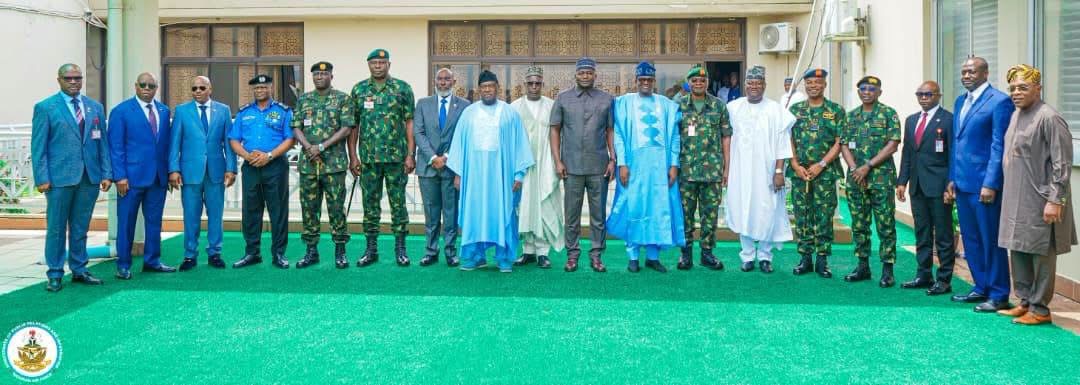
The Secretary to the Government of the Federation (SGF), Senator George Akume has tasked Nigeria’s top security chiefs with developing a unified assessment of the country’s security threats and a coherent defence strategy capable of addressing existing and emerging challenges.
According to an official statement signed by Yomi Odunuga, Special Adviser, Media and Publicity to the Secretary to the Government of the Federation, Akume gave the charge on Wednesday while inaugurating the Presidential Committee on the National Threat Assessment and Five-Year Strategic Defence Operations Plan established by President Bola Ahmed Tinubu.
The committee has 90 days to produce the National Threat Assessment and a rolling Five-Year Strategic Defence Operations Plan for the consideration and approval of the President.
Akume urged members to approach the assignment with the highest degree of professionalism, objectivity, urgency and patriotism, stressing that the initiative was critical to strengthening Nigeria’s capacity to anticipate and respond effectively to an increasingly complex security environment.
He said, “The Committee has been entrusted with an assignment of considerable national importance. I urge you to approach this task with the highest degree of professionalism, objectivity, urgency and patriotism.”
The SGF noted that contemporary security threats had become increasingly interconnected and adaptive, with the capacity to exploit gaps between institutions, jurisdictions and operational theatres.
While acknowledging the successes recorded by the Armed Forces and other security agencies across different theatres, Akume said Nigeria must move beyond responding to individual security challenges and establish a system capable of anticipating threats, setting priorities, allocating resources rationally and sustaining operational momentum.
According to him, “We must move beyond responding to individual security challenges to establishing a system capable of anticipating threats, setting priorities, allocating resources rationally and sustaining operational momentum.”
He said such a system must ensure that national security objectives were consistently translated into measurable outcomes, while responses to immediate threats remained anchored on a shared national understanding of the security environment.
Akume observed that operational requirements were sometimes considered independently without sufficient reference to an agreed national threat assessment, clearly prioritised national objectives or a unified capability plan.
He said the situation could make coordination more difficult and limit the efficient deployment of scarce resources.
The SGF said the committee was therefore expected to establish a coherent strategic system in which Nigeria’s assessment of threats would determine operational objectives, while the objectives would determine the capabilities required.
He added that capability requirements should, in turn, inform expenditure, procurement, force development and industrial priorities.
“In simple terms, we must establish a clear path from threat to objective, from objective to capability, from capability to resource, and from resource to measurable outcome,” Akume stated.
The SGF explained that the National Threat Assessment would provide the government with a comprehensive and objective understanding of Nigeria’s security landscape by identifying existing and emerging threats, their strategic implications, likely evolution and appropriate responses.
He said the assessment would provide a common planning basis for the Armed Forces, intelligence services and other relevant security agencies, while helping the government distinguish between immediate threats requiring urgent operational responses and emerging threats demanding early investment in intelligence, technology, infrastructure, doctrine, training and other capabilities.
On the Five-Year Strategic Defence Operations Plan, Akume said it was expected to translate the National Threat Assessment into practical and prioritised operational requirements.
He said the plan should identify what must be achieved in each operational theatre, as well as the forces, capabilities, equipment, infrastructure, logistics, intelligence, technology and other enablers required to accomplish the objectives.
The plan would also identify existing capability gaps and establish priorities based on the severity and urgency of identified threats, rather than institutional preferences.
Akume said the five-year timeframe would provide the medium-term horizon required for force development, capability acquisition, infrastructure development, training, maintenance, research and development, as well as the strengthening of Nigeria’s defence industrial base.
He, however, stressed that the plan would operate on a rolling basis and be reviewed annually to accommodate emerging threats, changing operational realities, technological developments and lessons from ongoing operations.
Under its terms of reference, the committee is mandated to review Nigeria’s principal security threats, assess their relative urgency and strategic implications, define operational priorities and identify the capabilities required in each theatre.
It is also expected to identify capability gaps and the equipment, logistics, infrastructure, technology, personnel and support requirements needed to address them, while determining procurement priorities based on assessed threats and operational requirements.
The committee will further establish implementation steps and realistic timelines for each priority, including mechanisms for monitoring progress and assessing outcomes.
The SGF said Nigeria’s military and security personnel deserved a strategic framework that clearly defines their objectives and provides the capabilities, resources and support required to accomplish their missions.
He said, “Our military and security personnel, who continue to demonstrate courage and commitment in defending our country, deserve a strategic framework that clearly defines their objectives and provides the capabilities, resources and support required to accomplish them.”
Akume thereafter formally inaugurated the committee on behalf of President Tinubu and wished members wisdom, diligence and success in discharging the national assignment.
The committee is coordinated and supported by the Office of the Special Adviser to the President on Homeland Security, Major General Adeyinka A. Famadewa (Rtd).
Its members include the National Security Adviser, Malam Nuhu Ribadu; Minister of Defence, General Christopher Musa (Rtd); Minister of State for Defence, Alhaji Bello Muhammad Matawalle; Chief of Defence Staff, General Olufemi Oluyede; Chief of Army Staff, Lieutenant General Waidi Shaibu; Chief of Air Staff, Air Marshal Sunday Kelvin Aneke; and Chief of Naval Staff, Vice Admiral Idi Abbas.
Others are the Inspector General of Police, Olatunji Rilwan Disu; Director-General, Department of State Services, Tosin Ajayi; and Director-General, National Intelligence Agency, Ambassador Muhammed Muhammed.
Speaking at the event, Famadewa expressed appreciation to President Tinubu for the confidence reposed in members of the committee and urged them to work collectively and in synergy towards strengthening Nigeria’s security architecture.
He said his role would not be to command members of the committee but to facilitate collaboration and harness their collective expertise towards achieving the objectives set by the President.
Famadewa said, “This assignment must be approached as a shared national responsibility. Our collective expertise and ability to work in synergy will be critical to delivering the strategic outcomes expected by Mr. President.”
He also disclosed that subcommittees would be established to facilitate the work, enable members to focus on specialised areas and ensure the committee completes the assignment within the stipulated timeframe.