

The Federal Government has unveiled the National Strategy for Combating Organised Crime 2027–2031, a five-year framework aimed at disrupting criminal networks, strengthening inter-agency cooperation and enhancing Nigeria’s capacity to prevent and respond to transnational organised crime.
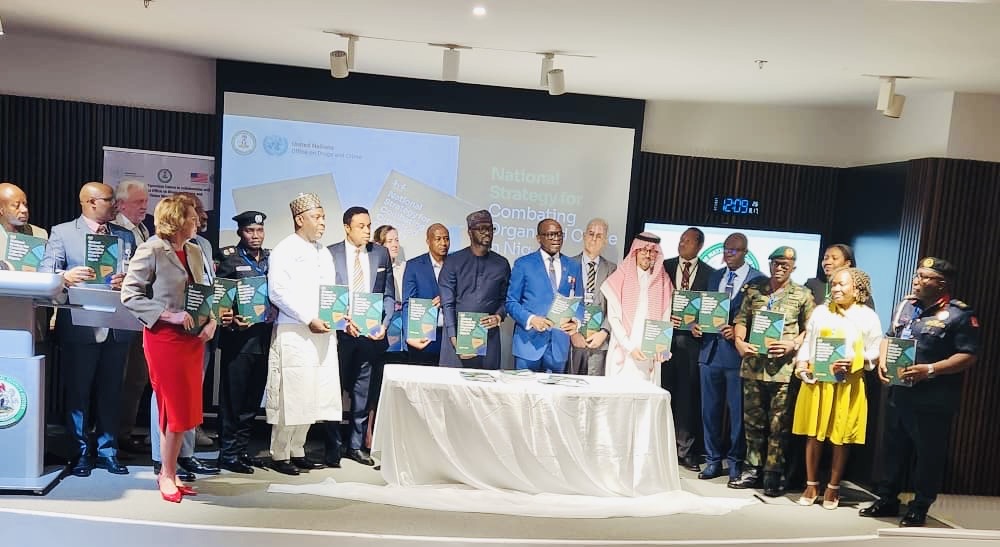
The strategy was unveiled at the Office of the National Security Adviser National Counter-Terrorism Centre (ONSA-NCTC), Abuja, on Monday, August 17, 2026, and was attended by senior government officials, security and law enforcement agencies, international partners, civil society organisations and other stakeholders.
The framework seeks to provide a coordinated national response to increasingly interconnected forms of organised crime, including drug and human trafficking, cybercrime, illicit financial flows, migrant smuggling, environmental crime, money laundering and other cross-border criminal activities.
Representing the National Security Adviser, Mallam Nuhu Ribadu, the National Coordinator, National Counter-Terrorism Centre, Major General Adamu Laka, said the launch marked a decisive step in Nigeria’s response to the evolving organised crime landscape.
He noted that while Nigeria had strengthened its legal framework and empowered law enforcement, intelligence and security institutions, the complexity of organised crime required stronger institutional capacity, closer coordination and intelligence-driven collaboration across sectors.
“The work does not end today. Indeed, it begins anew,” Laka said, stressing that the success of the strategy would depend on the effective and collaborative implementation of its provisions.
He said the Office of the National Security Adviser would support the implementation process through intelligence sharing, operational support, strategic coordination and sustained collaboration among relevant institutions.
Also speaking, the representative of the United Nations Office on Drugs and Crime, UNODC Nigeria Country Office, Cheikh Toure, said organised crime had evolved from isolated criminal activities into an interconnected ecosystem involving drugs, trafficking, fraud and illicit financial flows.
Toure said criminal networks were increasingly transnational, diversified and capable of adapting rapidly to government countermeasures, making it necessary for the strategy to remain flexible and responsive to emerging threats.
“Organised crime is not a peripheral security issue. It is a tax on development, investment, public confidence, and the ability of institutions to protect citizens,” he said.
He stressed that the success of the strategy would depend not only on international support but also on Nigeria’s own investment in law enforcement and justice institutions, including forensic capacity, information systems, training and personnel.
“The real test of this strategy will not be found in the pages of the document. It will be found in communities across Nigeria by 2031,” Toure said.
The Director, United States International Narcotics and Law Enforcement Affairs, Tolliver Derick, said the strategy represented an important milestone in the security partnership between Nigeria and the United States.
Derick noted that organised crime, cybercrime and terrorist financing were increasingly interconnected, stressing that illicit financial flows and cyber-enabled criminal activities had become shared international threats requiring coordinated responses.
“America First does not mean America alone,” he said, explaining that the United States would continue working with partners to strengthen their capacity to address threats that ultimately affect both Nigerian and American citizens.
He said the strategy would strengthen Nigeria’s capacity to disrupt criminal networks through operational teams, enhanced financial intelligence and asset recovery mechanisms, as well as deeper engagement with Interpol, ECOWAS and other international partners.
Earlier, Deputy Director, ONSA-NCTC, Mr Henry Sini, stressed the importance of sustained collaboration among Nigeria, neighbouring countries and international partners in combating organised crime.
Sini noted that Nigeria’s illicit drug landscape had evolved, with the country increasingly becoming a production location for cannabis and methamphetamine, while also facing growing cybercrime and other transnational criminal activities.
He said criminal networks constantly adapted their methods whenever government intensified enforcement, making continuous counter-adaptation strategies necessary.
Sini also highlighted progress in maritime security in the Gulf of Guinea following Nigeria’s Deep Blue Project, but warned that gains could be reversed by challenges such as unemployment, weak coastal governance, oil theft, criminal economies and porous borders.
“The fight against organised crime cannot be left to one agency, one individual, one organisation or one country,” he said, calling for sustained cooperation among security and law enforcement agencies, governments, civil society and international partners.
Giving an overview of the strategy and its Monitoring, Evaluation and Learning Framework, Coordination Consultant with TOC, Ayodele Olowonihi, said the strategy adopts a whole-of-government and whole-of-society approach.
He said it is structured around four key pillars: Prevent, Pursue, Protect and Promote, aimed at preventing organised crime, strengthening investigation and prosecution, protecting victims and witnesses, and promoting national, regional and international cooperation.
Olowonihi said the framework would also strengthen investigative capacity, improve coordination, protect vulnerable groups and ensure that implementation is guided by measurable outcomes, human rights, intelligence-led action and adaptability.
Barbra Marcus, in her presentation, highlighted the institutional mechanisms developed during the strategy’s preparation, including a National Multi-Agency Coordination Platform and a functional National Working Group coordinated by the Office of the National Security Adviser.
She said more than 15 institutions and civil society organisations had participated in the process, while Nigeria had also strengthened regional cooperation with Benin and Liberiathrough knowledge exchange and greater collaboration among law enforcement, justice, peace and security actors.
The launch culminated in the unveiling and presentation of the National Strategy for Combating Organised Crime 2027–2031, which stakeholders said would provide a common framework for anticipating emerging threats, disrupting criminal networks, strengthening institutional coordination and deepening regional and international cooperation.
The strategy is expected to guide Nigeria’s organised crime response over the next five years, with its success ultimately measured by stronger institutions, safer communities, reduced opportunities for criminal networks and greater public confidence in the country’s security and justice systems.