

The Nigerian Army has commenced a major restructuring of its operational command structure following the approval by President Bola Ahmed Tinubu, GCFR, President and Commander-in-Chief of the Armed Forces, Federal Republic of Nigeria, for the establishment of four additional divisions aimed at strengthening national security and enhancing military operations across the country.
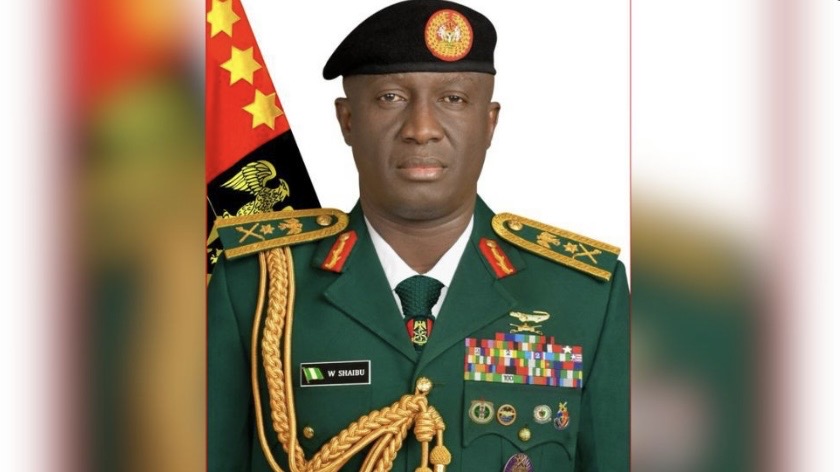
According to an official statement signed by Colonel Appolonia Anele, Acting Director Army Public Relations, the Chief of Army Staff (COAS), Lieutenant General Waidi Shaibu, has approved the appointment of General Officers Commanding (GOCs) to lead the newly established divisions as part of efforts to expand the Nigerian Army’s force structure, improve command and control, and boost its capacity to respond to the nation’s evolving security challenges.
The statement disclosed that the newly created divisions would commence operations in phases, beginning with the attainment of Initial Operational Capability (IOC), while measures are being implemented to achieve Full Operational Capability (FOC). The phased activation, it noted, is intended to ensure operational continuity, seamless deployment and rapid force projection nationwide.
As part of the reorganisation, the Army has also redefined the Areas of Responsibility for its divisions. Under the new arrangement, 1 Division Kaduna will oversee Kaduna, Kano, Katsina and Jigawa States, while 2 Division Ibadan will be responsible for Oyo, Osun, Ekiti and Ondo States. The 3 Division Jos will cover Plateau, Bauchi and Gombe States.
The newly established 5 Division, headquartered in Makurdi, will oversee Benue, Nasarawa and Kogi States, while 6 Division Port Harcourt will continue to cover Rivers, Akwa Ibom and Cross River States. The 7 Division Maiduguri will remain responsible for Borno and Yobe States, while 8 Division Sokoto will retain responsibility for Sokoto, Kebbi and Zamfara States.
The new 9 Division, headquartered in Ilorin, will oversee Kwara and Niger States, while the 10 Division, based in Jalingo, will take responsibility for the border areas of Taraba and Adamawa States. Meanwhile, 81 Division Lagos will continue to cover Lagos and Ogun States, while 82 Division Enugu will retain responsibility for Enugu, Anambra, Abia, Ebonyi and Imo States. The newly established 83 Division, with headquarters in Benin City, will assume responsibility for Edo, Delta and Bayelsa States upon its activation later in the year.
To provide leadership for the new formations, the COAS approved the deployment of several senior officers. Major General Yakubu Yahaya has been redeployed from Headquarters Joint Task Force (North Central), Operation SAVANNA SHIELD, to Headquarters 9 Division, Ilorin, where he will serve as General Officer Commanding and Commander of Operation SAVANNA SHIELD.
Major General Chinedu Ralph Nnebeife has been posted from Headquarters 2 Division/Sector 3 Joint Task Force (North West), Operation FANSAN YAMMA, to Headquarters 10 Division, Jalingo, as General Officer Commanding, while Major General Moses Gara moves from Headquarters Joint Task Force Operation WHIRL STROKE to Headquarters 5 Division, Makurdi, where he assumes the dual role of General Officer Commanding and Commander of Operation WHIRL STROKE.
Similarly, Major General Auwalu Mahmuda has been redeployed from the Army Headquarters Directorate of Inspection and Compliance to Headquarters 2 Division, Ibadan, as General Officer Commanding.
The statement also announced the activation of three additional brigades to reinforce the new divisions. Brigadier General A.O. Odubiyi will command the newly established 11 Brigade, Gboko, Brigadier General A.M. Haruna takes charge of 29 Brigade, Kainji, while Brigadier General R.M. Aminu has been appointed Commander of 10 Brigade, Lafia.
Lieutenant General Shaibu congratulated the newly appointed commanders and urged them to provide visionary leadership, sustain operational momentum and uphold the highest standards of professionalism, discipline and mission effectiveness.
He also expressed appreciation to President Tinubu for what he described as unwavering support and strategic investment in expanding the Nigerian Army’s operational capabilities, noting that the establishment of the additional divisions marks a significant milestone in the transformation of the Service and demonstrates the Federal Government’s commitment to strengthening Nigeria’s defence architecture.
The Army Chief expressed confidence that the expanded force structure would improve command and control, enhance operational coordination, strengthen border security, facilitate faster deployment of troops and resources, and significantly improve the Nigerian Army’s ability to respond effectively to emerging security threats while supporting lasting peace and stability across the country.