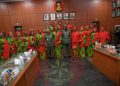


The Chief of the Air Staff (CAS), Air Marshal Sunday Kelvin Aneke, has reaffirmed that safety remains the bedrock of operational effectiveness in the Nigerian Air Force (NAF), charging commanders at all levels to institutionalise a proactive safety culture capable of sustaining mission readiness, combat capability and the protection of personnel and equipment.
Speaking while declaring open the First Nigerian Air Force Safety Review Board (SRB) Meeting for Year 2026, Air Marshal Aneke said the two-day meeting was convened to critically assess the Service’s safety performance, evaluate emerging risks, identify areas requiring improvement and develop strategic initiatives that would further strengthen safety awareness across all NAF operations and activities.
He observed that the increasingly complex security environment demands that the Nigerian Air Force maintains the highest standards of professionalism while ensuring that safety remains an integral part of operational planning, decision-making and mission execution.
“Operating within a complex and demanding security environment, the Nigerian Air Force must maintain high levels of professionalism, mission readiness and decisive air power effectiveness. Operational success depends fundamentally on safety being an integral component of the processes of planning, decision-making and execution,” the CAS stated.
Air Marshal Aneke recalled that during the maiden Safety Review Board under his leadership in December 2025, a decision was taken to expand future Board meetings to at least two days to allow for more detailed reporting, exhaustive reviews and robust deliberations on critical safety issues.
According to him, safety should no longer be viewed merely as a statutory obligation but as a strategic enabler of operational effectiveness, stressing that every aircraft, vehicle, equipment, facility and personnel entrusted to the Service must be safeguarded through strict compliance with established safety standards and global best practices.
The Chief of the Air Staff commended the Superintendent of Standards and Evaluation for raising safety standards across the Service and equally praised Branch Chiefs, Air Officers Commanding, Commandants of NAF Professional Military Education Institutions, Directors, Command Evaluation Officers, Air Component Commanders, commanders at all levels and Unit Safety Officers for sustaining safety awareness and implementing preventive measures throughout the Nigerian Air Force.
Despite these achievements, he noted that recent safety incidents and hazard reports indicated the need for greater improvements in risk assessment, procedural compliance, maintenance discipline, supervision, human factors management and reporting practices.
“It is essential to strengthen our commitment to proactive safety management rather than reactive responses to incidents,” he emphasised.
The CAS stressed that the essence of the Safety Review Board extends beyond examining accident statistics, explaining that the forum is intended to identify systemic deficiencies, analyse trends and formulate practical recommendations capable of preventing future mishaps.
He urged participants to engage in frank, objective and solution-driven deliberations.
“The value of this meeting will be reflected in the quality of recommendations generated and the effectiveness of their implementation within our units and formations,” he said.
Reiterating his command philosophy of building and sustaining a professional and mission-ready force capable of delivering decisive air power effects, Air Marshal Aneke called on commanders to provide visible leadership by ensuring effective supervision, strict enforcement of standards and accountability across all formations.
He also encouraged all personnel to embrace the Nigerian Air Force’s “Safety Just Culture,” which promotes voluntary reporting of hazards, near misses and safety concerns without fear of sanctions.
“I urge personnel to embrace a positive safety reporting culture whereby hazards, near misses and safety concerns are promptly reported without fear of sanctions. This is the essence of the ‘Safety Just Culture,’ which the NAF Safety Management System encourages by giving credence to voluntary reporting of hazards and risks. Such reports offer valuable lessons that can prevent future incidents and protect both lives and property,” he stated.
The Chief of the Air Staff further directed participants to critically assess the Service’s current safety posture, identify emerging threats and recommend innovative measures that would strengthen the Nigerian Air Force Safety Management System.
He expressed confidence that the outcome of the Board would significantly enhance operational readiness, preserve combat capability and protect the Service’s most valuable asset, its personnel.
“The recommendations arising from this Board should contribute meaningfully to enhancing operational readiness, maintaining combat capability and safeguarding our most valuable resource, our personnel,” Air Marshal Aneke declared before formally opening the meeting.
Earlier in his welcome address, the Chief Superintendent of Standards and Evaluation, Air Vice Marshal E.O.E. Ebiowe, welcomed members of the Air Staff, members of the Nigerian Air Force Safety Review Board and other participants, describing the meeting as a critical component of the Service’s safety governance framework.
He explained that the Safety Review Board, held twice annually, provides an opportunity to evaluate safety performance during the preceding six months in accordance with the provisions of the Nigerian Air Force Air Operations Directive and the NAF Safety Management System Manual.
“Today’s meeting provides the appropriate forum to review the Nigerian Air Force’s safety performance during the period under review. The Board will review safety trends, assess safety performance indicators and targets, evaluate significant hazards and associated risks, review implementation of previous Board decisions and determine additional measures required to enhance safety performance across the Service,” Air Vice Marshal Ebiowe said.
He noted that while accidents often attract greater attention because of their consequences, incidents and near misses provide invaluable opportunities to identify latent hazards before they escalate into major accidents.
“Incidents and near misses often reveal hazards and latent conditions before they develop into accidents. Timely reporting, objective investigation and effective implementation of investigation recommendations remain critical to preventing recurrence and strengthening safety performance,” he stated.
Air Vice Marshal Ebiowe disclosed that since the last Safety Review Board meeting, the Nigerian Air Force had continued to implement several safety initiatives, including Safety Management System programmes, Crew Resource Management training, safety sensitisation campaigns, accident investigations, hazard mitigation programmes and continuous monitoring of safety performance across commands.
He urged participants to actively contribute to discussions and ensure that practical, achievable recommendations emerge from the meeting to further strengthen safety management across the Nigerian Air Force.
“The effectiveness of this Board depends on our objective review of available information and our collective commitment to implementing practical and achievable recommendations. I encourage all members to actively participate in our deliberations as we work towards further strengthening safety management across the Nigerian Air Force,” he said.
The 2026 First Nigerian Air Force Safety Review Board Meeting brought together senior officers, commanders, safety specialists and key stakeholders from across the Service to review safety trends, assess operational risks and chart a strategic course for sustaining a safer, more professional and mission-ready Nigerian Air Force.