

The Federal Government has reaffirmed its commitment to supporting the establishment and development of the Federal College of Agriculture, Kirikasama, in Jigawa State as part of efforts to strengthen agricultural education and drive food security across the country.
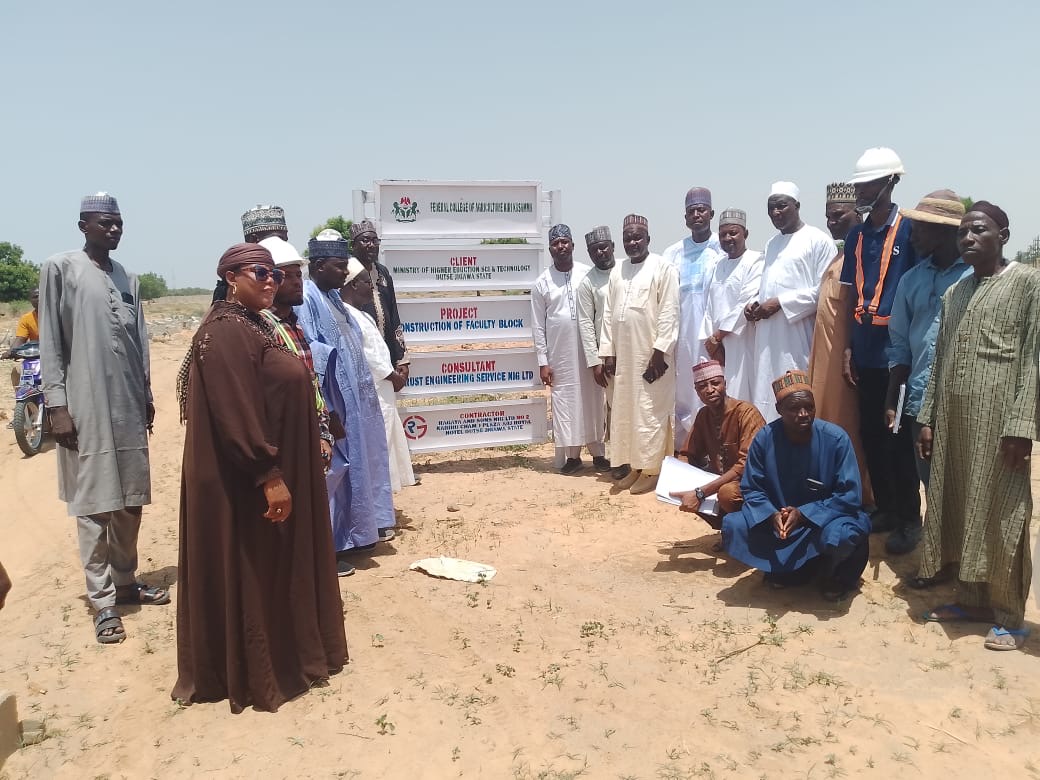
In an official signed statement by the Public Relations Officer to the Executive Secretary of the Agricultural Research Council of Nigeria (ARCN), Mrs. Khadijat Oluwatoyin Ameen (ANIPR), the Executive Secretary of ARCN, Dr. Adamu Abubakar Dabban, gave the assurance during an oversight visit to the site of the proposed institution in Kirikasama.
Dr. Dabban stated that ARCN would continue to provide institutional support to ensure the college fulfills its mandate of producing skilled agricultural professionals capable of addressing emerging challenges in the sector.
“As Executive Secretary of ARCN, I assure this institution of our continued support. We remain committed to strengthening agricultural colleges through capacity building, policy support, institutional development and stronger linkages with research institutes. We will continue to promote initiatives that position our colleges to meet the demands of a rapidly changing agricultural landscape,” he said.
He noted that the establishment of the college reflects the Federal Government’s commitment to food security, economic diversification, youth empowerment and rural development, adding that institutions such as the Federal College of Agriculture, Kirikasama, would play a critical role in producing the skilled manpower required to transform the agricultural sector.
According to him, agriculture remains a major pillar of Nigeria’s economy, providing food, employment, income and industrial raw materials, despite facing challenges such as climate change, low productivity, pest and disease outbreaks, post-harvest losses, inadequate mechanization and limited adoption of modern technologies.
Dr. Dabban emphasized that overcoming these challenges would require a new generation of agricultural professionals equipped with practical skills, innovation and entrepreneurial capacity.
The ARCN Executive Secretary highlighted the council’s achievements over the years, including the development and release of improved varieties of rice, maize, cassava, sorghum, millet, cowpea, soybean, wheat, groundnut and horticultural crops.
He said the technologies developed by ARCN and its affiliated institutions have improved crop yields, enhanced resilience to climate change and boosted food production nationwide.
Dr. Dabban further disclosed that research institutes under ARCN have recorded significant breakthroughs in livestock production, fisheries, aquaculture, mechanization, irrigation, value addition and post-harvest management, while also supporting the control of major agricultural threats such as Tuta Absoluta in tomato production, ginger diseases and cassava pests.
“Research efforts have supported the control of major agricultural threats, including Tuta Absoluta in tomato production, ginger diseases, cassava pests and other challenges affecting food security. These successes demonstrate the importance of research in solving practical agricultural problems and improving the livelihoods of farmers,” he stated.
He stressed that research alone was insufficient without strong institutions to train competent professionals capable of transferring knowledge to farmers, establishing agribusiness enterprises and supporting grassroots agricultural development.
Dr. Dabban commended the Federal Government, the Jigawa State Government, traditional institutions, host communities and other stakeholders for their contributions toward the successful take-off of the college.
He described the institution as strategically positioned to serve as a hub for innovation, technology transfer, entrepreneurship and community development, where research findings would be translated into practical solutions for the agricultural sector.
The ARCN boss also urged the management of the college to embrace excellence, innovation and accountability, while preparing students for emerging trends in agriculture, including digital agriculture, artificial intelligence, precision farming, biotechnology and climate-smart agriculture.
He encouraged stronger collaboration between the college, ARCN research institutes, development partners and the private sector to enhance staff development, student training, technology transfer and research collaboration.
Addressing students, Dr. Dabban described agriculture as a critical sector that goes beyond farming to encompass food security, job creation, poverty reduction, environmental protection and economic growth.
He urged them to remain focused and committed to excellence as future scientists, researchers, extension agents, agribusiness entrepreneurs and policymakers.
Earlier, the Pioneer Acting Provost of the institution, Professor Muhammed Gwaram, expressed appreciation to the ARCN Executive Secretary and his delegation for the visit, noting that it provided an opportunity to assess the level of construction work and ongoing preparations for the commencement of academic activities.
Also speaking, the Chairman of Kirikasama Local Government Area, Alhaji Muhammad Mag, thanked President Bola Ahmed Tinubu and the ARCN leadership for locating the institution in the community and pledged the support of residents toward its successful take-off.
The oversight visit was attended by the Director of Planning, Research and Statistics, Dr. Aliyu Shuaibu Madugu; the Public Relations Officer to the Executive Secretary, Mrs. Khadijat Oluwatoyin Ameen (ANIPR); the Special Assistant to the Executive Secretary, Engr. Umar Muhammad Alfa; traditional rulers and other stakeholders.
The Agricultural Research Council of Nigeria is responsible for coordinating agricultural research, training and extension activities across the country through the National Agricultural Research Institutes and Federal Colleges of Agriculture under its supervision. The council promotes the development and dissemination of technologies aimed at improving agricultural productivity and enhancing farmers’ livelihoods.