

By Nkechi Eze
As the Nigerian Navy marks its 70th anniversary, the Service has unveiled an ambitious long-term maritime security strategy that points toward future underwater warfare capabilities, advanced military technologies and stronger force projection across the Gulf of Guinea.
The development marks one of the clearest indications yet that Nigeria’s naval leadership is recalibrating its defence posture beyond conventional anti-piracy operations and coastal security missions toward a more technologically driven maritime force prepared for emerging global threats.
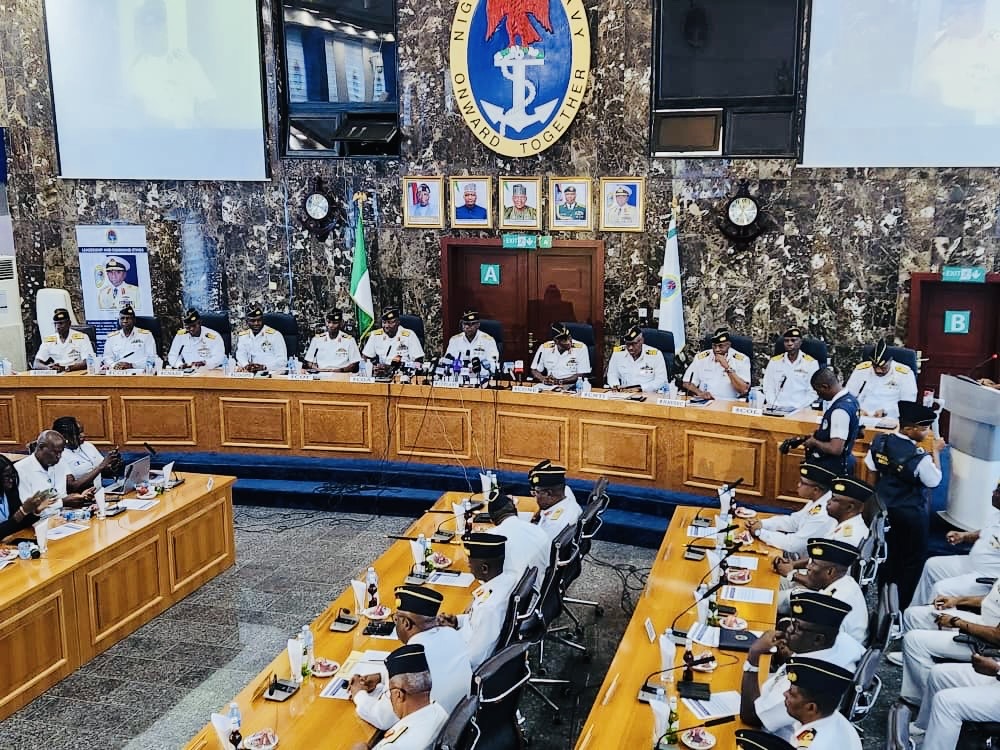
Speaking during activities commemorating the Navy’s anniversary celebrations, the Chief of the Naval Staff (CNS), Vice Admiral Idi Abbas , revealed that the Service is increasingly focusing on future warfare concepts, strategic surveillance systems and long-term maritime dominance.
Vice Admiral Abbas, who was represented by the Chief of Policy and Plans, Rear Admiral Akinola Olodude, explained that evolving global security realities now require the Nigerian Navy to think beyond traditional threats such as piracy, crude oil theft and sea robbery.
Although the Navy did not formally announce plans to acquire submarines, the Naval Chief suggested that modern maritime defence planning can no longer ignore underwater warfare capabilities and sophisticated offshore security systems.
According to him, discussions around underwater warfare platforms, strategic surveillance technologies and indigenous military innovation are becoming increasingly important as nations prepare for future maritime competition and evolving security challenges.
The Naval Chief acknowledged that Nigeria still faces considerable technological limitations, particularly its dependence on foreign military hardware and overseas technical expertise for critical defence operations.
He stressed the need for the country to deepen local research, indigenous production and technological innovation within the defence sector in order to reduce vulnerability and strengthen long-term operational independence.
“We have to move further ahead in technology and research,” he stated.
Vice Admiral Abbas also highlighted Nigeria’s recent success in maritime security, noting that the country’s removal from the global piracy list remains one of the most significant achievements recorded by the Nigerian Navy in recent decades.
He attributed the success to sustained naval operations, support from the Federal Government and growing international cooperation in securing the Gulf of Guinea.
Despite these gains, the Naval Chief warned that criminal elements operating within the maritime environment are becoming increasingly sophisticated and interconnected.
According to him, intelligence assessments now indicate that maritime criminal networks are evolving beyond piracy into more complex transnational operations involving cyber-related attacks, narcotics trafficking, illegal arms movement and organised maritime crime.
“Threats evolve,” the Naval Chief emphasized, noting that the changing security environment is compelling the Nigerian Navy to redesign its maritime doctrine and operational strategy.
He disclosed that the Service is already expanding surveillance operations, rapid-response capabilities and regional maritime cooperation efforts across strategic sea corridors and neighbouring African states.
The Navy boss described the Nigerian Navy as an institution undergoing strategic reconstruction after years of intensive operations against piracy, oil theft and maritime criminality.
Using the analogy of rebuilding an ageing vessel into a modern warship, he said the transformation currently taking place within the Service goes beyond the acquisition of ships and weapons systems.
The Navy, he explained, is also intensifying engagement with coastal communities, expanding social intervention programmes and strengthening recruitment awareness campaigns aimed at improving intelligence gathering within riverine and waterfront areas.
The broader objective, according to the Naval Chief, is for Nigeria to emerge not merely as a country reacting to maritime threats, but as a dominant naval power capable of shaping security architecture, protecting trade routes and influencing strategic stability across the Gulf of Guinea.
He noted that as future security assessments continue to evolve, advanced offshore warfare systems, underwater defence platforms and strategic deterrence capabilities may increasingly become part of Nigeria’s long-term maritime security considerations.
The remarks represent one of the strongest public signals yet that the Nigerian Navy is positioning itself for a new era of technologically driven maritime operations as it prepares for the complex security environment of the coming decades.