

By Nkechi Eze
The Chief of Army Staff (COAS), Lieutenant General Waidi Shaibu, has rolled out an ambitious combat transformation agenda for the Nigerian Army centred on armed drone warfare, expansion of Army aviation operations and stricter battlefield accountability, declaring that operational commanders can no longer afford excuses in the fight against insecurity across the country.
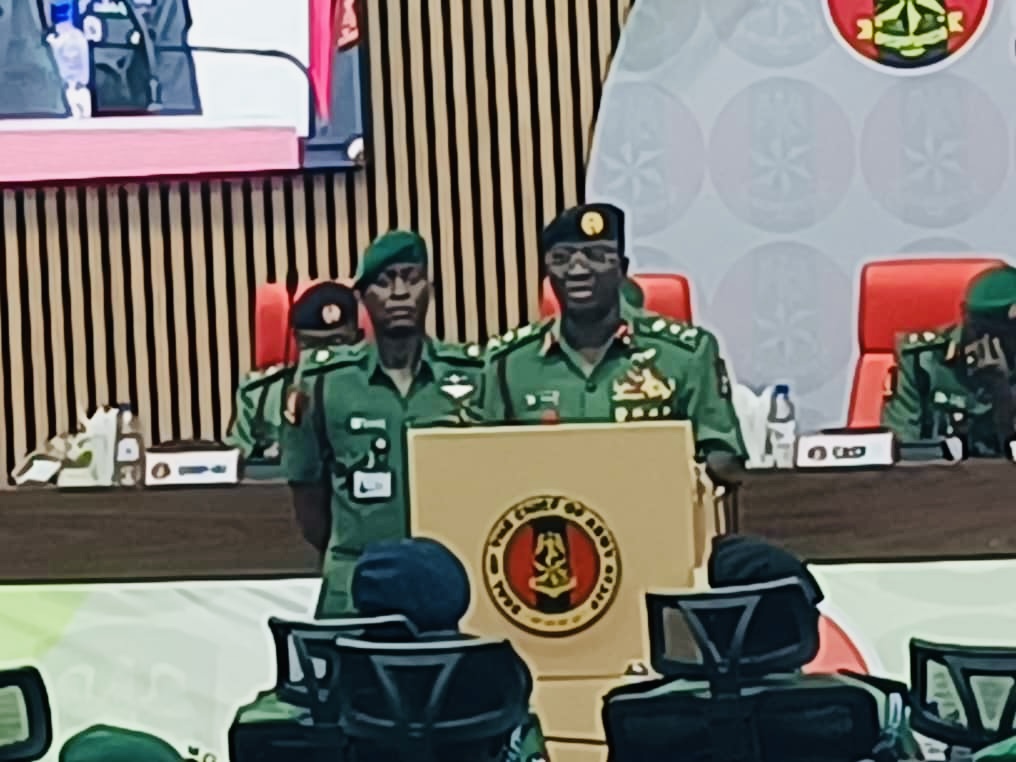
Speaking at the closing session of the Nigerian Army Bi-Annual Conference, Lieutenant General Shaibu said the Service was entering a new phase of technologically driven warfare designed to improve combat efficiency against terrorism, insurgency, banditry and other evolving security threats confronting the nation.
The Army Chief revealed that the acquisition of additional armed drones as well as the operational deployment of the Nigerian Army Aviation arm were already significantly improving battlefield effectiveness through enhanced surveillance, precision engagements and rapid casualty evacuation operations in active theatres of operation.
He explained that the conference extensively examined the increasingly complex nature of Nigeria’s security landscape and the urgent necessity for a more combat-ready, adaptive and technologically advanced force capable of responding swiftly to modern threats.
According to the COAS, deliberations during the three-day conference went beyond conventional operational reviews and focused largely on practical, solution-oriented reforms aimed at strengthening intelligence gathering, logistics coordination, troop welfare, combat training and inter-unit battlefield cooperation.
Lieutenant General Shaibu stressed that contemporary warfare now demands constant innovation, rapid operational adaptation and stronger institutional discipline, warning commanders at all levels that the effectiveness of military operations would henceforth be assessed based on measurable battlefield results rather than routine presentations and conference resolutions.
In what appeared to be a direct charge to field commanders, the Army Chief declared that implementation of operational directives would become the new benchmark for evaluating leadership performance across formations and units.
“Going forward, commanders at all levels are expected to translate conference resolutions into concrete actions,” he stated, insisting that operational success would only be determined through visible results on the battlefield.
The COAS further disclosed that the Nigerian Army was currently undertaking one of its most aggressive modernisation programmes in recent years, with several newly acquired combat capabilities already deployed to improve operational dominance in conflict-prone areas across the country.
As part of the broader transformation efforts, Lieutenant General Shaibu highlighted ongoing investments in recruit development, advanced combat training, leadership education and institutional reforms aimed at building a more disciplined, professional and merit-driven force capable of adapting to emerging security realities.
He also disclosed that multiple intervention projects were underway nationwide to improve operational facilities, troop accommodation and overall living conditions for personnel, stressing that troop welfare remained a critical component of operational effectiveness.
The Army Chief reiterated the Service’s commitment to sustaining what he described as a “soldier-first culture,” maintaining that motivated and properly catered-for troops remained essential to battlefield success.
The conference, he said, also reviewed ongoing welfare programmes including prompt payment of operational entitlements, improved healthcare services, educational support initiatives and expanded welfare packages for personnel and their families.
Lieutenant General Shaibu further commended President Bola Ahmed Tinubu for his continued support to the Armed Forces and the ongoing military transformation initiatives being implemented across the Services.
He expressed confidence that the renewed operational momentum and ongoing reforms would significantly strengthen Nigeria’s capacity to confront terrorism, insurgency, banditry and other security threats undermining national stability and public safety.