


By Nkechi Eze
The Chairman of the Independent Corrupt Practices and Other Related Offences Commission (ICPC), Musa Adamu Aliyu, has called for the institutionalisation of anti-corruption education within Nigeria’s legal training system, describing it as a critical step toward strengthening integrity, accountability, and ethical consciousness among future legal practitioners.
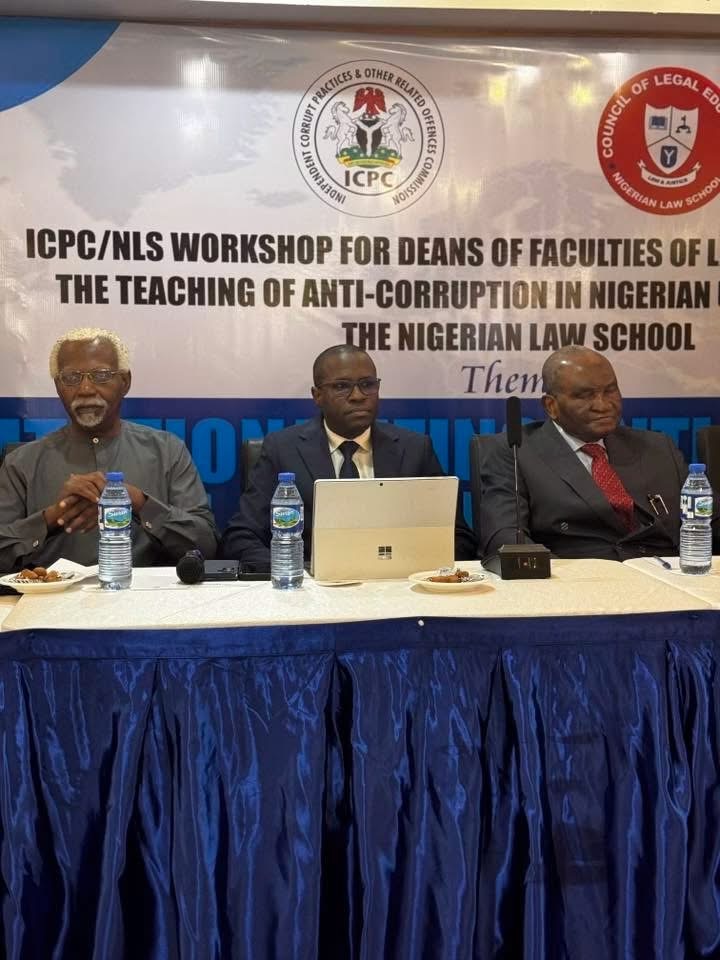
Dr. Aliyu made the call on Tuesday in Abuja during the ICPC/Nigerian Law School Workshop for Deans of Faculties of Law on the teaching of anti-corruption in Nigerian universities and the Nigerian Law School, themed: “Institutionalising Anti-Corruption Education in Nigerian Legal Training,” held at Bon Hotel Elvis.
Speaking at the workshop, the ICPC Chairman said corruption remained one of the greatest threats to Nigeria’s development, noting that it weakens institutions, undermines the rule of law, erodes public trust, and distorts economic growth.
He stressed that the fight against corruption could not rely solely on investigation and prosecution, but must also include preventive and educational approaches capable of shaping ethical values and promoting transparency and accountability.
“Combating corruption cannot be limited to investigation and prosecution alone. It must also involve preventive, educational, and value-driven approaches capable of shaping attitudes, strengthening ethical consciousness, and promoting a culture of integrity, transparency, and accountability,” he stated.
Dr. Aliyu further noted that legal education occupies a strategic position in the administration of justice, adding that lawyers serve as custodians of the law and defenders of justice, whose ethical orientation directly influences governance and public confidence in the justice system.
“In recognition of this pivotal role, there is an increasing need to inculcate integrity, accountability, and anti-corruption values at the formative stages of legal education,” he said.
The ICPC Chairman explained that the workshop was designed to provide a platform for Deans of Faculties of Law and the Nigerian Law School to collectively develop frameworks for integrating anti-corruption education into legal training.
According to him, the engagement would explore possible curriculum models, lecturer training methodologies, and institutional collaborations between the Commission, academia, and the Nigerian Law School.
“The critical issue before us is therefore not whether anti-corruption education is necessary, but how best it should be delivered,” he stated.
Dr. Aliyu added that the initiative was conceived as a pilot intervention capable of shaping broader professional ethics and integrity training across other disciplines in the future.
Also speaking, the Chairman of the Council of Legal Education, Emeka Ngige, described corruption as a major factor responsible for failed development strategies and stunted economic growth in Nigeria.
He commended the ICPC for convening what he described as an “epochal and thought-provoking workshop,” noting that legal education must produce practitioners equipped not only with legal knowledge but also with the ethical fibre required to confront corruption.
“The Nigerian Law School through teaching and learning has emerged as the furnace where future leaders of the Bar and Bench are forged. Infusing anti-corruption studies into the curriculum of the Law School is an idea whose time has come,” Chief Ngige said.
He added that integrating anti-corruption studies into legal education would help strengthen public confidence in the justice system and support the work of anti-corruption agencies.
“Integrating anti-corruption studies into the curriculum of the Nigerian Law School is not an addition to legal education, but a restoration of its very ethical core and essence,” he declared.
Chief Ngige further warned universities against exceeding admission quotas allocated to law faculties by the National Universities Commission (NUC) and the Council of Legal Education, describing the practice as a form of corruption that places unnecessary pressure on stakeholders within the legal education system.
“It is an act of corruption for any university to deliberately exceed its quota for law students admission,” he warned, while urging the ICPC to intensify enlightenment efforts on the dangers posed by such practices.
In his goodwill message, the Executive Secretary of the National Universities Commission, Abdullahi Ribadu, underscored the importance of universities in shaping ethical behaviour and sustaining behavioural change among young people.
Professor Ribadu noted that corruption weakens institutions, erodes public trust, and slows national development, stressing that tackling it requires continuous education and deliberate value reorientation.
“University education goes beyond acquiring certificates and professional knowledge. It is also about shaping the character and civic responsibilities of students and all members of the University community,” he said.
He added that universities remain critical platforms for influencing behavioural change because they engage young people at formative stages of their lives.
The two-day workshop brought together deans of law faculties, officials of the Nigerian Law School, legal education regulators, and anti-corruption stakeholders to deliberate on strategies for embedding anti-corruption studies into Nigeria’s legal education curriculum.