

By Nkechi Eze
Nigeria’s anti-narcotics war recorded a sweeping nationwide breakthrough as operatives of the National Drug Law Enforcement Agency (NDLEA) dismantled emerging drug trafficking routes, intercepted a dangerous consignment of the terror-linked substance, Captagon, and uncovered a web of illicit operations spanning several states, in what authorities describe as a decisive blow to criminal syndicates threatening national security.
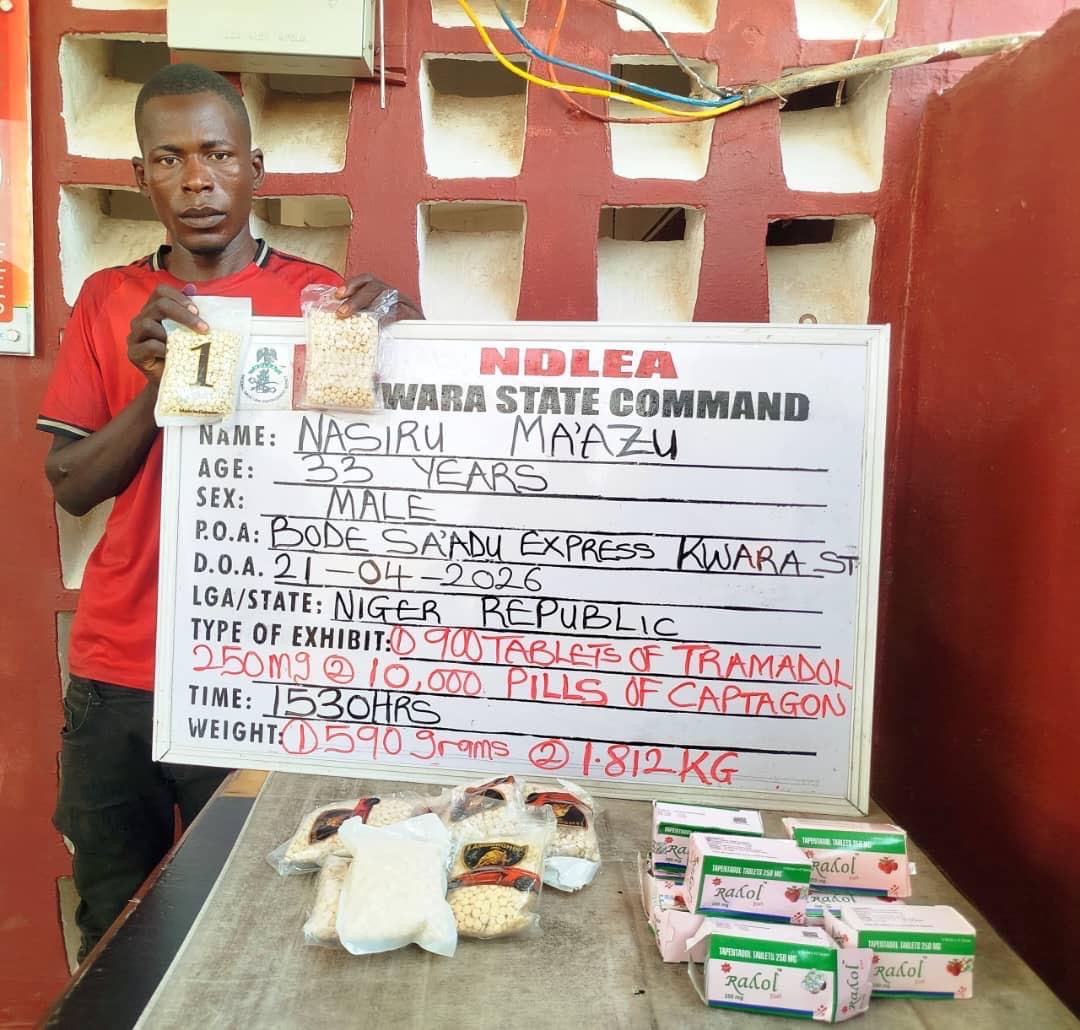
According to an official signed statement by the Director, Media and Advocacy of NDLEA, Femi Babafemi, the Agency intercepted a fresh consignment of Captagon in Kwara State, barely five years after its first recorded seizure on the African continent at the Apapa Seaport in Lagos. The latest operation, carried out on Tuesday, 21 April 2026 along Bode Saadu road, led to the arrest of a 33-year-old suspect, Nasiru Mu’azu, from whom 10,000 pills of the highly addictive amphetamine substance and additional packets of Tapentadol were recovered.
Captagon, notorious for its widespread abuse in the Middle East, has been linked to militant groups, including ISIS, where it is used both as a funding source and as a stimulant to sustain combatants in prolonged conflicts. Its reappearance in Nigeria has raised fresh concerns among security agencies about attempts to re-establish trafficking corridors into the country.
In a separate operation at the same Kwara corridor, NDLEA operatives intercepted a trailer on 24 April, uncovering a concealed compartment loaded with 155,900 capsules of tramadol, 6,000 ampoules of tramadol injection, as well as thousands of tablets of co-codamol and bromazepam. A 24-year-old suspect, Aminu Isah, was arrested in connection with the seizure.
In Oyo State, operatives thwarted a sophisticated drug trafficking attempt involving ingestion, when a commercial bus traveling along the Ibadan/Oyo expressway was intercepted. A passenger, Eze Prince Emeka, was subjected to a body scan which confirmed he had ingested illicit substances. Under observation, he excreted 45 wraps of cocaine weighing 1.043 kilograms. Investigations revealed he intended to transport the drugs through trans-Saharan routes to Europe, using Algeria as a transit point.
Further operations in Edo State led to the seizure of 1,196,000 pills of pharmaceutical opioids along the Benin-Lagos expressway, with two suspects arrested. In Lagos, a suspect was apprehended with 810 kilograms of a cannabis strain known as Arizona, while another was arrested in Bauchi State with 154.5 kilograms of skunk.
In Ekiti State, NDLEA operatives uncovered 466.8 kilograms of skunk stored in a residential building, while in Cross River State, a major raid on cannabis farms in Uyanga community led to the destruction of 20,000 kilograms of the substance spread across eight hectares of farmland, alongside the recovery of processed cannabis.
In a development underscoring the intersection between drug trafficking and broader security threats, NDLEA operatives in Niger State intercepted 394 components used for Improvised Explosive Devices (IEDs) being transported by a suspect along the Kontagora-Zuru road. The suspect and recovered materials have been handed over to relevant security agencies for further investigation.
The Agency also sustained its War Against Drug Abuse (WADA) advocacy campaign nationwide, conducting sensitization programmes in schools, religious centres, workplaces, and communities, reinforcing preventive measures against drug abuse.
Chairman and Chief Executive Officer of NDLEA, Brigadier General Mohamed Buba Marwa (Rtd), commended the coordinated efforts of operatives across the affected states, noting that the interception of Captagon represents a significant disruption of attempts by traffickers to revive a previously dormant supply chain.
He described the seizure as a critical national security milestone, warning that the drug remains a potent enabler of violence due to its ability to suppress fear and fatigue. Marwa assured that the Agency remains vigilant, emphasizing that efforts are not only focused on confiscating illicit substances but also on dismantling the networks that sustain criminality and insecurity across the country.