


By Nkechi Eze
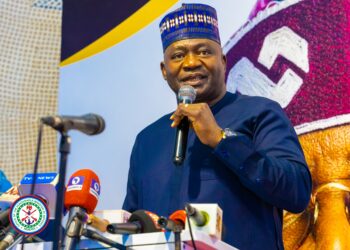
Fresh controversy has trailed the appointment of Hakeem Fawehinmi as substantive Vice Chancellor of the University of Abuja, with growing scrutiny focusing on the legality of the process that produced him.
At the heart of the dispute is an alleged breach of clearly defined eligibility criteria governing the appointment, particularly the requirement that candidates must possess a Doctor of Philosophy (PhD) degree. The position was advertised in 2025 with explicit conditions, including a PhD qualification and a minimum of 10 years’ experience as a professor.
Sources familiar with the process disclosed that more than 50 applicants vied for the position, out of which 10 were shortlisted following security screening by the Department of State Services. The candidates subsequently underwent a rigorous two-day interview conducted by the Joint Council/Senate Selection Board.
Following the exercise, three candidates emerged, with the Governing Council reportedly adopting a merit-based scoring system that produced Fawehinmi as its preferred candidate.
However, concerns have since been raised over whether the appointee met the fundamental academic requirement outlined in the advertisement. Both the Federal Ministry of Education and the university’s Governing Council are said to be in receipt of a formal petition challenging the legality of the appointment, placing the matter under potential official review.
Central to the controversy is the distinction between academic and professional qualifications. The appointment is being challenged on the grounds that a medical fellowship reportedly held by the appointee does not constitute a PhD or its equivalent, thereby raising questions about his eligibility to participate in the selection process.
The argument draws strength from a judgment delivered on May 8, 2025, by the National Industrial Court of Nigeria in Suit No. NICN/ABJ/421/2024, which held that medical fellowship qualifications cannot be equated with a PhD. The court reportedly emphasized that a postgraduate diploma conferring medical fellowship status does not meet the threshold of an academic doctorate.
Further reinforcing this position is a clarification issued on March 5, 2026, by the Federal Ministry of Education, reiterating that while postgraduate medical colleges may be accredited to award PhDs, their fellowship certifications remain professional qualifications rather than academic degrees.
Analysts note that if the advertised requirement was strictly a PhD or its equivalent, and if a fellowship does not satisfy that condition, the eligibility of the appointed candidate and by extension the integrity of the entire selection process could be fundamentally undermined.
The development has also drawn attention to broader concerns within Nigeria’s university system, where controversies surrounding the appointment of vice chancellors and other principal officers have become increasingly frequent.
Under the University Miscellaneous Provisions Act of 1993 (as amended), commonly referred to as the University Autonomy Act, governing councils are empowered to advertise vacancies, constitute search committees, and conduct interviews to select qualified professors typically with at least 10 years’ experience for a single five-year tenure.
While the framework was designed to safeguard institutional independence and promote merit-based leadership, critics argue that recent developments suggest a pattern of procedural breaches, with some governing councils allegedly sidelining statutory requirements in favour of preferred candidates.
Federal authorities have maintained that although professional fellowships are critical for clinical expertise and career advancement, they do not replace the PhD, which remains the benchmark for academic leadership roles in Nigerian universities.
As the controversy persists, attention is now focused on whether the University of Abuja’s Governing Council will uphold the appointment or revisit the process in light of the legal and regulatory questions raised. The outcome is expected to have significant implications not only for the institution but also for governance standards across Nigeria’s public university system.