

…as Wang Yi reaffirms Taiwan’s historical and legal status at meeting with German Foreign Minister
By Nkechi Eze
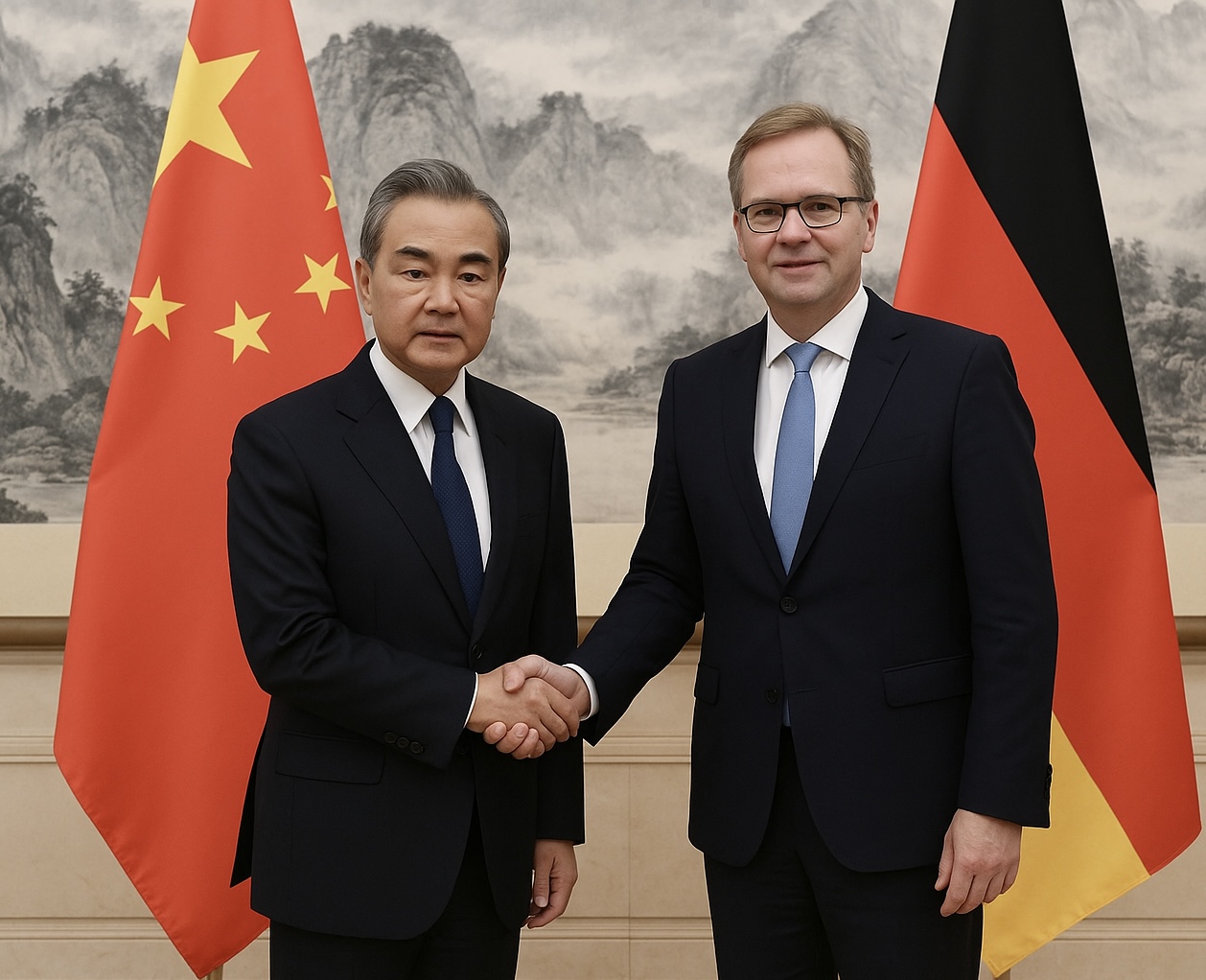
China has issued a strong warning against any form of support for “Taiwan independence,” declaring that such actions constitute interference in China’s internal affairs and violate both domestic and international law. The caution was delivered on Monday in Beijing by Chinese Foreign Minister Wang Yi, who also serves as a member of the Political Bureau of the Communist Party of China (CPC) Central Committee, during talks with visiting German Foreign Minister Johann Wadephul.
In a detailed presentation, Wang Yi traced the historical origin and legal foundation of China’s claim over Taiwan, stressing that the island “has been part of China since ancient times.” He underscored that international agreements concluded during and after World War II clearly affirmed this position.
Wang referenced the 1943 Cairo Declaration, which explicitly stated that all territories stolen from China by Japan, including Taiwan must be returned. He also highlighted Article 8 of the 1945 Potsdam Proclamation, jointly issued by China, the United States, the United Kingdom and the Soviet Union, which reaffirmed the implementation of the Cairo Declaration. Following Japan’s unconditional surrender on August 15, 1945, the Chinese government resumed the exercise of sovereignty over Taiwan, culminating in a formal surrender ceremony in Taipei on October 25 of the same year.
Wang further noted that with the establishment of the People’s Republic of China (PRC) in 1949, the Central People’s Government became the sole legitimate government representing all of China, naturally inheriting sovereignty over Taiwan. This position, he said, is reinforced by the landmark United Nations General Assembly Resolution 2758 of October 1971, which restored China’s seat at the UN to the PRC and expelled the “representatives” of the Taiwan authorities. He added that the UN’s legal interpretation affirms Taiwan as a province of China.
The Chinese foreign minister also cited the 1972 Sino-Japanese Joint Statement, in which Japan recognized the PRC as the sole legal government of China and acknowledged China’s position that Taiwan is an inalienable part of its territory. This commitment, he added, was further strengthened in the 1978 Treaty of Peace and Friendship Between China and Japan.
“These ironclad historical and legal facts have unequivocally and irreversibly affirmed the status of Taiwan as China’s territory,” Wang declared.
Wang criticized recent remarks made by Japan’s current leader on hypothetical scenarios involving Taiwan, describing them as reckless and a serious breach of Japan’s commitments. He warned that such comments undermine China’s sovereignty and territorial integrity, challenge the outcomes of World War II, disrupt the post-war international order, and threaten peace in Asia and beyond.
Marking the 80th anniversary of the victory in the Chinese People’s War of Resistance Against Japanese Aggression, Wang stressed that Japan, as a defeated nation, should have demonstrated deeper reflection and a higher sense of responsibility. Instead, he said, Japan’s leader is “trying to exploit the Taiwan question—the very territory Japan colonized for half a century, committing countless crimes against the Chinese people—to provoke trouble and threaten China militarily. This is completely unacceptable.”
Wang concluded by stating that the Chinese people, alongside peace-loving nations, share a collective responsibility to uphold the principles of the UN Charter and prevent any attempt by Japan to pursue re-militarization or revive militarist ambitions.
The meeting in Beijing reinforced China’s firm stance on the Taiwan question and highlighted the broader geopolitical tensions surrounding regional security and historical accountability.