

By Nkechi Eze
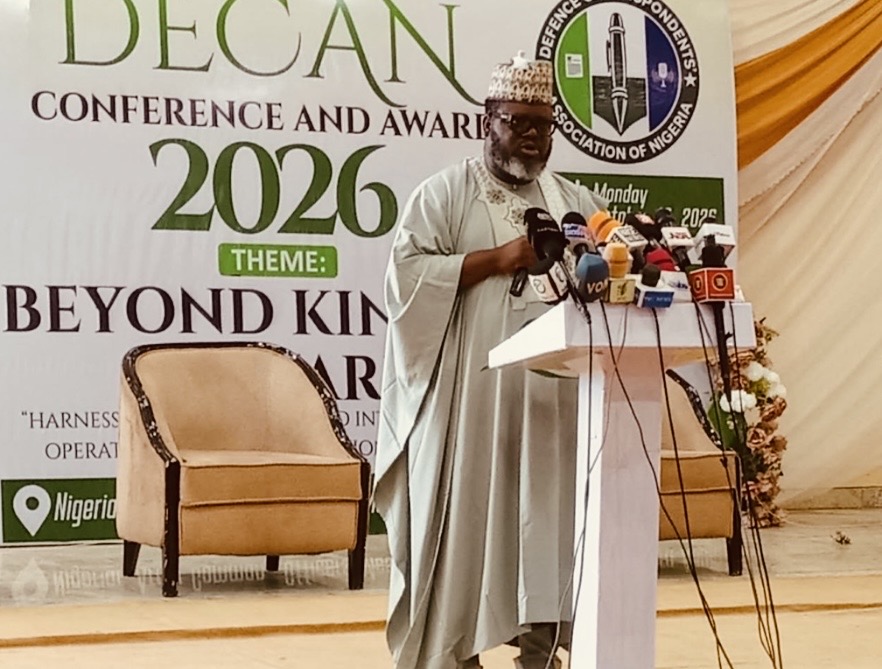
The President of the Defence Correspondents Association of Nigeria (DECAN), Comrade Odita Sunday, has identified artificial intelligence (AI), satellite surveillance, data analytics and unmanned systems as critical tools for strengthening Nigeria’s national security and tackling evolving security threats.
Sunday made this known while delivering his address at the 2026 DECAN Conference and Awards, themed “Beyond Kinetic Warfare: Harnessing Technology and Intelligence-Led Operations for Nigeria’s National Security.”
He said the changing nature of security threats required Nigeria to complement conventional military operations with modern technology and intelligence-driven strategies to detect threats early, prevent attacks and improve operational effectiveness.
According to the DECAN president, security challenges now extend beyond traditional battlefields to cyberspace, digital platforms, information networks and financial systems, which terrorist organisations and criminal networks increasingly exploit for communication, recruitment and coordination.
He stressed that Nigeria must strengthen its capacity to analyse intelligence accurately and respond to threats with precision, noting that a proactive approach would improve the ability of security agencies to prevent attacks before they occur.
Sunday explained that emerging technologies, including artificial intelligence, satellite surveillance, data analytics, unmanned systems and secure communications, could significantly enhance the capabilities of security agencies when properly deployed.
He, however, emphasised that technology alone could not guarantee improved security without sound policies, trained personnel and effective intelligence-sharing mechanisms.
“The threats confronting Nigeria do not operate within institutional boundaries. A single security challenge may require military, police, intelligence, cyber and financial responses,” he said.
The DECAN president therefore called for stronger collaboration among the military, police, intelligence services and other relevant institutions, urging them to share actionable intelligence promptly and securely.
He also advocated increased investment in cybersecurity expertise and encouraged Nigerian professionals and technology companies to develop homegrown solutions capable of addressing the country’s peculiar security challenges.
On the recent Nigerian Air Force aircraft crash, Sunday extended condolences to the families of the deceased and the leadership and personnel of the Service.
He called for a thorough and professional investigation into the incident, stressing that its findings should help strengthen aviation safety, improve operational procedures and enhance the protection of military personnel.
Addressing the role of the media in national security, the DECAN president urged defence correspondents to maintain accuracy, professionalism and responsible reporting while respecting legitimate operational sensitivities.
He cautioned that the rapid spread of misinformation made accuracy more important than speed, adding that national security considerations should not be used to undermine legitimate journalism and accountability.
Sunday reaffirmed DECAN’s commitment to promoting professional defence journalism and facilitating constructive engagement among security agencies, policymakers, technology experts, academics and the media.
He said the association would continue to encourage its members to deepen their understanding of emerging technologies, intelligence, cybersecurity and modern warfare.
The DECAN president further urged Nigeria to invest in intelligence, technology, cybersecurity, research, innovation and human capital, while ensuring that the use of emerging technologies remained guided by law, ethics, accountability and respect for human dignity.
He noted that the future of national security would depend not only on military hardware but also on the quality of intelligence, institutions and personnel available to the country.
Sunday expressed hope that the conference would generate practical recommendations for addressing Nigeria’s evolving security challenges and strengthen collaboration between security institutions and the media.