


By Nkechi Eze
The National Agency for Food and Drug Administration and Control (NAFDAC) and the Public Complaints Commission (PCC) have agreed to strengthen institutional collaboration and intelligence sharing to combat counterfeit medicines, substandard and unwholesome products in Nigeria.
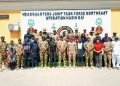
According to an official statement signed by Mr. Adegboyega Osiyemi, Deputy Director, Public Relations Unit, NAFDAC, the commitment was reaffirmed when the Chief Commissioner of the Public Complaints Commission, Hon. Bashir Abubakar, led a delegation of the Commission on a courtesy visit to the NAFDAC Corporate Headquarters in Abuja.
Receiving the delegation, the Director-General of NAFDAC, Prof. Mojisola Christianah Adeyeye, highlighted the importance of inter-agency cooperation in protecting public health and strengthening regulatory enforcement.
Adeyeye recalled that Abubakar had previously received the NAFDAC Integrity Award in 2018 following his role in providing critical intelligence that contributed to the interception of 41 containers of tramadol at a Nigerian port.
She said the development demonstrated the value of timely intelligence sharing and coordinated action among government institutions in tackling the circulation of dangerous regulated products.
The NAFDAC boss noted that the Agency had established strategic partnerships with institutions including the Nigeria Customs Service, National Drug Law Enforcement Agency (NDLEA), National Orientation Agency (NOA), Pharmacists Council of Nigeria (PCN) and the Nigeria Police Force.
According to her, the partnerships had remained critical to efforts to prevent the importation, distribution and circulation of counterfeit medicines, unwholesome food products and other substandard regulated products.
Adeyeye reaffirmed NAFDAC’s commitment to ensuring that regulated products in the Nigerian market are safe, wholesome, efficacious, of consistent quality and compliant with established regulatory standards.
“NAFDAC is a complex agency that deals with the public 24/7. There is hardly anybody who does not consume one or more NAFDAC-regulated products everyday,” she said.
She stressed that regulatory compliance was central to NAFDAC’s mandate because of the direct consequences of regulated products on human lives.
“If there is no compliance in NAFDAC, a child may die, a pregnant woman may die, and a man or a woman living with hypertension may die. Our job in NAFDAC is about life and death. That is why we have international guidelines and standards,” Adeyeye said.
The Director-General also disclosed that NAFDAC was working towards attaining WHO Maturity Level 4 after achieving Maturity Level 3 under the World Health Organization’s Global Benchmarking framework.
She recalled that the Agency had to close significant regulatory gaps before achieving its current maturity level.
“In 2018, NAFDAC had 200 indicators and 800 recommendations to close or satisfy before we could get to Maturity Level 3 during the WHO benchmarking. We closed the gaps, and we were given Maturity Level 3. Today, we are working towards Maturity Level 4,” she said.
Adeyeye added that improved regulatory maturity would enhance the international acceptability of products manufactured and approved by NAFDAC.
She further explained that the Agency’s regulatory responsibilities also contribute to economic development by supporting local pharmaceutical and manufacturing capacity, facilitating international trade and creating employment opportunities.
“NAFDAC is focused. We are not there yet, but we are compliant. The Agency is not only doing regulation to safeguard public health; we are also doing regulation for the survival of our country,” she said.
On his part, the PCC Chief Commissioner, Hon. Bashir Abubakar, said the delegation’s visit was primarily to commend NAFDAC for its efforts in tackling the menace of counterfeit medicines and unwholesome products.
“We came here primarily to commend you and commend your efforts and passion in tackling the menace of fake drugs and unwholesome products in Nigeria,” Abubakar said.
He explained that the PCC, as Nigeria’s Ombudsman institution, receives complaints from members of the public and stakeholders across various sectors, with complaints outside its mandate referred to relevant authorities for appropriate action and follow-up.
Abubakar also commended Adeyeye for her public enlightenment and media engagement initiatives, stressing that sustained communication was important in helping Nigerians understand NAFDAC’s regulatory mandate.
He urged the Agency to continue building a regulatory system capable of commanding respect and deterring violations.
“By building a system, those who follow due process and have integrity will respect you, while people on the other side will fear you,” he said.
The Chief Commissioner also proposed expanding NAFDAC’s inter-agency collaboration framework to include the Corporate Affairs Commission (CAC), Nigeria Ports Authority (NPA), National Union of Road Transport Workers (NURTW) and the Nigerian Shippers’ Council.
He said stronger cooperation among the institutions would improve intelligence gathering, monitoring and enforcement across the supply chain, thereby providing a more coordinated approach to combating counterfeiting and the circulation of substandard and unwholesome products.
The engagement underscored the commitment of NAFDAC and the PCC to deeper institutional collaboration, stronger regulatory compliance and enhanced protection of public health in Nigeria.