

By Nkechi Eze
The Nigerian High Commission in India has said it is monitoring the deportation case of Re-Ekene Vitus Chukwuma, who is currently being held at the Lampur Detention Camp in Delhi over visa overstay and other immigration-related issues.
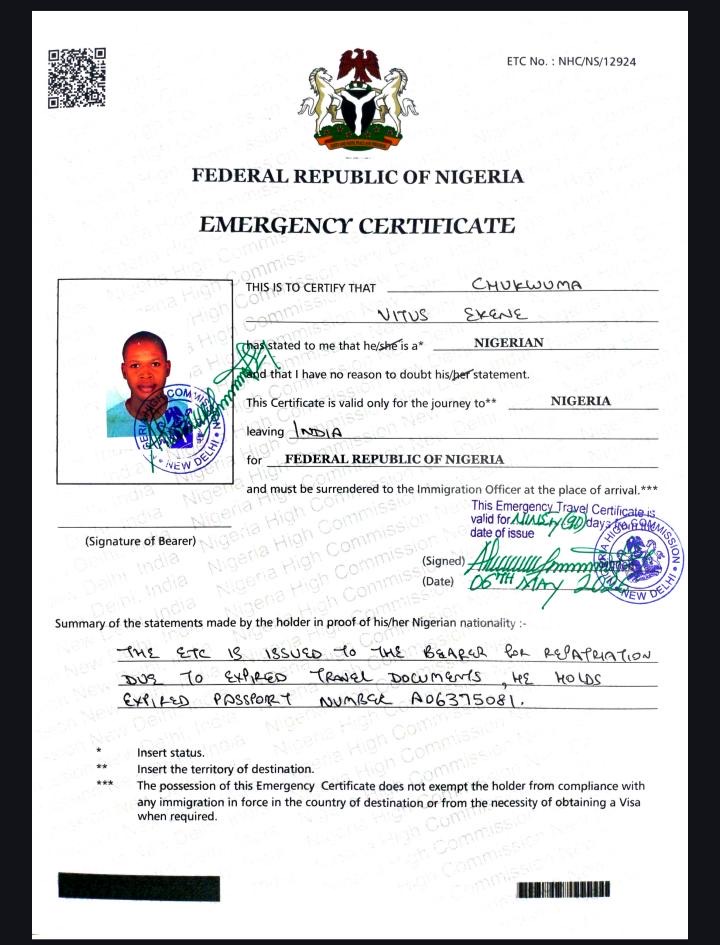
According to a statement signed by Abdur-Rahman Balogun, Director of Media, Public Relations and Protocols, Nigerians in Diaspora Commission (NiDCOM), Chukwuma was arrested in December 2025 for overstaying his visa after remaining in India despite having an expired Nigerian passport and an Emergency Travel Certificate (ETC) issued to facilitate his return to Nigeria.
The statement said Chukwuma had informed a consular officer of the Nigerian High Commission by telephone that he had successfully sent his wife and three children back to Nigeria but chose to remain in India to conduct business despite lacking proper documentation.
It explained that Chukwuma’s Nigerian passport had expired in 2020, while the ETC issued to him by the High Commission during an amnesty period also expired while he was in detention.
According to NiDCOM, Chukwuma had been given the opportunity to return to Nigeria during the amnesty period but declined to utilise the ETC, opting instead to remain in India after sending his family back home.
The High Commission explained that the Foreigners Regional Registration Office (FRRO) is responsible for the deportation process and that detainees must first be checked and cleared before deportation.
It said several Nigerians in detention had already been cleared for deportation, while others remained in custody awaiting clearance. Upon clearance, deportees are required to bear the cost of their return, after which the Nigerian High Commission issues ETCs following receipt of formal deportation requests from the Indian authorities.
The Mission also disclosed that it recently received reports alleging that some detainees were involved in the sale of illegal substances within the deportation camp, adding that some detainees had petitioned the FRRO over the development.
NiDCOM said the Nigerian High Commission would continue to monitor Chukwuma’s situation alongside that of hundreds of other Nigerians awaiting deportation in India.
It added that the Mission had requested another six-month amnesty period for Nigerians residing or working illegally in India to voluntarily leave the country without payment of penalties.
The Commission further said the initiative was part of the Federal Government’s foreign policy of citizen-centred diplomacy under President Bola Ahmed Tinubu’s Renewed Hope Agenda.
As part of efforts to safeguard the welfare of Nigerians in detention abroad, the High Commission also plans to undertake consular visits to prisons and detention facilities across other provinces in India to assess the condition of Nigerian inmates and report its findings to the Ministry of Foreign Affairs.
NiDCOM, therefore, reiterated its warning to Nigerians living abroad to respect the laws of their host countries and avoid activities that could expose them to arrest, detention or deportation.