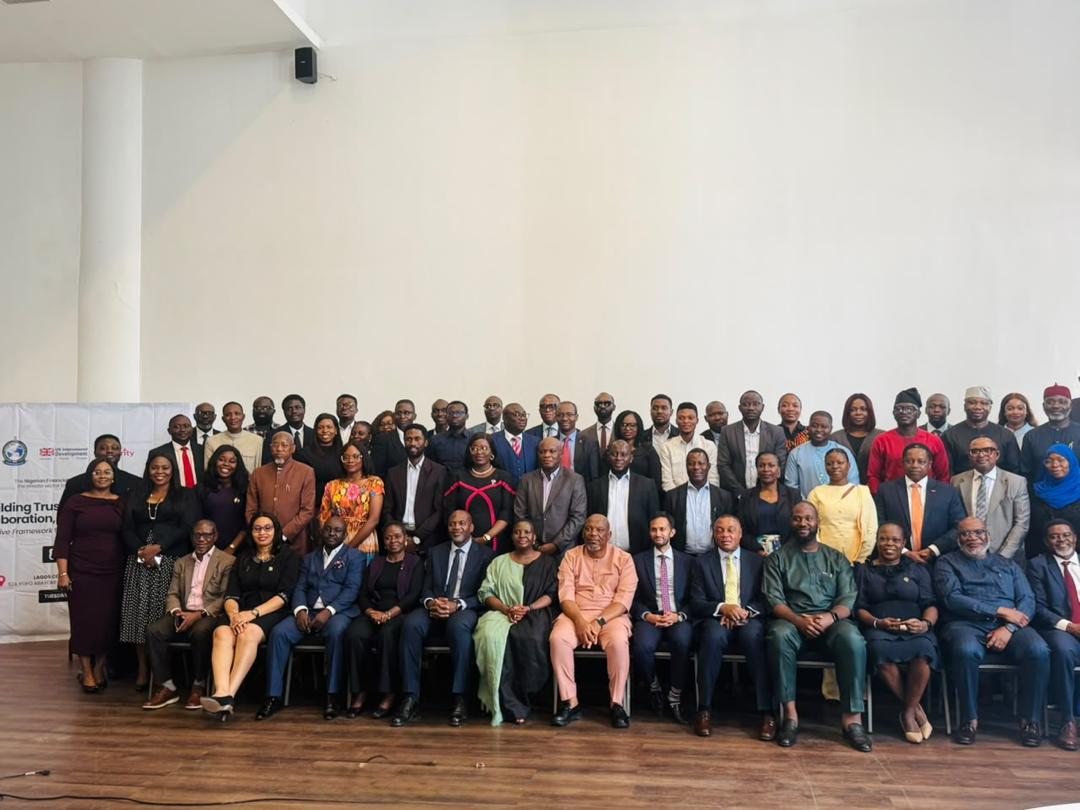
The Nigerian Financial Intelligence Unit (NFIU) has moved to deepen cooperation between government and the private sector in the fight against financial crime, convening a high-level engagement to co-design a new framework for sharing financial intelligence across Nigeria’s economy.
The session, held with support from the British High Commission and the Convention for Business Integrity (CBi), drew regulators, banks, insurance firms, fintechs, Virtual Asset Service Providers and technology companies to shape the proposed Joint Financial Intelligence Collaboration (JFIC), an initiative designed to give public and private institutions a trusted platform to detect emerging threats, disrupt illicit financial networks and reinforce the resilience of the country’s financial system.
Speaking on behalf of NFIU Chief Executive Officer Hajia Hafsat Abubakar Bakari, the Unit’s General Counsel, Mr Felix Obiamalu, said the engagement represented a turning point in the initiative’s development, noting that discussions had progressed from concept to concrete action. “We have moved from dialogue to design, to commitment and implementation,” he said, adding that the focus was now on jointly determining how the partnership should function, the value it should deliver and how it can be sustained over the long term.
Mr Jehanzeb Khan, Illicit Financial Flows Officer at the UK’s Foreign, Commonwealth and Development Office, spoke on behalf of the British High Commission and underscored the importance of stronger public-private collaboration in confronting illicit financial flows, a challenge that continues to test regulatory systems across the region.
For the Convention for Business Integrity, Managing Director Mr Olusoji Apampa said the process had been deliberately structured to put private sector actors at the heart of decision-making, ensuring the emerging framework mirrors real operational conditions and commands broad ownership among stakeholders rather than being imposed from above.
Delivering the keynote address, Ms Xolisile Khanyile, former Chair of the Egmont Group and former Director of South Africa’s Financial Intelligence Centre, described private sector involvement as a national responsibility and called on Nigeria to pursue a practical, phased rollout of the initiative. “Trust, shared ownership and collaboration are the foundations of every successful public-private partnership,” she said, noting that Nigeria’s standing within the global anti-money laundering and counter-terrorism financing framework made the initiative both timely and necessary.
The engagement closed with stakeholders voicing strong support for the proposed framework and a shared resolve to build a partnership that strengthens financial intelligence gathering, sharpens threat detection and equips Nigeria to respond to increasingly sophisticated forms of financial crime. Participants were united in the view that no single institution can tackle today’s financial crimes in isolation, and that meaningful progress depends on government and industry sharing insights, flagging risks early and building collective resilience against illicit financial activity.