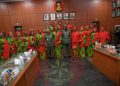
The Director General of the National Information Technology Development Agency (NITDA), Kashifu Inuwa CCIE, has urged Jigawa State to leverage technology, its youthful population and abundant resources to build a sustainable economy and reduce its dependence on federal allocations.
Inuwa made the call on Thursday at the Galaxy Information Technology and Telecommunications (Galaxy ITT) Repositioning Retreat in Abuja, where he challenged the state to adopt a deliberate and strategic approach to digital transformation and economic development.
He expressed concern that Jigawa and other parts of Northern Nigeria continued to rely heavily on federal allocations despite possessing significant human and natural resources that could be harnessed to create wealth, generate employment and strengthen their economic base.
The NITDA DG said Jigawa must rethink its development strategy by identifying its competitive advantages, particularly its youthful population and land resources, and deploying technology to unlock their economic potential.
He stressed that sustainable development could not be achieved without clear objectives, strategic planning and measurable targets, urging the state to determine what it wanted to accomplish within the next two to three years and develop practical strategies for achieving those goals.
Inuwa identified the absence of clear development plans and excessive attention to politics as some of the factors undermining development in Northern Nigeria.
He argued that the region could achieve greater economic independence if it moved beyond dependence on government revenue and deliberately invested in sectors capable of producing sustainable economic value.
The NITDA boss also recalled the pioneering role of former Jigawa State Governor, Ibrahim Saminu Turaki, in establishing Galaxy ITT and laying the foundation for technology-driven development in the state.
According to him, Turaki demonstrated considerable foresight by investing in ICT at a time when technology had not yet assumed the dominant position it occupies in the global economy.
He, however, noted that the absence of continuity in subsequent administrations prevented Jigawa from fully maximising the opportunities created by the initiative.
Inuwa said Jigawa was among the early states to recognise the potential of technology as a development tool but had since lost ground as digital technology became increasingly central to global economic growth and competitiveness.
He therefore challenged Galaxy ITT to reposition itself as a strategic vehicle for driving digital transformation in Jigawa, leveraging its experience and understanding of Nigeria’s information technology landscape.
He emphasised that technology had become a major driver of economic growth, noting that many of the world’s leading companies were built around technology and digital innovation.
Inuwa, however, said Galaxy ITT could not drive the transformation alone, stressing the need for supportive legal, policy and institutional frameworks.
He called for closer collaboration between Galaxy ITT and the Jigawa State Information Technology and Digital Economy Agency, particularly in implementing digital policies and expanding the state’s digital economy.
The NITDA DG also explained the evolution of the agency’s mandate, noting that it was established in 2001 to promote the adoption and use of ICT in Nigeria at a time when fewer than 500,000 Nigerians had access to computers and ICT contributed less than 0.5 per cent to the country’s Gross Domestic Product.
He said NITDA’s mandate had since evolved from promoting technology adoption to developing policies, regulations and legal instruments capable of positioning technology as an enabler of economic activities.
Inuwa said the adoption of Nigeria’s digital economy policy in 2019 marked a significant shift in the country’s approach to technology, as ICT became increasingly recognised as a horizontal enabler across virtually every sector of the economy.
He explained that NITDA subsequently developed a strategic roadmap and action plan, focusing its regulatory and policy interventions on creating markets, generating employment and promoting inclusive economic growth through technology.
He said the agency’s vision was to build a digitally empowered Nigeria capable of achieving inclusive economic growth through technological innovation.
Turaki, who attended the retreat, also commended NITDA for its efforts towards advancing Nigeria’s digital transformation agenda.
The former governor, who established Galaxy ITT as part of his administration’s ICT development drive before the organisation later metamorphosed into Galaxy Backbone, urged stakeholders to sustain efforts towards strengthening Nigeria’s digital economy.
The retreat consequently highlighted the need for Jigawa State to move from dependence on federal allocations towards a technology-driven economic model anchored on strategic planning, youth development, institutional collaboration, policy continuity and effective utilisation of its available resources.