

The Independent National Electoral Commission (INEC) and the Konrad-Adenauer-Stiftung (KAS) have agreed to broaden their collaboration on voter education, electoral technology, institutional capacity and democratic governance ahead of the 2027 general elections.
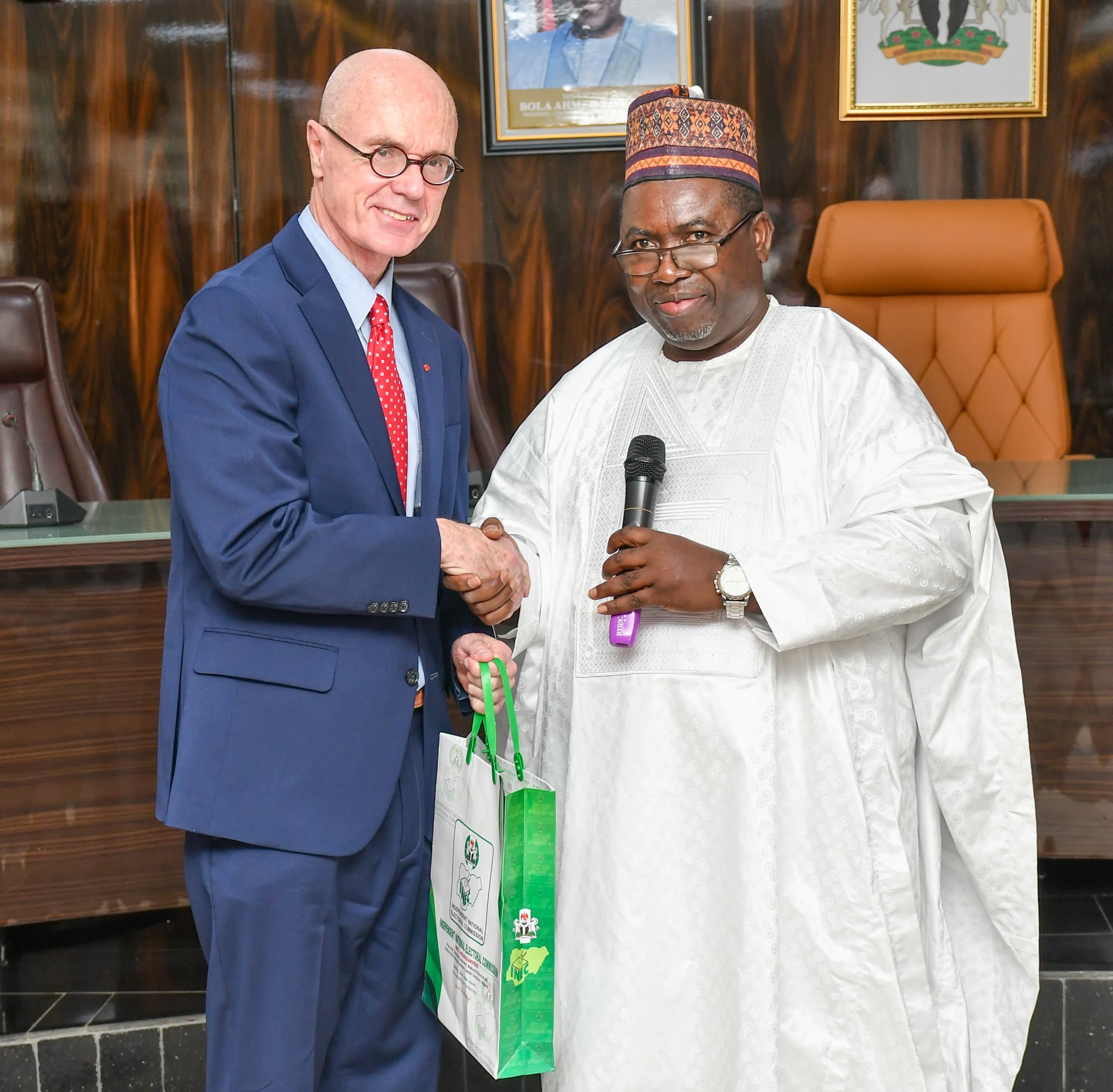
The commitment was made in Abuja when the KAS Country Representative in Nigeria, Moritz Sprenker, paid a courtesy visit to the INEC Chairman, Prof. Joash Ojo Amupitan, as part of efforts to strengthen the foundation’s engagement with Nigeria’s electoral institutions.
Prof. Amupitan said the increasing complexity of contemporary elections made strategic partnerships with development organisations, civil society groups, academic institutions, political actors and other stakeholders essential to strengthening Nigeria’s electoral process.
He reaffirmed the Commission’s commitment to delivering elections that are free, fair, credible, transparent and inclusive, with electoral outcomes reflecting the choices of Nigerian voters.
“INEC remains committed to ensuring that the votes of Nigerians count and that election outcomes reflect the genuine choices of the electorate,” Amupitan said.
The INEC Chairman said preparations for the 2027 elections were already progressing across several areas, including the testing and adaptation of administrative and technical procedures, deployment and testing of biometric technologies, security and election-governance workshops, engagements with political parties and other stakeholders, and capacity-building for election officials.
He identified Continuous Voter Registration (CVR) as a key area requiring sustained attention, stressing the need to provide eligible Nigerians with adequate opportunities to register and participate in the electoral process.
“Continuous Voter Registration is critical to ensuring that eligible Nigerians are captured in the voters’ register and are able to exercise their constitutional right to vote,” he said.
Amupitan urged KAS to strengthen its support for civic and voter education, particularly programmes targeted at youths, women and grassroots communities.
He said greater voter awareness and participation would be essential to building public confidence in the electoral process and ensuring that citizens understand their rights and responsibilities before, during and after elections.
The INEC Chairman also identified the National Peace Accord and the commencement of political campaigns as critical stages in the electoral calendar, calling for sustained engagement among political parties, candidates and other stakeholders to promote peaceful political competition and prevent avoidable tensions.
He further proposed expanded cooperation in electoral technology, institutional capacity-building, electoral governance, as well as research and technical development through the Electoral Institute of Nigeria.
Earlier, Sprenker said the visit marked the beginning of a renewed phase in KAS’s engagement with Nigeria’s electoral institutions.
He noted that the foundation had operated in Nigeria for more than 25 years and had developed partnerships with government institutions, INEC, universities, think tanks, political leaders, youth organisations, civil society groups, the media and inter-religious organisations.
According to him, KAS operates in more than 100 countries and its programmes are anchored on the principles of freedom, justice and solidarity, with a focus on good governance, the rule of law, human rights and the social market economy.
“Democratic development depends on strong institutions, informed citizens and constructive engagement. KAS is committed to supporting initiatives that strengthen Nigeria’s democratic institutions,” Sprenker said.
He recalled that KAS and INEC had maintained a longstanding relationship, with a three-day capacity-building workshop held in Lagos in March on public procurement representing their most recent major engagement.
Sprenker said the foundation was interested in expanding its cooperation beyond existing areas to include stronger engagement with INEC, the National Assembly and other democratic institutions.
He reaffirmed KAS’s commitment to supporting initiatives that promote sustainable democratic development and strengthen the capacity of Nigeria’s institutions.
The Abuja meeting is expected to provide a platform for both organisations to expand electoral support beyond the technical conduct of elections to broader issues of voter confidence, citizen participation, technological innovation, institutional resilience and peaceful political engagement.