


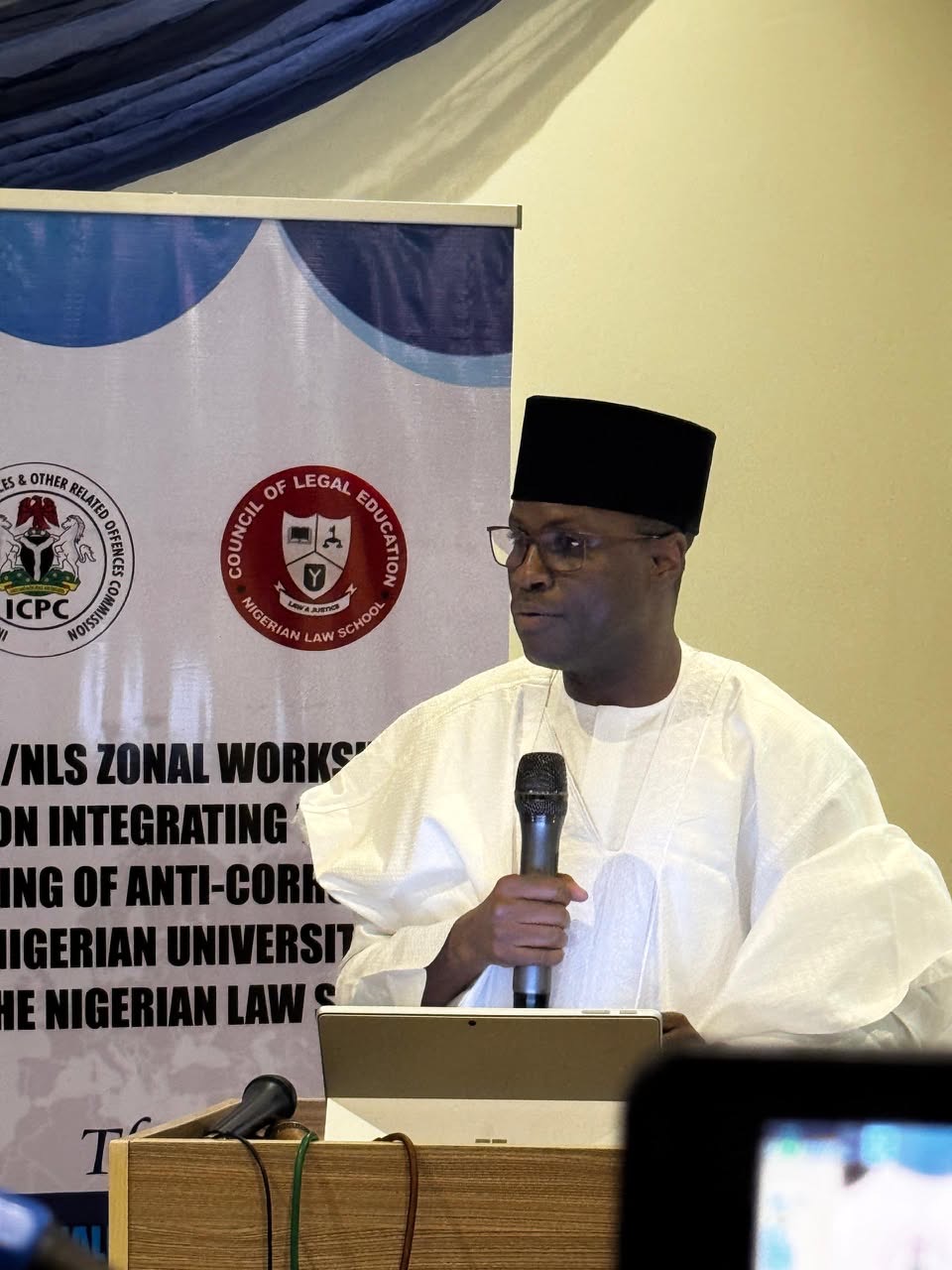
The Chairman of the Independent Corrupt Practices and Other Related Offences Commission (ICPC), Dr. Musa Adamu Aliyu, SAN, has stressed that Nigeria’s anti-corruption campaign must begin in the classroom rather than the courtroom, arguing that sustainable integrity can only be achieved by instilling ethical values before corruption takes root.
According to an official signed statement by the Head, Media and Public Communications of the ICPC, Mr. J. Okor Odey, Dr. Aliyu made the remarks while speaking at the ICPC and Nigerian Law School Kano Zonal Workshop on Integrating Anti-Corruption Education into Nigerian Universities and the Nigerian Law School.
The ICPC Chairman said corruption continues to impose enormous costs on ordinary Nigerians, noting that its effects extend beyond financial losses to weakening institutions, undermining justice, slowing national development and eroding public confidence in governance.
“The public pays for corruption,” he stated.
Dr. Aliyu maintained that while investigation and prosecution remain vital components of the Commission’s mandate, preventing corruption through education is equally important.
“There is no more fertile ground for prevention than the classroom,” he said.
He explained that legal education plays a defining role in shaping the ethical values and professional judgment of lawyers, whose conduct has far-reaching implications for governance, accountability and the administration of justice.
According to him, when members of the legal profession compromise ethical standards, the justice system itself is weakened, making it imperative for universities and the Nigerian Law School to embed integrity and accountability into legal education.
The ICPC Chairman disclosed that the Kano workshop forms part of the Commission’s broader initiative to institutionalise anti-corruption education within legal training. He noted that the engagement follows an earlier workshop with Deans of Faculties of Law and the Nigerian Law School in Abuja, while a similar programme is scheduled to hold in Lagos for stakeholders from the South-West.
Dr. Aliyu clarified that the Commission is not seeking to impose a rigid curriculum but is collaborating with legal educators to develop a framework that reflects academic realities while strengthening ethical standards across the legal profession.
“The Commission will support and facilitate this process,” he assured participants, adding that the initiative has the potential to extend beyond legal education into other professions and eventually across the public sector.
He observed that the true success of the initiative would be measured not by the deliberations held during the workshop but by the ethical decisions future lawyers make when confronted with opportunities to compromise justice.
Illustrating the long-term impact of legal education, Dr. Aliyu urged participants to imagine a young lawyer facing the temptation to act unethically years after graduation, noting that such decisions would ultimately be influenced by the values instilled during legal training.
He also expressed concern over increasing public scrutiny of the legal profession and stressed the need to produce lawyers who are recognised not only for their legal competence but also for their unwavering commitment to truth, justice and accountability.
The ICPC Chairman challenged participants to reflect on whether legal education should produce professionals who strengthen national development or individuals who use their knowledge to frustrate justice.
He commended participants and resource persons for contributing to what he described as an important national conversation and paid special tribute to Professor Isa Hayatu Chiroma, SAN, for his contributions to the anti-corruption curriculum initiative.
Dr. Aliyu reaffirmed the Commission’s commitment to supporting reforms in Nigeria’s legal education system and called on parents, teachers and members of the legal profession to lead by example in promoting integrity and ethical conduct.
“I hope that one day we will all look back with pride and know that we made a difference in the history of this country,” he said.
The ICPC maintained that the curriculum initiative goes beyond academic reform, describing it as a strategic investment in raising a new generation of lawyers whose commitment to integrity will strengthen the administration of justice and Nigeria’s long-term fight against corruption.