

By Nkechi Eze
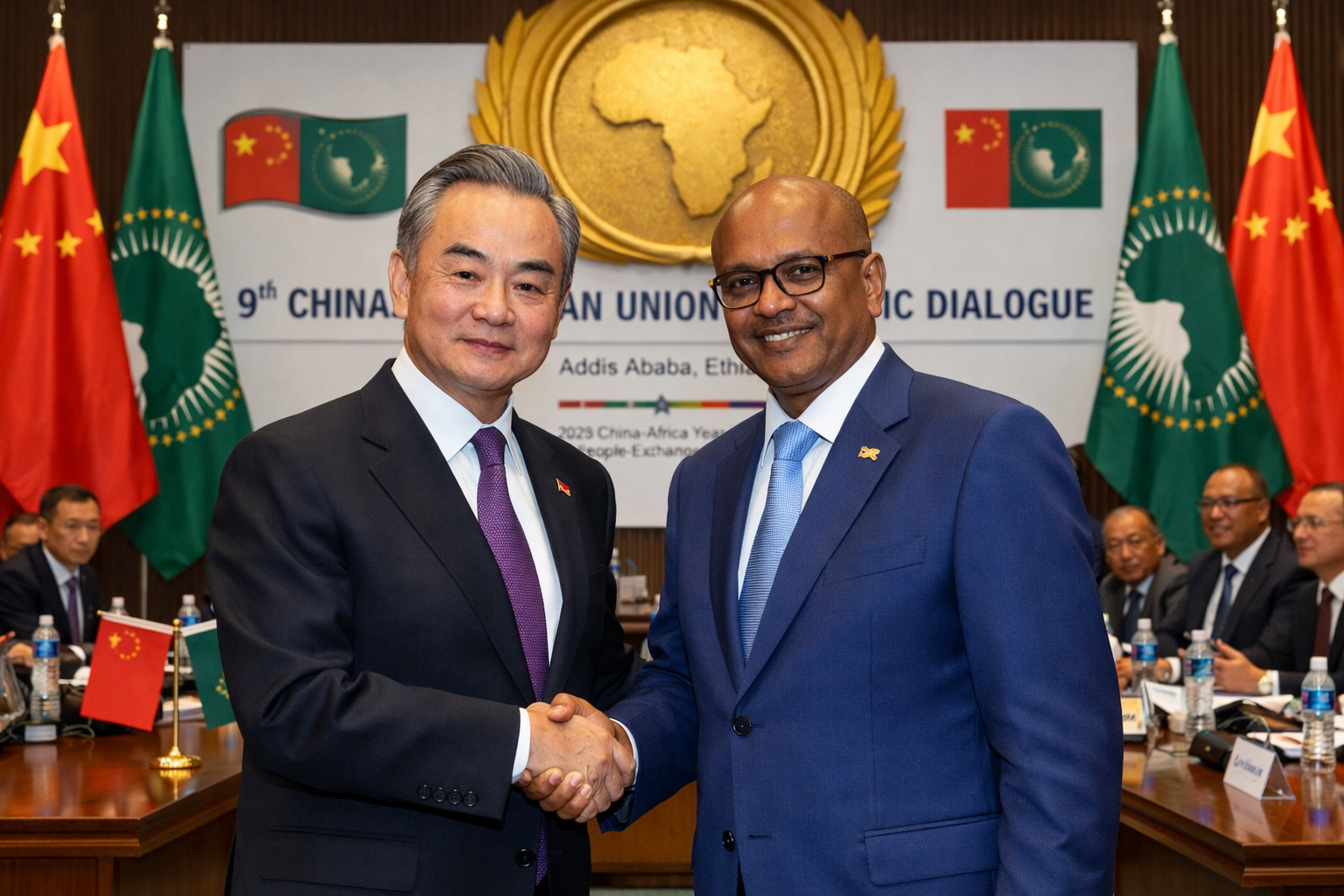
China and the African Union have reaffirmed their shared commitment to strengthening South–South cooperation, advancing modernization, and safeguarding the collective interests of the Global South, as Chinese Foreign Minister Wang Yi and African Union Commission Chairperson Mahmoud Ali Youssouf jointly convened the ninth China–AU Strategic Dialogue in Addis Ababa, Ethiopia.
The high-level engagement, held on Thursday at the African Union headquarters, brought together both sides for extensive consultations on global and regional issues, as well as the future direction of China–Africa relations. On the same occasion, Wang Yi and Youssouf also attended the official launching ceremony of the 2026 China–Africa Year of People-to-People Exchanges, an initiative aimed at deepening mutual understanding and strengthening bonds between the peoples of China and Africa.
During the dialogue, Wang, who is also a member of the Political Bureau of the Communist Party of China Central Committee, and Youssouf exchanged views on a wide range of issues, including China–Africa joint efforts in advancing modernization, global governance reform, zero-tariff treatment, the proposed International Organization for Mediation, and the Outlook on Peace and Development in the Horn of Africa. Both sides noted that China and the African Union, as important members of the Global South, share a broad consensus on major international and regional issues.
They underscored the importance of jointly safeguarding the legitimate rights and interests of the Global South and reaffirmed their commitment to supporting each other in protecting their respective core interests and major concerns. In this context, both sides emphasized the need to further strengthen coordination and cooperation in order to inject positive momentum into global and regional peace, stability, and development.
The African Union side reiterated its firm adherence to the one-China principle, stressing that there is but one China in the world, that Taiwan is an inalienable part of China’s territory, and that the government of the People’s Republic of China is the sole legal government representing the whole of China. The AU also expressed firm support for all efforts by the Chinese government to achieve national reunification.
Both sides further reaffirmed the imperative of upholding a global order based on international law, particularly respect for sovereignty and territorial integrity, as well as the peaceful settlement of disputes. They also voiced concern over recent developments in Venezuela, stressing that the sovereignty and territorial integrity of all countries must be respected and that the fundamental principles of the United Nations Charter and international law must be upheld.
On practical cooperation, Wang and Youssouf reviewed collaboration across various sectors and highlighted the importance of enhanced alignment between China’s 15th Five-Year Plan and the implementation plan of the African Union’s Agenda 2063. They agreed to deepen communication, coordination, and mutual support in their respective major initiatives, including China’s Global Security Initiative, Global Governance Initiative, and the International Organization for Mediation, alongside Africa’s Agenda 2063 and its flagship programmes such as Silencing the Guns by 2030 and the African Continental Free Trade Area.
Both sides reaffirmed their commitment to promoting the effective implementation of all signed cooperation agreements and memoranda of understanding, while agreeing to explore the full potential for practical cooperation between China and the African Union. The ultimate goal, they stressed, is to deliver tangible and lasting benefits to the peoples of China and Africa and to further consolidate the China–Africa partnership in an evolving global landscape.