

By Nkechi Eze
China’s major-country diplomacy with Chinese characteristics is poised to reach new heights in 2026, as the country prepares to enter a new phase in its global engagement under the 15th Five-Year Plan, Chinese Foreign Minister Wang Yi has said.
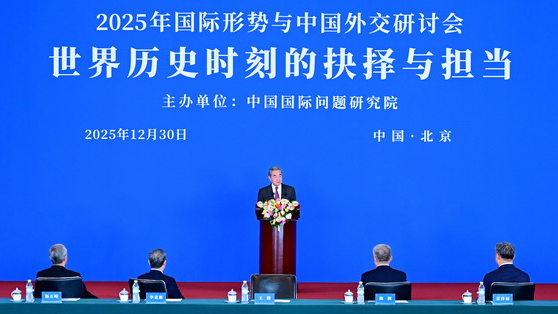
Wang made the remarks on Tuesday in Beijing at the Symposium on the International Situation and China’s Foreign Relations, where he outlined Beijing’s diplomatic vision for the coming year and beyond, anchored on safeguarding national interests while contributing more actively to global development and progress.
According to Wang, the commencement of the 15th Five-Year Plan next year will mark a critical turning point for China’s foreign relations, with diplomacy playing a central role in creating a favorable external environment for the country’s modernization drive and national rejuvenation. He said China’s diplomacy in 2026 would focus on strengthening strategic support for domestic development, enhancing head-of-state diplomacy, contributing to high-quality economic growth and mitigating internal and external risks amid intensifying global competition.
Wang stressed that China would seek to align its development more closely with that of other countries by sharing the experience of Chinese modernization with the wider world, with the ultimate goal of advancing the great rejuvenation of the Chinese nation while contributing to humanity’s collective progress.
On major-country relations, the foreign minister reaffirmed China’s unwavering commitment to peaceful development and its desire to promote a framework of major-country relations characterized by peaceful coexistence, overall stability and balanced development. He said China would work toward the sound, steady and sustainable development of China–United States relations on the basis of mutual respect, peaceful coexistence and mutually beneficial cooperation, while firmly safeguarding China’s sovereignty, security and development interests.
Regarding relations with Russia, Wang said China would continue to pursue lasting good-neighborliness, comprehensive strategic coordination and mutually beneficial cooperation, while jointly upholding international strategic stability. He added that China would also deepen engagement with Europe, cherishing the tradition of mutual respect, seeking common ground while shelving differences, and expanding cooperation to open new space for China–Europe relations, with a shared commitment to multilateralism.
Turning to regional diplomacy, Wang said China would work more actively to build a community with a shared future among neighboring countries, guided by the principles of amity, sincerity, mutual benefit and inclusiveness. He said Beijing would advocate common security, properly manage differences and prevent conflicts, while actively mediating regional hot-button issues to restore stability and build strategic trust.
He noted that China would also focus on building a prosperous regional environment by deepening cooperation under the Regional Comprehensive Economic Partnership framework, accelerating the implementation of the China–ASEAN Free Trade Area 3.0, and strengthening collaboration in ecological protection, sustainable development, cultural exchanges and people-to-people connectivity.
Wang emphasized China’s commitment to the Global South, describing it as a cornerstone of Beijing’s foreign policy. As the world’s largest developing country, he said China would continue to safeguard the collective interests of developing nations and promote solidarity and cooperation. He highlighted BRICS as a vital platform for advancing the voice and representation of the Global South in a multipolar world, adding that China would support a bigger and stronger BRICS mechanism.
He also disclosed that 2026 would mark the 70th anniversary of China’s diplomatic relations with African countries, during which Beijing would advance cooperation initiatives supporting Africa’s modernization and push for zero-tariff policies. In the Middle East, China plans to host the second China–Arab States Summit and accelerate negotiations on a China–Gulf Cooperation Council Free Trade Agreement, while continuing to support Latin America and the Caribbean in pursuing independent development paths.
On global economic cooperation, Wang said China would inject stronger momentum into global openness by adhering to high-standard opening-up, sharing the benefits of its vast market and opposing decoupling and protectionism. He said Beijing would advance high-quality Belt and Road cooperation, balancing major infrastructure projects with smaller livelihood-focused initiatives.
China, he added, remains committed to a World Trade Organization–centered multilateral trading system and will oppose protectionism and what he described as “tariff hegemony.” As host of APEC 2026, China plans to work closely with member economies to promote the building of an Asia-Pacific community and explore pathways toward a Free Trade Area of the Asia-Pacific.
Wang also said China would play a more active role in reforming and improving global governance, working with like-minded countries to practice true multilateralism, strengthen the authority and central role of the United Nations, and ensure that development issues and the interests of the Global South receive greater prominence in international governance.
Concluding, the foreign minister said China would safeguard its national sovereignty, security and development interests with a stronger sense of mission and responsibility, while remaining committed to people-centered diplomacy. He said the Ministry of Foreign Affairs would strengthen risk early-warning mechanisms and law enforcement cooperation to better protect Chinese citizens and businesses overseas, assuring that China’s diplomatic efforts would continue to combine national resolve with a commitment to global peace, stability and shared development.