


By Nkechi Eze
The Independent National Electoral Commission (INEC) has operationalised an intelligence-driven security framework to identify and address potential threats across Nigeria’s 176,846 polling units ahead of the 2027 general elections.
The framework, known as the Inter-Agency Consultative Committee on Election Security (ICCES) Tentacle, is designed to strengthen security coordination, protect election personnel and ensure voters can exercise their franchise without intimidation.
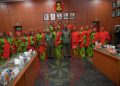
INEC Chairman, Prof. Joash Amupitan, disclosed this on Friday in Abuja when he received a pre-election fact-finding mission from the Economic Community of West African States (ECOWAS) at the commission’s national headquarters.
Amupitan said the commission was working with the Nigeria Police Force, Department of State Services, Nigeria Security and Civil Defence Corps and the Armed Forces to strengthen security arrangements for the elections.
He explained that the intelligence-driven framework would enable relevant security agencies to identify and respond to potential threats across polling units, thereby improving the safety of voters, electoral officials and election materials.
The INEC chairman particularly emphasised the protection of members of the National Youth Service Corps serving as ad-hoc election staff, as well as persons with disabilities and other vulnerable voters.
He said the commission was also strengthening its operational and technological capacity to deliver credible, transparent and peaceful elections across the country.
Amupitan disclosed that Nigeria’s registered voter population had exceeded 103 million, with the 2027 elections expected to cover 36 states and the Federal Capital Territory, 774 local government areas, 8,809 registration areas and 176,846 polling units.
He announced that the presidential and National Assembly elections would hold on January 16, 2027, while governorship and state Houses of Assembly elections were scheduled for February 6, 2027.
On preparations, he said INEC had completed nine of the 14 major statutory activities on its electoral timetable, including three phases of the Continuous Voter Registration exercise and the physical display of the Preliminary Register of Voters nationwide.
He added that the preliminary register had been uploaded to the commission’s online portal to allow Nigerians to scrutinise their details and submit claims and objections ahead of the certification of the final register on December 15, 2026.
The chairman also said the commission had adopted a field-based readiness assessment approach across the six geopolitical zones, with exercises completed in the South-West, North-West, South-East and North-East. The South-South assessment, he said, would take place in Port Harcourt, Rivers State.
On technological safeguards, Amupitan said the Bimodal Voter Accreditation System (BVAS) would be deployed for fingerprint and facial biometric accreditation, while the electronic result management systems, including the eEC8A electronic verification platform, would support transparency in result management through the INEC Result Viewing Portal (IReV).
He further disclosed that INEC had secured approval for the Consolidated Election Management Body Salary Structure (CEMBSS), while state operational overheads had increased by 150 per cent to strengthen the commission’s capacity.
However, he warned that improved staff welfare would be accompanied by strict disciplinary measures against administrative negligence, extortion and partisan conduct. He said mandatory oaths of neutrality had also been introduced for INEC personnel in accordance with Section 26 of the Electoral Act 2026.
Amupitan called for sustained collaboration with ECOWAS in election observation, technical exchanges and efforts to tackle electoral disinformation, identifying digital misinformation, logistics in difficult terrains and inclusive voter education as areas where the regional body could provide support.
Reaffirming the commission’s impartiality, he said INEC had no preferred candidate or political party ahead of the elections.
“Our sole allegiance is to the rule of law, the sovereign will of the Nigerian electorate, and the democratic progress of our nation,” he said.
Earlier, the Head of the ECOWAS Pre-Election Fact-Finding Mission and former Vice-President of Sierra Leone, Victor Bockarie Foh, said the delegation was in Nigeria to assess INEC’s preparedness and that of other stakeholders ahead of the 2027 elections.
Foh said the mission was part of ECOWAS’ conflict prevention framework and would engage political party leaders, government officials, electoral authorities, civil society organisations and other stakeholders.
He explained that the findings would help the regional organisation identify areas where it could support INEC and other stakeholders to promote peaceful and credible elections.