

By Nkechi Eze
With 100 days to the 2027 General Election, the Independent National Electoral Commission (INEC) says preparations have entered a critical implementation stage, with 103.4 million voters now on the national register and major operational, technological and logistical arrangements underway.
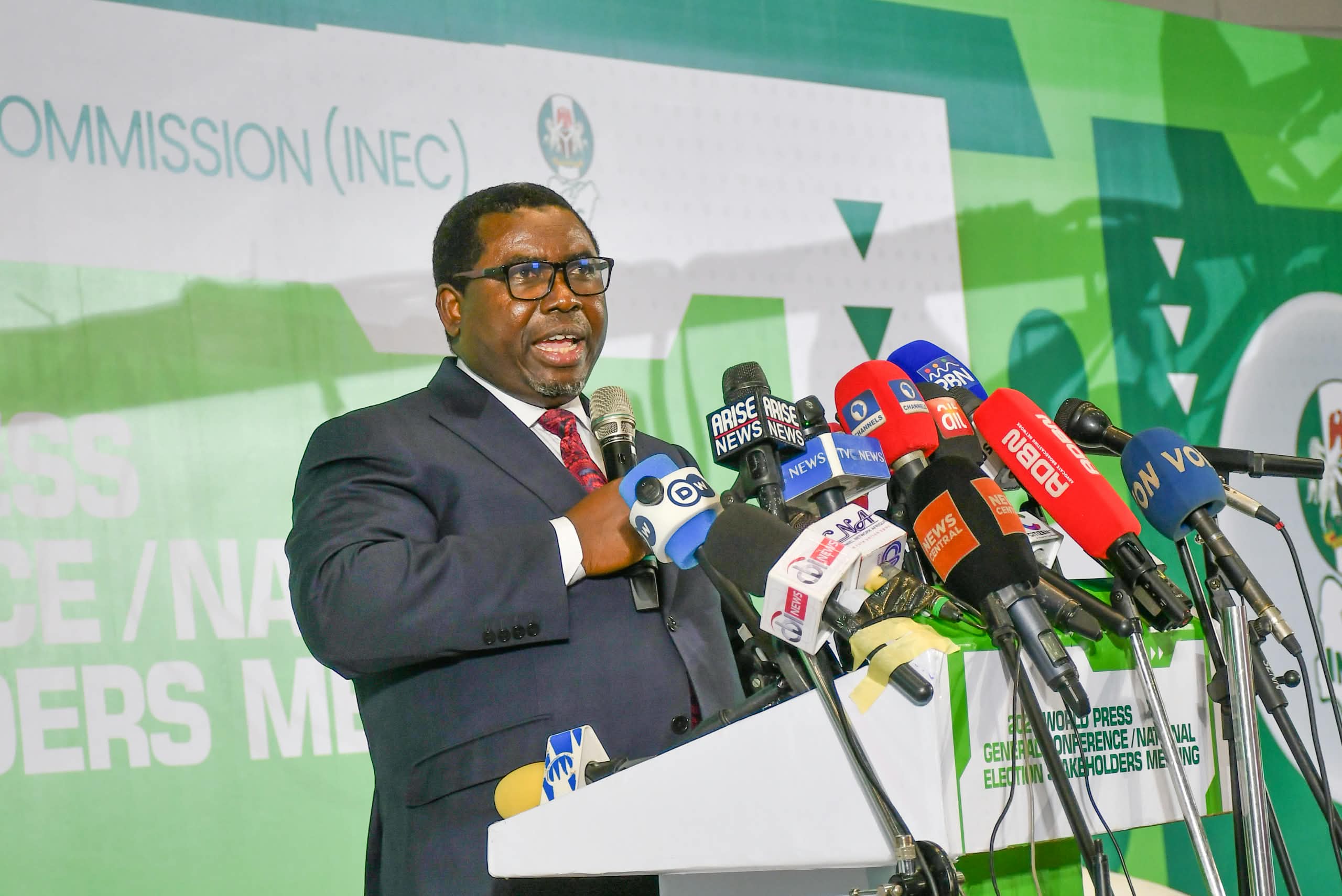
INEC Chairman, Professor Joash Amupitan, disclosed this on Tuesday in Abuja at a World Press Conference and National Stakeholders’ Meeting organised to mark the 100-day countdown to the January 16, 2027 Presidential and National Assembly elections.
Amupitan said nine of the 14 major statutory milestones in the commission’s revised timetable had been completed, with the remaining activities focused on translating months of planning into effective election-day delivery across 176,846 polling units, 8,838 Registration Areas and 774 Local Government Areas.
The chairman said the final register followed three phases of Continuous Voter Registration, which generated 10,772,421 new registrations.
The first phase produced 2.61 million registrations, while the second and third phases recorded 4.12 million and 3.87 million respectively.
Lagos leads the voter register with 7,488,633 registered voters, followed by Kano with 6,570,276 and Kaduna with 4,662,640. Ekiti has the lowest figure at 1,055,708, while Bayelsa has 1,200,691.
Women account for 48.25 per cent of registered voters, compared with 51.75 per cent for men, while the register includes 232,658 Persons With Disabilities across 10 categories.
INEC said the next major phase of the electoral timetable would commence on October 9 with the nationwide display of the Register of Voters for public scrutiny.
The exercise will run until October 15, allowing voters to verify their details and submit claims or objections. Distribution of Phase One Permanent Voter Cards to Local Government Centres is also scheduled to begin on October 9.
The commission said it had introduced online registration and printable PVC technology to make voter registration and collection more convenient, while the final register is expected to be presented to political parties on December 15.
On election technology, INEC disclosed that it had acquired 57,000 additional Bimodal Voter Accreditation System (BVAS) devices, with existing units also subjected to software upgrades, battery optimisation and biometric calibration.
The commission plans to conduct a six-day stress test of configured BVAS devices from October 23 to 28, followed by a nationwide mock accreditation and election simulation in November.
According to INEC, results from polling units will continue to be electronically transmitted to the IReV portal after the required verification processes.
The commission is also preparing for emerging threats associated with artificial intelligence, including deepfakes, voice cloning and other forms of digitally manipulated content.
Amupitan said INEC had established an Artificial Intelligence Division to help detect anomalies, strengthen database security and protect the commission’s digital platforms against cyber intrusions and unauthorised alterations.
He warned that AI-generated content could be deployed to impersonate election officials, fabricate result sheets and spread false information rapidly, urging the media and other stakeholders to verify election-related information before publication.
The chairman further cautioned against the announcement of unofficial election results, stressing that the legal authority to declare results rests with INEC.
Beyond technology, the commission is preparing a large temporary workforce for the elections, with 707,384 ad hoc personnel required for each election day, amounting to 1,414,768 engagements across the two phases of the 2027 elections.
Recruitment, which began on September 18, will close on November 18, with serving and former members of the National Youth Service Corps, students of tertiary institutions, qualified public servants and ICT professionals among those eligible.
INEC said additional measures were being introduced to improve the welfare, insurance and security of ad hoc personnel.
The commission is also working with transport unions to deploy more than 100,000 vehicles and 4,000 boats for the movement of election personnel and materials, particularly to riverine, mountainous and other hard-to-reach communities.
It said non-sensitive materials would be pre-positioned at Local Government Area hubs, while sensitive materials would be moved from Central Bank of Nigeria vaults to the LGAs 72 hours before election day.
On security, INEC said it was working with security agencies through the Inter-Agency Consultative Committee on Election Security to develop intelligence-led deployment plans aimed at protecting voters, officials and electoral materials.
The commission is also collaborating with the Ministry of Justice, EFCC, ICPC and NFIU to monitor campaign financing and address vote-buying and other forms of illicit electoral spending.
In its inclusion efforts, INEC said it was procuring Braille ballot guides, voter education materials, posters designed for deaf voters and magnifying glasses for visually impaired voters and persons with albinism. Sign language interpreters will also be deployed at state collation centres.
The commission further plans to hold town hall meetings for rural women across the 774 LGAs, alongside youth peace advocacy and voter mobilisation campaigns in local languages.
Amupitan said readiness assessments had been completed in the South-West and North-West, with other geopolitical zones scheduled for similar assessments.
He said the Election Monitoring and Support Centre would monitor preparations across the 36 states, the Federal Capital Territory and the 774 LGAs, while the Situation Room Data Support Centre would become operational six days before the election and remain active through the post-election period.
With the countdown now at 100 days, Amupitan said the commission had moved into the final phase of operational delivery.
“Our materials are in production, technology is undergoing rigorous quality assurance, our register is finalised for public display, and our workforce is being systematically trained,” he said.