

By Nkechi Eze
Stakeholders in Nigeria’s defence and security sector have called for safer, confidential and accessible reporting channels for victims of sexual and gender-based violence (SGBV), warning that weak complaint mechanisms, fear of retaliation and lack of confidence in existing systems continue to undermine efforts to prevent abuse and ensure accountability.
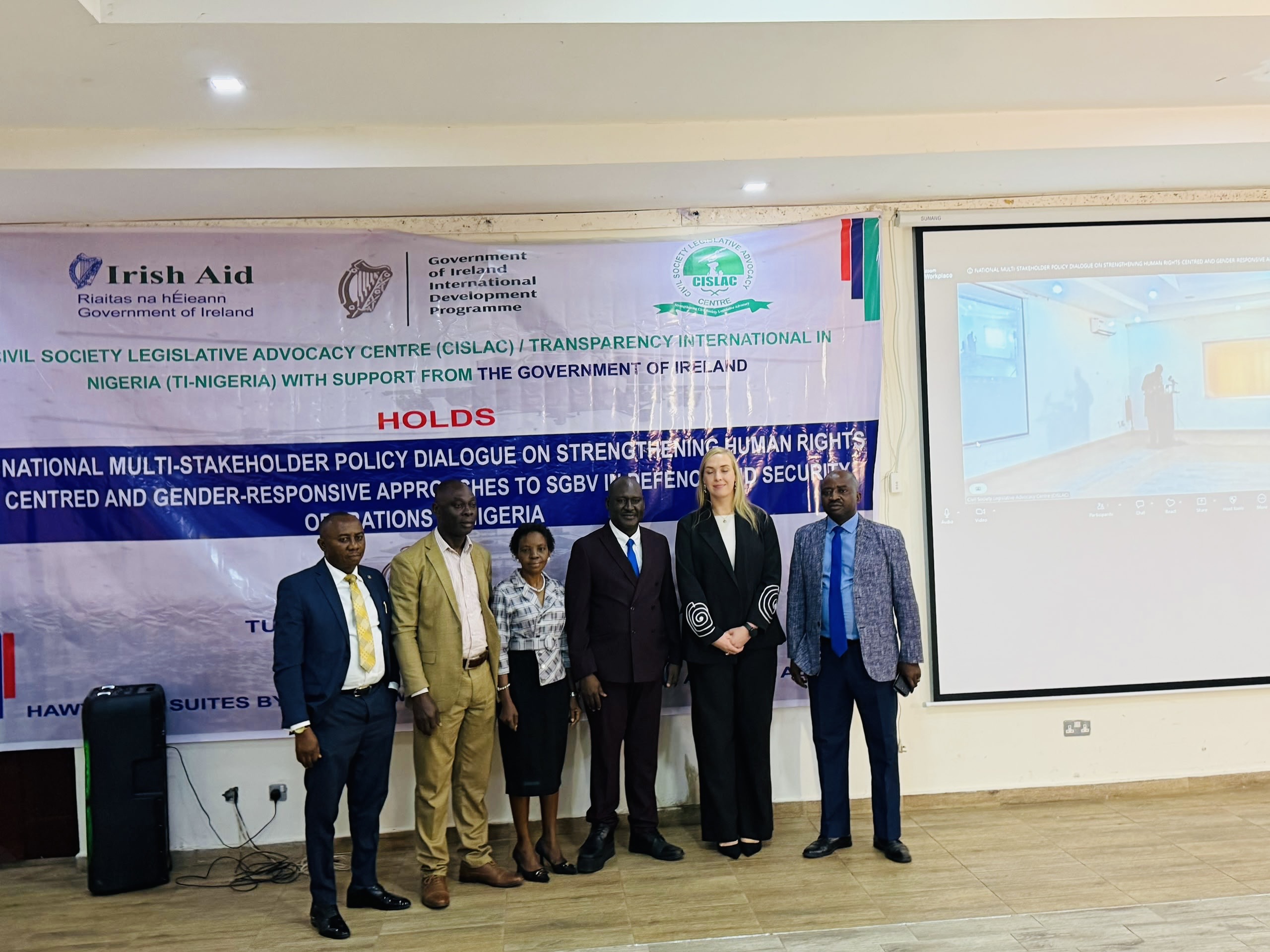
The call was made on Tuesday in Abuja at a National Multi-Stakeholder Policy Dialogue on “Strengthening Human Rights-Centred and Gender-Responsive Approaches to SGBV in Defence and Security Operations in Nigeria,” hosted by the Civil Society Legislative Advocacy Centre (CISLAC)/Transparency International Nigeria (TI-Nigeria), with support from the Government of Ireland.
The dialogue brought together representatives of defence and security agencies, government institutions, oversight bodies, civil society organisations, development partners, the diplomatic community, gender and human rights practitioners and the media to examine challenges surrounding the prevention, reporting and response to SGBV in Nigeria’s defence and security sector.
In his welcome address, Executive Director of CISLAC/TI-Nigeria, Comrade Auwal Ibrahim Musa (Rafsanjani), said safe, accessible, confidential and trusted reporting mechanisms were critical to tackling SGBV and strengthening accountability within security institutions.
Musa said victims and survivors often faced fear of retaliation, stigma, institutional barriers, concerns over confidentiality, power imbalances and lack of confidence in complaint mechanisms, factors which could discourage them from reporting incidents.
He stressed that institutional policies alone were not sufficient, urging security institutions to establish clear pathways through which complaints could move from reporting to investigation, referral, disciplinary action and, where appropriate, prosecution.
According to him, survivors and affected communities must remain at the centre of efforts to strengthen prevention, reporting, protection and accountability.
Speaking on behalf of the Ambassador of Ireland, Samuel Ameh said Ireland was pleased to support a dialogue that brought together stakeholders committed to finding practical solutions to challenges affecting communities.
Ameh stressed the importance of creating opportunities, particularly for young people, through education, skills development and meaningful engagement, noting that the right environment and adequate space were necessary for young people to learn, grow and contribute positively to society.
He reaffirmed Ireland’s commitment to supporting initiatives that promote education, inclusion and sustainable development, saying collaboration and greater attention to these areas could help create lasting opportunities and stronger communities.
Ameh commended the organisers for bringing stakeholders together and expressed optimism that the engagement would produce fruitful and impactful outcomes.
In a related intervention, Programme Manager, Defence, Security and Global Health at Transparency International Defence and Security (TI-DS UK), Yi Kang Choo, warned that the effectiveness of reporting systems should not be measured merely by their existence, but by whether people felt safe and confident enough to use them.
Choo posed a fundamental question to participants: “Who do you call when the person you fear is wearing a uniform?”
He said that for many people in conflict-affected communities, the availability of a trusted person or mechanism to report abuse could determine whether they felt safe to speak out or were compelled to remain silent.
Choo said the challenge was particularly important at a time when gender equality and human rights were facing growing pressures, while civic space was shrinking and resistance to women’s rights was increasing.
He said United Nations data showed that more than 9,000 cases of conflict-related sexual violence were verified in 2025, representing a significant increase from the previous year, while warning that the actual figure was likely much higher because many incidents went unreported.
According to him, women and girls were disproportionately affected, but men and boys, particularly those in detention, as well as people of diverse sexual orientations and gender identities, could also be targeted and face barriers to justice.
Choo said the situation raised a fundamental question for the defence and security sector on how institutions entrusted with protecting citizens could themselves remain accountable and worthy of public trust.
He said preventing sexual violence required systems where people could report safely, complaints were taken seriously and investigations were credible.
He further said research by Transparency International Defence and Security had established a close relationship between corruption and sexual violence.
According to him, the organisation’s report, “Closing the Blind Spot,” found that corruption remained a significant gap in the Women, Peace and Security agenda and could enable abuse directly, including through sexual forms of corruption, or indirectly through bribery, intimidation and abuse of power that prevented survivors from reporting violence or accessing justice.
“Where corruption becomes embedded, impunity can follow,” he said.
Choo also cited Nigeria’s performance in the 2025 Government Defence Integrity Index, which assessed 17 countries in Sub-Saharan Africa, saying all the countries faced high to critical risks of corruption in the defence sector.
He said Nigeria’s overall score of 28 remained within the very high corruption-risk band, although it represented an improvement from the country’s score of 22 in 2020.
He noted that Nigeria performed better in some formal safeguards, with its compliance and ethics units scoring 83 and disciplinary measures for personnel scoring 88 out of 100.
However, he said there remained a significant gap in the ability of people to speak up, noting that Nigeria scored only 17 on whistleblowing across its defence and security sector.
Choo said the figures suggested that while systems might exist on paper, people did not yet feel sufficiently safe or confident to use them.
He stressed that having rules and institutions was only the first step, adding that such mechanisms must work effectively for the people who depend on them.
“When people are too afraid to report, an institution does not avoid the problem. It simply loses the information it needs to address it,” he said.
According to him, complaints from communities could provide critical information on where discipline was failing and where public trust was being lost, just as intelligence helps security institutions identify operational risks before they become crises.
Choo, however, noted that change was possible, citing the 2026 report of the UN Secretary-General which recorded a decline over five years in sexual violence cases attributed to the Congolese National Police following sustained engagement with the United Nations on accountability and the implementation of dedicated reform roadmaps for the police and army.
He said the experience demonstrated that sustained accountability could produce measurable improvements.
Choo also called for gender considerations to be integrated into the entire security system, including the recruitment, vetting, promotion, training and deployment of personnel, stressing that prevention must begin long before a complaint was made.
He urged institutions to strengthen reporting systems to make them safe, confidential and survivor-centred, while advocating complaint mechanisms that were sufficiently independent from the agencies they oversee.
He also proposed that institutions should publicly report annually on the number of complaints received, investigated and resolved, while protecting the identities and privacy of survivors.
On women’s participation in the security sector, Choo said representation remained important, noting that women constituted less than 11 per cent of the Nigeria Police Force.
He, however, stressed that simply increasing the number of women in uniform would not, by itself, end abuse.
According to him, institutions where women could serve and lead at every level would nevertheless be better positioned to recognise abuse, respond to survivors and challenge cultures in which misconduct could remain unaddressed.
Choo noted that Nigeria already had an important policy framework through its third National Action Plan on Women, Peace and Security, launched in December 2025, which called on security agencies, civil society, men and boys to champion the agenda.
He stressed that ending sexual violence was not merely a women’s issue, but a shared responsibility requiring meaningful participation by men, particularly those in positions of leadership and influence, as well as greater support for survivors and women-led and civil society organisations.
Choo also expressed confidence in CISLAC’s work in strengthening integrity in Nigeria’s defence and security sector, noting that TI-DS had worked with the organisation for more than four years, with support from the Ministry of Foreign Affairs of the Netherlands, across Nigeria’s six geopolitical zones.
He said CISLAC had trained civil society organisations and journalists in defence oversight and human rights complaints handling, with gender inclusion integrated into the work.
He noted that the Office of the National Security Adviser had invited CISLAC to contribute to the review of the National Security Strategy, while the organisation had also consistently advocated during House hearings on the Police Act amendment for women to constitute at least 30 per cent of police recruits, in line with African Union and ECOWAS benchmarks.
Choo added that an independent evaluation commissioned by TI-DS found CISLAC’s work and interventions to be efficient and effective.
He said meaningful change in the defence and security sector required trust between citizens and institutions, with institutions listening to communities and civil society providing evidence, expertise and constructive scrutiny.
Delivering a goodwill message on behalf of the Inspector-General of Police, IGP Olatunji Disu, the Head of the Police Complaint Response Unit (CRU), SP Fidelis Toddo, said the Nigeria Police Force recognised SGBV as both a criminal justice and fundamental human rights concern.
He said the operations of the Force were guided by the Constitution, relevant laws, human rights principles and professional policing standards, stressing that security operations must protect citizens, their rights and dignity, particularly women, children and vulnerable groups.
The IGP said the Police was committed to gender-responsive and survivor-centred approaches to the prevention, reporting, investigation and response to SGBV.
He said victims and survivors must be treated with dignity, confidentiality and sensitivity, while perpetrators should be subjected to appropriate investigation and lawful accountability.
Disu said the Police Complaint Response Unit remained an important accountability mechanism through which members of the public could report complaints and allegations of police misconduct.
He added that effective complaint management, investigation, follow-up and resolution were necessary to strengthen public confidence and accountability within the Force.
The IGP called for stronger collaboration among the Police, Armed Forces, other security agencies, government institutions, human rights bodies, civil society organisations, development partners, traditional institutions, communities and survivors.
He said such collaboration would help stakeholders identify gaps, share experiences and develop practical recommendations on policies, procedures, referral systems, capacity building and accountability.
The Police, he said, welcomed partnerships and technical support that could strengthen personnel capacity and sustain people-centred policing.
Also speaking, the representative of the ICPC Chairman, Peace Arocha, Deputy Director, Legal Services Department and Team Lead, Sexual Harassment and Abuse Response Team (SHART), said the protection of human dignity must remain central to efforts to tackle sexual harassment, abuse and gender-based violence.
Arocha identified underreporting as a major challenge, noting that many victims remained reluctant to speak out because of stigma, fear of retaliation and lack of confidence in existing systems.
She called for stronger preventive measures, effective reporting mechanisms, proper investigation and adequate support for survivors, reaffirming the ICPC’s commitment to collaboration with relevant stakeholders.
The participants stressed the need for defence and security institutions to adopt survivor-centred and gender-responsive approaches while ensuring that personnel and members of the public had safe avenues to report abuse without fear of further victimisation.
They also called for stronger institutional accountability, improved referral and support systems and sustained collaboration among security agencies, government institutions, civil society organisations and development partners to ensure that survivors received appropriate protection and access to justice.
The dialogue further underscored the importance of sustained political will and collaboration beyond individual project cycles, with stakeholders stressing that building public trust required security institutions to listen to complaints, act on them and demonstrate accountability.
They maintained that security and human rights should not be treated as competing objectives, but as mutually reinforcing elements of effective, professional and trusted security governance.
The stakeholders ultimately stressed that the success of Nigeria’s efforts to combat SGBV would depend not only on the existence of policies and complaint mechanisms, but on whether survivors and members of the public could trust those systems to listen, protect them from retaliation and deliver credible accountability.