By Nkechi Eze
The Initiative for Research, Innovation and Advocacy in Development (IRIAD) and The Electoral Hub have urged the Federal Government to move beyond policy announcements and translate ongoing reforms into tangible improvements in the lives of Nigerians.
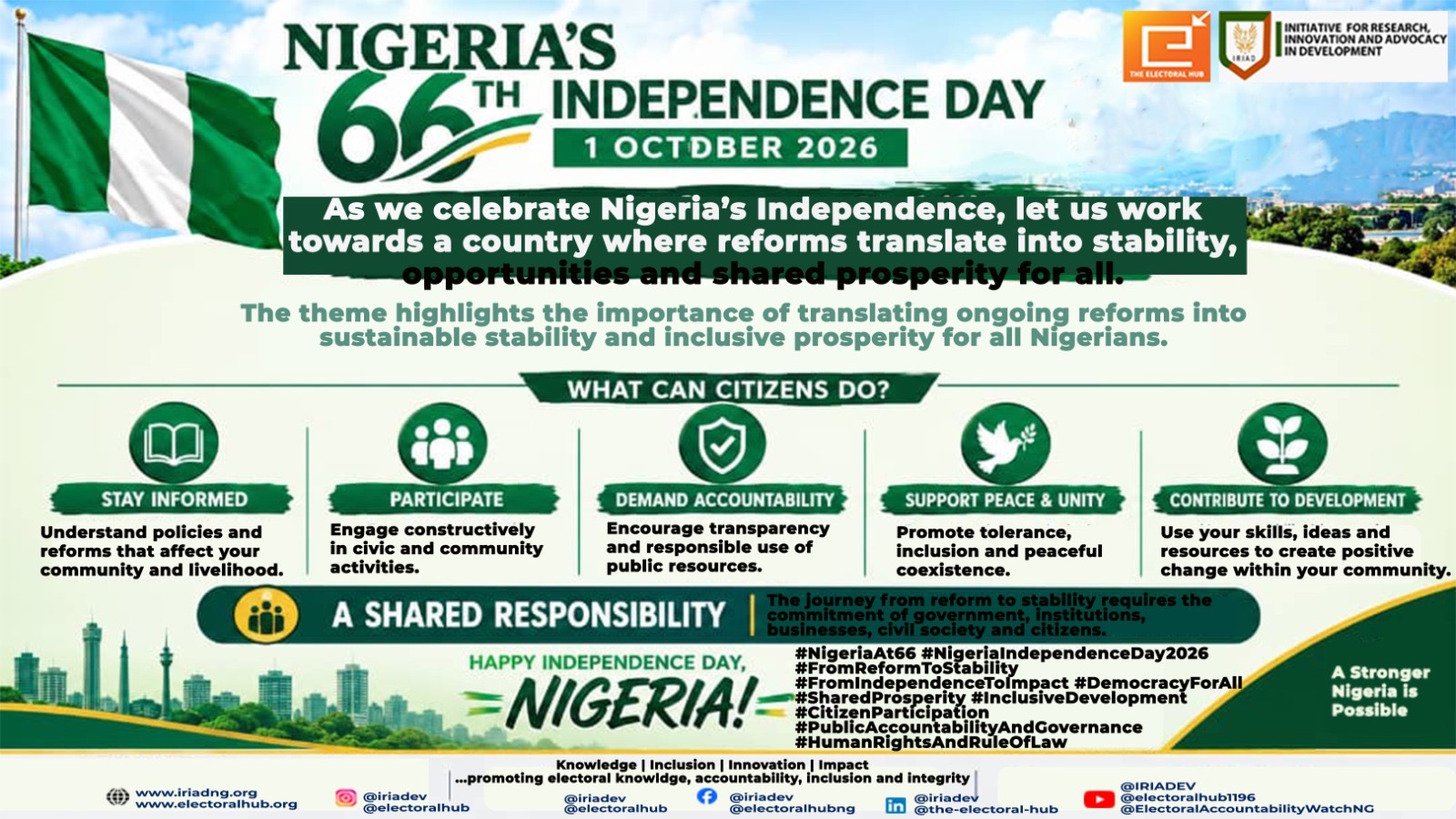
According to an official statement signed by Princess Abijah Hamman-Obels, Director, The Electoral Hub, the organisations made the call in their message to Nigerians to commemorate the country’s 66th Independence Anniversary.
They said the anniversary provided an opportunity to honour the leaders and ordinary citizens whose courage, sacrifice and determination contributed to Nigeria’s independence, as well as millions of Nigerians who continue to contribute to national development.
The organisations acknowledged the importance of the Federal Government’s 2026 Independence theme, “From Reforms to Stability: Consolidating Nigeria’s Renewed Hope for Shared Prosperity,” but stressed that economic reforms must translate into improved public services, stronger institutions, greater opportunities and better welfare for citizens.
They said reforms alone could not create stability unless supported by effective institutions, adherence to the rule of law, responsible management of public resources, access to opportunities, safe communities and public confidence in government.
IRIAD and The Electoral Hub said Nigerians expected a country where electricity, healthcare, education, roads, water and sanitation services were accessible and reliable, while businesses could grow and citizens could secure decent livelihoods.
They also called for a democratic and peaceful society where farmers could safely access their farms, children could attend school without fear and citizens could move freely, while security and justice institutions protect lives and property in accordance with human rights and the rule of law.
The organisations expressed concern over the gap between the adoption of government reforms and their implementation, citing Nigeria’s participation in the Open Government Partnership (OGP) as an example.
They noted that Nigeria joined the OGP in 2016 and had developed successive National Action Plans aimed at strengthening transparency, accountability, access to information, democratic inclusion and citizen participation.
According to them, although the fourth OGP National Action Plan was completed in February 2025, it was still awaiting Presidential assent as of September 30, 2026.
They said the situation highlighted the need for reforms to move beyond commitments and announcements to actual implementation, backed by clear institutional responsibilities, adequate funding, timelines, monitoring and public accountability.
The organisations therefore urged the Presidency and Federal Executive to prioritise the approval and operationalisation of reform initiatives, including OGP NAP IV, while ensuring that major reforms have measurable targets and mechanisms for public reporting.
They also called on the National Assembly to strengthen oversight by monitoring the implementation of laws, scrutinising public spending and addressing institutional or legislative barriers that prevent approved reforms from producing results.
IRIAD and The Electoral Hub urged Ministries, Departments and Agencies to make reform implementation measurable and citizen-focused, while calling on state and local governments to translate national reforms into practical improvements at the community level.
They further tasked security and justice institutions with strengthening safety, access to justice and respect for human rights, and urged economic institutions to ensure that reforms support productive employment, food security, infrastructure, business growth and improved household welfare.
The organisations called on civil society and the media to monitor government reforms from commitment to implementation, while urging development partners and the private sector to support institutional capacity, innovation, accountability and job creation.
They also encouraged citizens to remain informed and participate actively in governance by using available civic, legal and information-access mechanisms to monitor government commitments and hold public institutions accountable.
They said Nigeria’s 66th Independence Anniversary should renew the country’s collective commitment to building institutions that deliver tangible results.
“Independence gave us the freedom to determine our future. Reforms give us the tools to shape it. Implementation turns those tools into results,” the organisations said, urging a transition “from reforms to results, from commitments to implementation, and from renewed hope to shared prosperity” that Nigerians can see, feel and experience.