


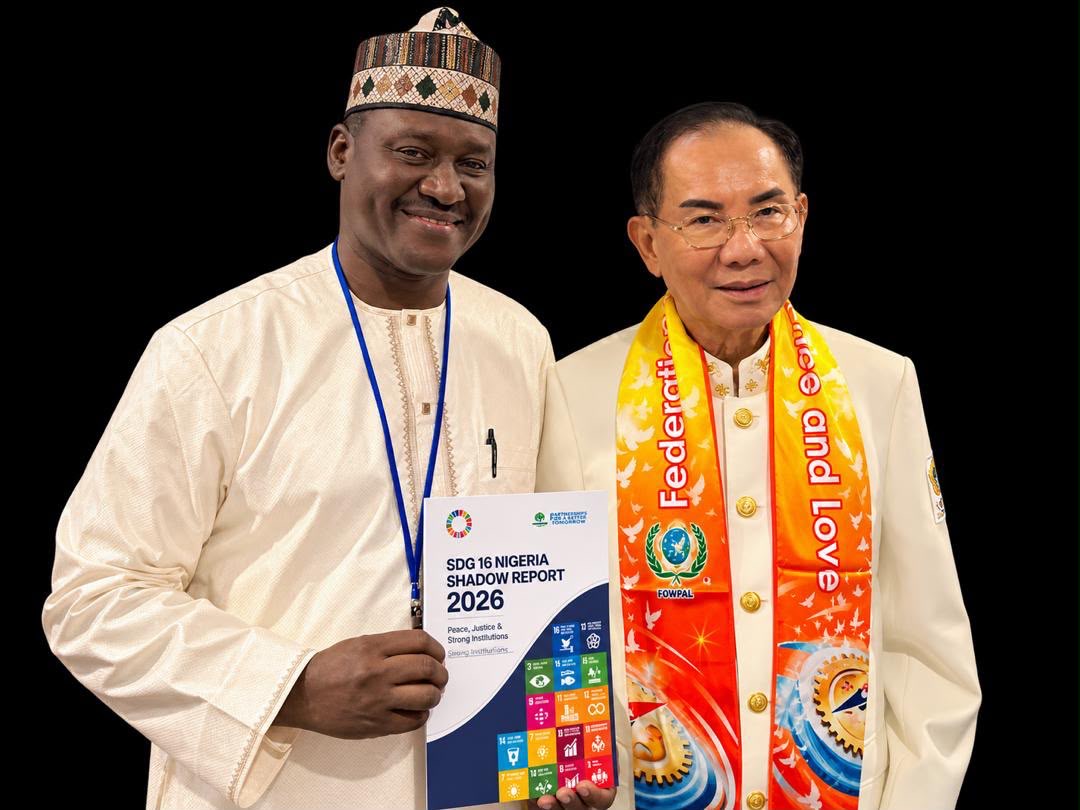
By Nkechi Eze
Nigeria must move beyond enacting laws and establishing institutions to ensuring that they function effectively, independently and in the public interest, Executive Director of the Civil Society Legislative Advocacy Centre (CISLAC), Comrade Auwal Ibrahim Musa (Rafsanjani), has said.
Rafsanjani, who is also Head of Transparency International Nigeria, made the call in New York on Tuesday while launching the 9th Nigeria SDG 16 Shadow Report at a side event of the 81st United Nations General Assembly.
The report, covering July 2025 to August 2026, assesses Nigeria’s progress and setbacks in achieving Sustainable Development Goal 16, which focuses on peace, justice and strong institutions.
He said while Nigeria had recorded important institutional and enforcement actions in areas such as illicit financial flows, asset recovery and anti-money laundering, these gains had not yet translated into corresponding improvements in the country’s legal framework, transparency, access to information and public confidence.
“Nigeria has made legislative and policy advances, but implementation and enforcement remain weak, inconsistent and, in some cases, undermined by political interference,” Rafsanjani said.
He stressed the need to protect institutions established to serve the public interest from undue influence, while strengthening their independence, transparency and accountability.
According to him, political corruption remains a major obstacle to anti-corruption efforts, while concerns surrounding asset declaration and unexplained wealth continue to raise questions about the management of public resources.
Rafsanjani also called for greater transparency in the management of recovered assets, warning that asset recovery without effective post-recovery tracking could undermine the purpose of the exercise.
“Without effective post-recovery tracking and public accountability, recovered assets can become vulnerable to mismanagement and the cycle of corruption can be repeated,” he said.
He identified the judiciary, security institutions and electoral bodies as critical pillars of Nigeria’s democracy, noting that concerns surrounding institutional integrity and public confidence underscore the need for stronger safeguards and accountability mechanisms.
On insecurity, Rafsanjani described the growing commercialisation of kidnapping for ransom as another major concern highlighted by the report.
“This is not simply a security challenge. It has profound implications for governance, economic development, human rights and the rule of law,” he said.
He noted that the inability of citizens to live, work or travel without fear weakens the foundations of peaceful and inclusive societies and undermines broader development efforts.
As the 2030 deadline for achieving the Sustainable Development Goals approaches, Rafsanjani said Nigeria faces an urgent implementation challenge, stressing that the country’s problem was not a lack of laws, policies or institutions, but ensuring that they deliver tangible results.
He described the 9th Nigeria SDG 16 Shadow Report as “both a mirror and a roadmap,” saying it reflects the country’s current position while identifying reforms required to move forward.
Rafsanjani called on the Federal Government, civil society, development partners and the international community to renew their commitment to strengthening institutions, protecting civic space, improving transparency, ensuring access to information, safeguarding public resources and upholding the rule of law.
“We must move from commitments to implementation and from institutions on paper to institutions that work for the people,” he said.