


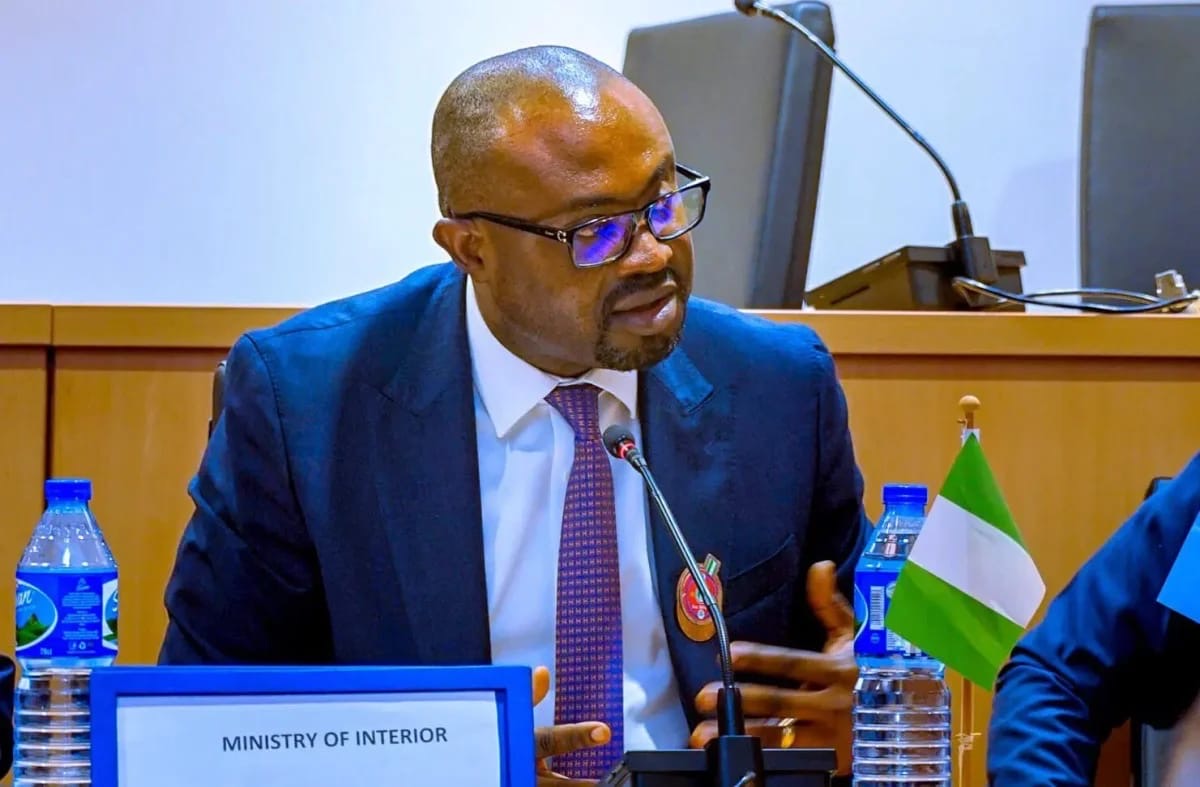
The Minister of Interior, Hon. Olubunmi Tunji-Ojo, has countered former Vice President Atiku Abubakar’s claim that Nigeria’s land borders would need to be reopened if he wins the 2027 presidential election, saying the borders are already open but subject to necessary security and regulatory controls.
Tunji-Ojo, who supervises the Nigeria Immigration Service (NIS), said it was therefore inaccurate to describe Nigeria’s land borders as closed, noting that several major crossings had been reopened by successive administrations.
The Minister said the previous administration reopened Seme, Illela, Maigatari and Mfum on December 16, 2020, while Idiroko and Ikom were reopened for goods and services on April 20, 2022.
He added that Kamba and Tsamiya border crossings in Kebbi State were reopened in February 2026 under the current administration, linking Nigeria with Niger Republic and Benin Republic respectively.
Addressing Atiku’s specific reference to Cameroon, Chad, Niger and Benin Republic, Tunji-Ojo explained that the history of some border restrictions, particularly along the Cameroon axis, was driven by security concerns rather than the 2019 trade policy.
According to him, the prolonged closure of the Banki and Amchidé crossings followed Boko Haram activities in 2014 and was implemented for security reasons. The crossings were subsequently reopened in 2019, while Fotokol and Gambaru followed in 2021 after joint military and stabilisation efforts by Nigeria, Cameroon, Niger and Chad.
The Minister cautioned against presenting the different circumstances surrounding Nigeria’s border management as one continuous closure, saying doing so would conflate trade regulation with counter-insurgency operations.
“Folding this separate, security-driven history into one continuous 2019 shutdown misrepresents two distinct issues, trade regulation and counter-insurgency, as a single failure,” he said.
Tunji-Ojo acknowledged that some northern border crossings were still subject to tighter restrictions because of banditry and residual insurgent threats, but stressed that such measures were deliberate security decisions.
He said lifting restrictions without regard to the security situation could expose traders and border communities to greater risks.
The Minister maintained that effective border management required more than simply opening or closing borders, stressing the need to combine security, proper documentation, customs compliance and controlled trade facilitation.
He challenged the former Vice President to explain how his proposed border policy would differ from the existing approach, rather than portraying trade, security and infrastructure issues as a single failure.
“If he has a new border proposal, he should set it out and explain how it differs from the current approach, rather than treating separate trade, security and infrastructure issues as one and the same,” Tunji-Ojo said.