

The Joint Task Force North East, Operation HADIN KAI, is strengthening measures to prevent the diversion of humanitarian and other resources to terrorist groups as part of efforts to disrupt terrorism financing in the region.
The Theatre Command is working with the National Technical Risk Assessment Committee on Non-Profit Organisations (NPOs) to identify vulnerabilities that could be exploited to channel funds and material resources to terrorist organisations.
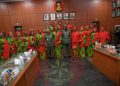
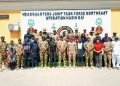
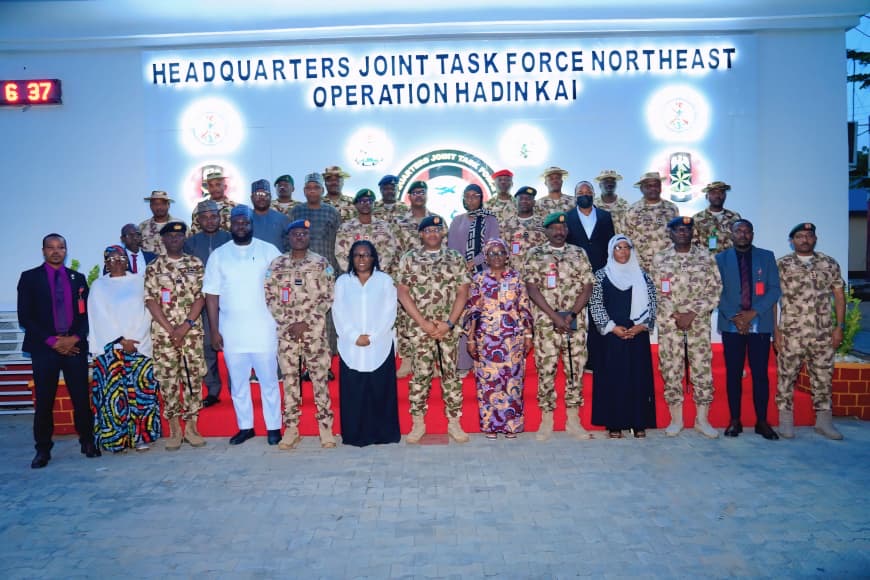
The collaboration was disclosed on Wednesday, August 19, 2026, when the Team Leader of the Committee, Mrs Ibinabo Amachree, led members on a visit to the Headquarters Theatre Command, Operation HADIN KAI, in Maiduguri.
The visit formed part of the ongoing 2026 National Technical Risk Assessment of Non-Profit Organisations in Nigeria, which is being conducted ahead of the country’s next international evaluation on Anti-Money Laundering and Counter-Terrorist Financing.
Amachree said the assessment was building on the findings of the 2022 National Risk Assessment, which identified the North East and North West as areas with elevated terrorism-financing risks.
She identified some of the vulnerabilities as non-compliance with established operational procedures, movement of large amounts of cash without adequate documentation and security arrangements, as well as the potential exploitation of humanitarian and service-oriented organisations by terrorist groups.
According to her, the current assessment is adopting a risk-based approach to identify NPOs that may be particularly vulnerable to abuse for terrorism-financing purposes.
She added that relevant agencies had developed measures to strengthen monitoring of high-risk organisations, including due diligence and vetting of personnel and vendors engaged by NPOs operating in vulnerable areas.
The Theatre Commander, Operation HADIN KAI, Major General Abdulsalam Abubakar, described terrorism financing as a critical enabler of terrorist activities and stressed the need to cut off the financial lifelines sustaining terrorist organisations.
Abubakar said the Theatre Command would continue to support legitimate humanitarian and non-profit activities but insisted that organisations operating in the theatre must comply with established security and operational procedures.
He expressed concern over the movement of cash and humanitarian supplies without adequate documentation, security coordination and escorts.
The Theatre Commander consequently urged humanitarian and non-profit organisations to give sufficient advance notice of planned movements to enable Operation HADIN KAI coordinate security escorts, route protection and, where necessary, air support.
He further called for proper due diligence and security screening of local vendors and service providers contracted by humanitarian organisations, noting that stronger controls were necessary to prevent terrorist groups from exploiting legitimate humanitarian operations.
Abubakar also recalled that Operation HADIN KAI recently hosted a Humanitarian Civil-Military Coordination Roundtable involving humanitarian actors and United Nations agencies, where issues affecting humanitarian access, personnel movement and the delivery of supplies were discussed.
He said measures were agreed at the meeting to improve coordination between security forces and humanitarian organisations operating in the North East.
The Theatre Commander assured the Risk Assessment Committee of Operation HADIN KAI’s readiness to provide relevant operational information and other support required for the assessment, subject to security and operational considerations.
He also urged legitimate NPOs operating in the region to maintain close coordination with security authorities, comply with established procedures and promptly report suspicious activities or vulnerabilities that could be exploited by terrorist organisations.