


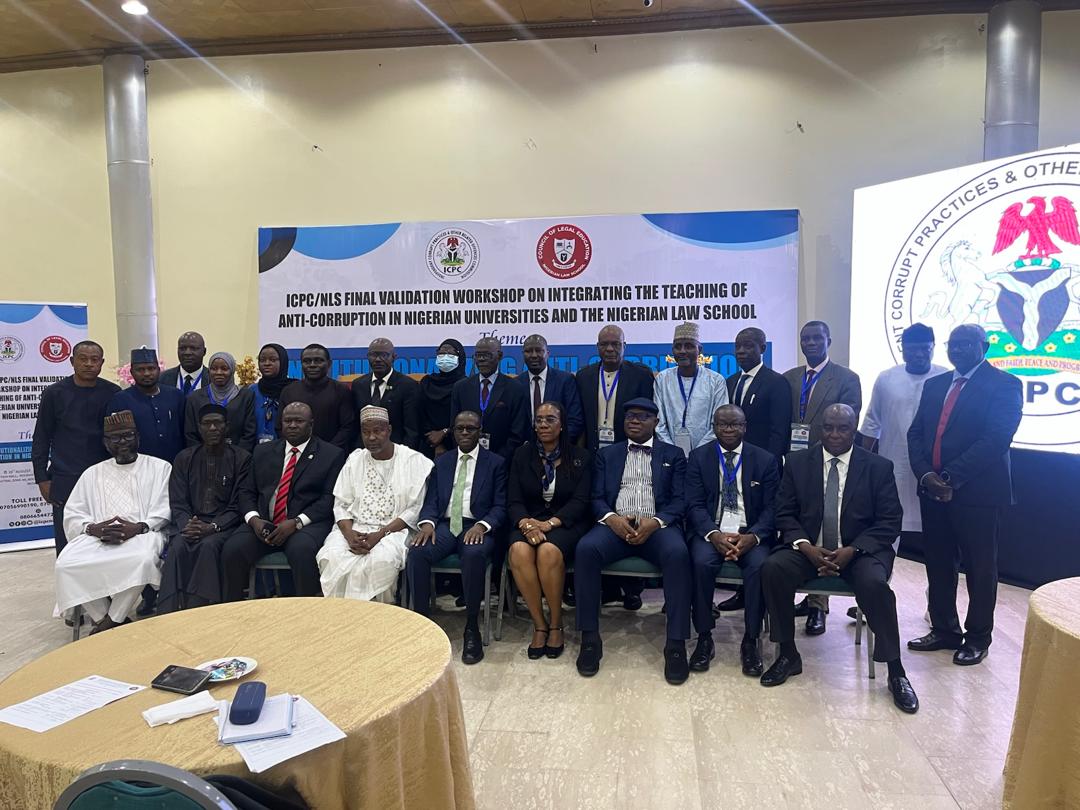
The Independent Corrupt Practices and Other Related Offences Commission (ICPC) has intensified efforts to prevent corruption by promoting the integration of anti-corruption education into Nigeria’s legal training system.
The ICPC Chairman stated this on Monday in Abuja at the ICPC–Nigerian Law School (NLS) Final Validation Workshop on Integrating the Teaching of Anti-Corruption in Nigerian Legal Education, held at Rockview Royal Hotel.
The Chairman said the initiative was designed to strengthen the foundations of integrity, accountability, ethical conduct and respect for the rule of law among future members of the legal profession.
He explained that the proposed curriculum framework was the outcome of extensive consultations involving Deans of Faculties of Law in Nigerian universities, representatives of the Nigerian Law School and other stakeholders.
According to the Chairman, stakeholder engagements held in Abuja in May, Kano in June and Abuja again in July provided a platform for participants to examine existing practices and develop appropriate curriculum content, learning outcomes and methods of delivery.
He said the final validation workshop was a critical step towards securing broad stakeholder ownership and national acceptance of the proposed framework, subject to relevant regulatory processes, including consideration and ratification by the National Universities Commission (NUC).
The ICPC Chairman stressed that corruption remained a major obstacle to Nigeria’s development, as it weakens institutions, undermines the rule of law, erodes public confidence, distorts opportunities and compromises public service delivery.
He said the fight against corruption must extend beyond investigation, prosecution and punishment to include prevention, education, institutional reform and the deliberate cultivation of values that promote integrity.
“Enforcement is necessary, but it is only one part of the solution. Sustainable progress also requires prevention, education, institutional reform, and the deliberate cultivation of values that make integrity and responsible conduct part of our everyday lives,” he said.
The Chairman identified legal education as a strategic avenue for corruption prevention, noting that lawyers play central roles in the administration of justice, governance, public policy, business and the protection of the rule of law.
He said Nigeria needed to produce lawyers who were not only knowledgeable and professionally competent but also possessed the integrity, courage, ethical judgment and sense of responsibility required to resist corrupt practices.
The Chairman explained that the initiative fell within the ICPC’s preventive and educational mandate under the Corrupt Practices and Other Related Offences Act, 2000.
He said the Commission’s experience had shown that Nigeria could not “arrest or prosecute its way out of corruption”, stressing the need to invest in knowledge, values, systems and institutions capable of preventing corruption from taking root.
He noted that integrating anti-corruption principles into legal education was not merely about adding another subject to the academic curriculum but about shaping the character and professional orientation of future lawyers.
According to him, the beneficiaries would eventually interpret laws, administer justice, advise institutions, influence public policy and occupy leadership positions across the country.
The ICPC Chairman expressed appreciation to the Nigerian Law School, NUC, Deans of Faculties of Law, law teachers, resource persons and members of the technical committee for their contributions to the initiative.
He urged participants to critically review the proposed curriculum, identify areas requiring improvement and make practical recommendations that would strengthen its content, relevance, delivery and sustainability.
He expressed confidence that the workshop would produce a well-validated and nationally acceptable framework capable of providing a strong foundation for anti-corruption education in Nigerian legal training.
The Chairman said the ultimate objective was to build a legal education system that would produce not only excellent lawyers but professionals committed to upholding justice, resisting corruption, strengthening the rule of law and contributing to national development.