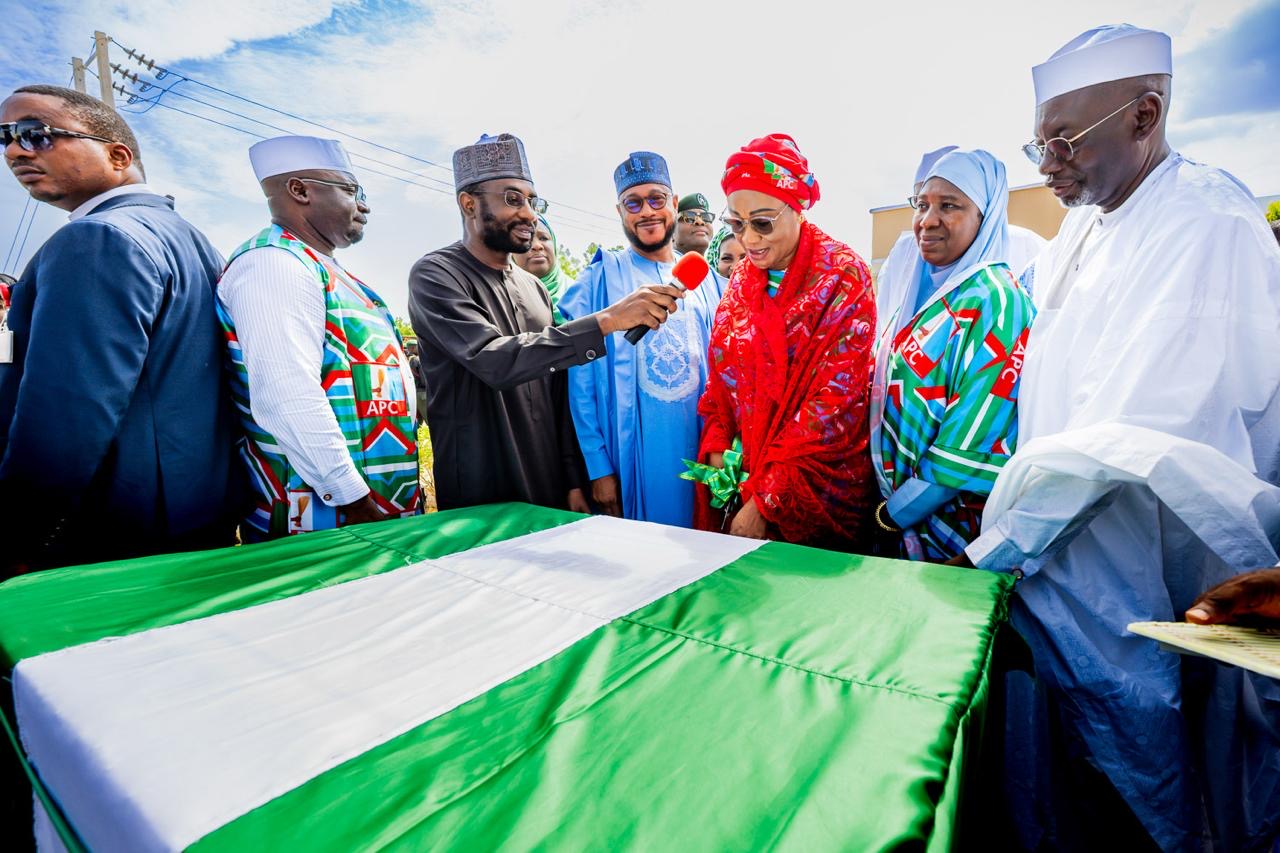
Nigeria’s First Lady, Senator Oluremi Tinubu, has commissioned the President Bola Ahmed Tinubu Academy, a modern clinic and dialysis centre, and launched the National Community Food Bank Programme in Hadejia, Jigawa State, describing the initiatives as landmark interventions aimed at expanding access to quality healthcare, advancing education, and tackling food insecurity.
Speaking during the commissioning ceremony, Senator Tinubu said the newly inaugurated projects reflect the commitment of the Federal and Jigawa State governments to improving critical infrastructure, investing in human capital development, and delivering sustainable social interventions to vulnerable Nigerians.
She noted that the state-of-the-art clinic and dialysis centre would provide much-needed relief to patients suffering from chronic illnesses, particularly kidney disease, while improving access to quality healthcare for residents of Hadejia, neighbouring communities, and beyond.
The First Lady described the President Bola Ahmed Tinubu Academy as a symbol of President Bola Ahmed Tinubu’s commitment to human capital development, innovation, and educational excellence, stressing that investments in education today would secure a better future for Nigeria’s younger generation.
She also launched the National Community Food Bank Programme for the North-West geopolitical zone, describing it as a deliberate and sustainable response to food insecurity and malnutrition among vulnerable households. According to her, the initiative targets children under six years, pregnant women, and lactating mothers in line with the Renewed Hope Agenda’s focus on food security and improved healthcare outcomes.
Senator Tinubu explained that the programme is being implemented through a strategic partnership involving the Office of the First Lady, the Federal Ministry of Health and Social Welfare, the National Primary Health Care Development Agency, and the Bank of Agriculture.
Recalling the rollout of the initiative, she said the National Community Food Trust Fund and its Board of Trustees were inaugurated in Abuja on April 2, 2026, while the first zonal launch took place in Borno State on April 27 for the North-East. She added that the Jigawa event marked the second zonal launch for the North-West.
The First Lady disclosed that the programme had already recorded encouraging results in Borno State, enrolling 560 beneficiaries and reaching 468 vulnerable children, pregnant women, and lactating mothers within two months. She expressed confidence that Jigawa State would surpass those achievements through effective implementation and collaboration.
She called for sustained partnerships among governments, communities, farmers, civil society organisations, and the private sector to build a transparent and efficient food bank system capable of reaching vulnerable households across the country.
The clinic and dialysis centre were constructed and fully equipped by FutureMap Foundation and eHealth Africa in recognition of the First Lady’s commitment to improving the welfare of underserved communities, while the President Bola Ahmed Tinubu Academy was established with the support of President Bola Ahmed Tinubu and the National Information Technology Development Agency (NITDA).
Designed as complementary institutions, the academy and clinic integrate education, innovation, and healthcare delivery. The academy features a fabrication laboratory, maker space, innovation laboratory with artificial intelligence-driven learning facilities, auditorium, residential hostel, and entrepreneurship hub. Its research facilities are expected to support the development of healthcare technologies, including diagnostic tools and organ prototypes for early detection and prevention of chronic diseases, particularly kidney-related ailments.
The adjoining clinic houses a dedicated dialysis centre, operating theatre, maternity facilities, continuous piped oxygen systems, and renewable energy infrastructure to ensure uninterrupted delivery of critical medical services.
Earlier, the Governor of Jigawa State, Mallam Umar A. Namadi, described the launch of the National Community Food Bank Programme in the state as a demonstration of collective commitment to protecting vulnerable families and improving child nutrition.
He said the initiative aligns with the constitutional responsibility of government to ensure adequate food for citizens and complements Jigawa State’s existing Food and Nutrition Policy and Social Protection Policy.
Governor Namadi highlighted the state’s homegrown nutrition programme, which screened more than 240,000 children in 2024 and over 382,000 children in 2025, resulting in significant improvements in child nutrition and the training of 600 women in the production of locally formulated nutritious food.
He pledged the support of North-West governors for the successful implementation of the food bank programme through the provision of storage facilities, strengthened distribution systems, and transparent delivery mechanisms to ensure assistance reaches vulnerable households.
The event was attended by the governors of the seven North-West states and their spouses, the Minister of State for the Federal Capital Territory, Hajiya Mariya Mahmoud Bunkure, the Minister of State for Education, Professor Suwaiba Sa’id Ahmad, the Director-General of the National Primary Health Care Development Agency, Dr. Muyi Aina, representing the Coordinating Minister of Health and Social Welfare, Professor Muhammad Ali Pate, the Director-General of the National Information Technology Development Agency, Kashifu Inuwa Abdullahi, alongside senior government officials, traditional rulers, and other dignitaries.