

By Nkechi Eze
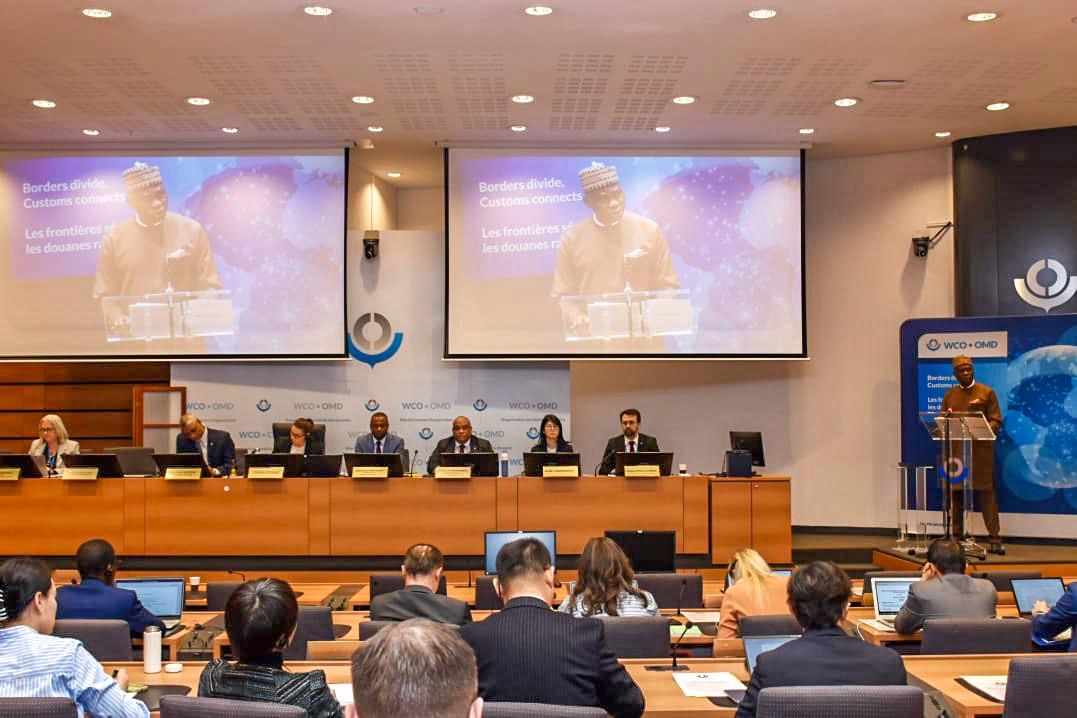
The Comptroller-General of the Nigeria Customs Service and Chairperson of the Council of the World Customs Organization, Bashir Adewale Adeniyi, on Monday made history after delivering the keynote address at the opening of the 46th Session of the WCO Enforcement Committee held at the organisation’s headquarters in Brussels, Belgium.
The landmark moment marked the first time in the Committee’s 43-year history that the opening session was jointly addressed by both the WCO Secretary-General, Ian Saunders, and the Council Chairperson. The development underscores the increasing strategic importance of the Enforcement Committee within the global customs community and highlights the prominent role of the Nigeria Customs Service in shaping international customs cooperation.
The session also signalled a significant shift in the Committee’s operational outlook, moving beyond a largely enforcement-driven platform toward a broader policy-oriented framework designed to address evolving global trade and security challenges.
Key discussions at the session focused on issues such as detection technologies, intelligence sharing, supply chain integrity and trade-based money laundering, all within a more structured and forward-looking framework. The Committee is also currently reviewing its Terms of Reference, which were last updated in 2009, in a bid to align its governance structure with the realities of an increasingly complex global trade environment.
In his keynote address, Adeniyi commended customs administrations around the world for their sustained efforts in combating transnational organised crime and safeguarding global trade routes.
He emphasised that threats within international supply chains are becoming increasingly sophisticated, requiring coordinated, intelligence-driven enforcement strategies.
“Customs enforcement today is no longer about isolated seizures; it is about protecting the integrity of global trade,” Adeniyi said.
As part of Nigeria’s contribution to the session, the Nigeria Customs Service is expected to present field-level perspectives on fragile border management, drawing from its operational experience as a frontline administration managing one of Africa’s most demanding border environments.
These insights are expected to enrich global policy discussions and strengthen collaboration within the international customs enforcement community.
Adeniyi concluded his address with a call for stronger partnerships among customs administrations worldwide.
“When Customs administrations work together, enforcement becomes stronger, trade becomes safer, and the global economy becomes more resilient,” he stated.
On the sidelines of the session, delegates also witnessed a live demonstration of drone technology by the Netherlands Customs team, highlighting the growing role of unmanned systems in modern border surveillance and border management operations.