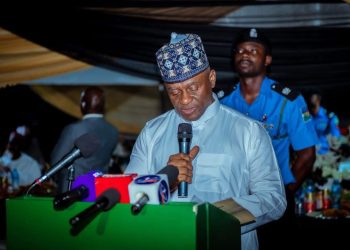



By Nkechi Eze
The Chairman of the Independent National Electoral Commission (INEC), Professor Joash O. Amupitan, has called on the Commission’s workforce and Nigerians at large to translate the discipline imbibed during the holy month of Ramadan into a renewed commitment to electoral integrity, as the country prepares for crucial off-cycle governorship elections.
In an Eid-el-Fitr message issued on Friday, March 20, 2026, from the Commission’s headquarters in Abuja, the INEC boss described the successful completion of Ramadan as a victory of the spirit over self, urging staff to carry forward its values into their professional conduct.
According to a statement signed by his Chief Press Secretary and Media Adviser, Adedayo Oketola, Prof. Amupitan said the moment presents a foundational opportunity for the Commission as it gears up for the 2026 governorship elections in Ekiti State and Osun State, as well as the 2027 General Election.
Highlighting what he described as a rare and symbolic alignment, the Chairman noted that this year’s Ramadan coincided with the Christian Lenten season, a development he said underscores unity and shared responsibility within the Commission and the broader Nigerian society.
“Seeing both faiths within the Commission engaged in simultaneous fasting and intercession reinforces my belief in our shared humanity,” he said. “The lessons of Ramadan patience, integrity, and empathy are the very virtues we require as we approach the critical milestones of 2026.”
Addressing over 14,000 staff spread across the country’s 774 Local Government Areas, Prof. Amupitan reaffirmed his commitment to staff welfare, describing it as a cornerstone of his leadership. He cited the recent organisation of an institutional Iftar, the first in eight years as a reflection of his administration’s staff-first approach.
At the same time, he stressed that welfare must be matched with professionalism, insisting that discipline and zero tolerance for misconduct remain non-negotiable if the Commission is to rebuild public trust and tackle voter apathy.
The Eid message comes at a critical phase in Nigeria’s democratic process, as INEC intensifies preparations under the framework of the Electoral Act 2026. The law mandates stricter compliance with technological innovations, including the Bimodal Voter Accreditation System (BVAS) and the INEC Result Viewing Portal (IReV), both designed to enhance transparency and credibility in elections.
Since assuming office on October 23, 2025, Prof. Amupitan has pursued an ambitious reform agenda aimed at modernising operations and restoring institutional confidence in the electoral body. The forthcoming governorship elections in Ekiti and Osun states, he noted, will serve as a litmus test for these reforms ahead of the 2027 general polls.
With a workforce exceeding 14,000 personnel, the Commission is placing equal emphasis on internal discipline and improved working conditions, recognising that a motivated and ethically grounded staff remains its strongest safeguard against external pressures and a key driver of credible elections.