

By Nkechi Eze
The Minister of Interior, Olubunmi Tunji-Ojo, has reaffirmed the Federal Government’s commitment to deepening institutional reforms, strengthening service delivery, and enhancing internal security administration through accountability and performance-driven leadership across all agencies under the Ministry.
Speaking at the 2026 Management Retreat of the Ministry of Interior and its agencies, the Minister commended the leadership and staff for sustaining reform initiatives that have repositioned the sector in alignment with the Renewed Hope Agenda of President Bola Ahmed Tinubu.
In an official signed statement, the Head of Press and Public Relations of the Ministry, Mrs. Mary Ali, disclosed that Dr. Tunji-Ojo charged the Ministry to continuously raise its performance standards, stressing that past accomplishments should serve as motivation rather than complacency.
“Yesterday belongs to history. What truly defines our future is what we do today. While we have recorded significant milestones, we must continue to raise the bar and pursue greater achievements in delivering efficient services to Nigerians,” the Minister said.
He underscored the Ministry’s pivotal role in national governance, noting that its responsibilities span identity management, border administration, correctional services, internal security, and citizenship services, areas that directly affect the daily lives of millions of Nigerians. According to him, strengthening these institutions remains central to national stability and public confidence in government.
Dr. Tunji-Ojo also commended the Permanent Secretary, Magdalene Ajani, for her administrative leadership, strategic coordination, and steadfast commitment to implementing key performance agreements and institutional reforms. He attributed much of the Ministry’s recent progress to the collaborative efforts of the management team, agency heads, and dedicated personnel working to improve operational efficiency and policy execution.
In her remarks, Dr. Ajani described the retreat as a vital platform for institutional reflection, performance evaluation, and strategic planning aimed at reinforcing accountability across the Ministry and its agencies. She explained that the theme of the retreat, “Accountable Leadership: Measuring Impact, Refining Results and Renewing Commitments,” reflects the Ministry’s resolve to ensure that leadership decisions translate into measurable outcomes for citizens.
“Accountability is fundamental to our operations because the work of our agencies touches the lives of millions of Nigerians every day. Our responsibility, therefore, is to ensure that our policies, programs, and reforms deliver measurable improvements in service delivery,” she said.
The Permanent Secretary noted that the Ministry has intensified reforms to strengthen institutional capacity, modernise operational systems, enhance transparency, and deepen inter-agency collaboration in line with national development priorities. She emphasised the shift toward data-driven performance management, clear key performance indicators, and robust monitoring and evaluation frameworks that will move the Ministry from activity-based reporting to outcome-based governance.
Highlighting the importance of digital transformation, Dr. Ajani said technology-driven reforms across identity management systems, border control operations, and emergency response coordination are already improving efficiency and reducing operational bottlenecks. However, she maintained that human capital remains the Ministry’s most valuable asset, calling for sustained investment in staff development, ethical standards, and a merit-based performance culture.
She further advocated stronger collaboration with other government institutions, security agencies, sub-national authorities, and international partners to enhance internal security administration and policy coordination nationwide.
Dr. Ajani urged participants at the retreat to engage in open dialogue, identify operational gaps, and develop practical solutions that will strengthen border governance, improve citizenship services, enhance correctional administration, bolster emergency preparedness, and increase public trust in government institutions.
The retreat also featured goodwill messages from key stakeholders, including the Chairman of the House of Representatives Committee on Reformatory Institutions, a representative of the Permanent Secretary, Career Management Office, Office of the Head of the Civil Service of the Federation, and a representative of the Chairman of the House of Representatives Committee on Interior. The speakers commended the Ministry’s ongoing reforms and stressed the importance of sustained collaboration between the executive and legislative arms in advancing internal security administration and institutional governance.
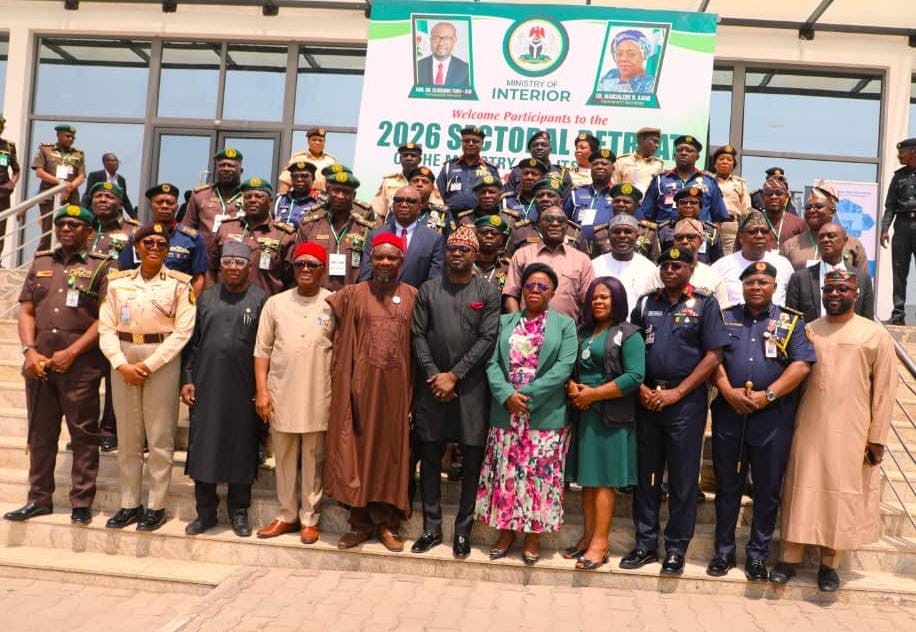
The high-level gathering brought together top management staff of the Ministry, heads of agencies, and senior officials to review performance indicators, refine policy strategies, and develop actionable frameworks aimed at delivering measurable improvements across Nigeria’s interior sector.