


By Nkechi Eze
The Civil Society Legislative Advocacy Centre (CISLAC) has called on local and international investors to strengthen anti-corruption and human rights safeguards in their business operations, warning that corruption in Nigeria’s defence sector is worsening insecurity, promoting illicit arms proliferation and exposing civilians to human rights abuses.
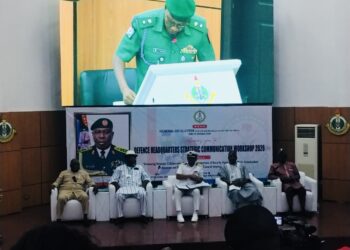
The organisation’s Programme Manager, Peace, Security, Anti-Corruption and Migration/IDPs, Abubakar Jimoh, made the call while speaking at a panel session on “Achieving and Maintaining Human Rights-Respecting Investment in Conflict-Affected Settings” in Geneva, Switzerland.
The session was co-organised by the United Nations Working Group on Business and Human Rights, the United Nations Development Programme (UNDP) and Transparency International Defence and Security at the Assembly Hall, Palais des Nations, on Wednesday, November 25, 2026.
Jimoh argued that despite increased government investment in defence and security over the past 15 years, persistent corruption, procurement irregularities, embezzlement and diversion of resources have continued to undermine the country’s capacity to address its numerous security challenges.
He recalled the 2015 defence procurement scandal, in which a government investigative panel exposed the alleged misappropriation of approximately $2 billion earmarked for arms procurement, with the then National Security Adviser implicated.
According to him, the impact of corruption in the defence sector is particularly severe because it deprives security institutions of resources needed to protect citizens while creating opportunities for illicit weapons to find their way into the hands of armed groups.
He disclosed that more than six million illegal weapons were estimated to be in circulation across Nigeria, warning that the activities of arms dealers, suppliers, financiers and intermediaries had contributed to the proliferation and diversion of firearms and ammunition.
Jimoh said the availability of illicit weapons had increased the operational capacity of terrorist groups and other armed actors, resulting in civilian casualties, displacement, destruction of livelihoods and widespread violations of fundamental rights.
He noted that women, children, older persons and internally displaced persons remained particularly vulnerable, with conflict-related sexual and gender-based violence, including rape, sexual slavery, forced marriages and exploitation, further worsening the humanitarian situation.
The CISLAC official also warned that human rights accountability must extend to state security institutions, noting that allegations of excessive use of force, extrajudicial killings and other unlawful actions against civilians in some conflict settings must be addressed.
He urged investors to conduct comprehensive human rights due diligence on both state and non-state security actors, particularly where business activities involve the provision of security services, infrastructure protection, equipment or other support to security institutions.
On preventing corruption in defence institutions, Jimoh urged investors to look beyond the Corruption Perceptions Index and incorporate the Government Defence Integrity Index into their risk assessment processes.
He explained that while the CPI provides an indication of perceived public-sector corruption, it does not adequately assess the institutional safeguards, accountability mechanisms and procurement vulnerabilities within defence establishments.
He said the GDI, developed by Transparency International Defence and Security, provides an evidence-based framework for examining corruption risks through the existence, effectiveness and enforcement of institutional controls across five key risk areas.
Jimoh further called for stronger civilian oversight of defence expenditure and procurement, pointing to challenges arising from the classification of defence information and inconsistencies in Nigeria’s Official Secrets Act, Freedom of Information Act and Public Procurement Act.
He identified civil society organisations as indispensable partners in strengthening accountability, promoting transparency, exposing corruption, preventing arms diversion and advocating reforms in the defence and security sector.
The CISLAC programme manager also called for mandatory disclosure of human rights and conflict-related risks in corporate investment documents, annual reports and sustainability disclosures.
He urged regulators and stock exchanges to ensure that businesses operating in high-risk sectors provide information on their exposure to conflict-affected areas, security arrangements, land acquisition, community displacement, human rights complaints and remedial measures.
Jimoh said Nigeria’s emerging sustainability reporting framework, including the adoption of IFRS S1 and IFRS S2, provided an opportunity to strengthen corporate accountability by incorporating more explicit requirements on conflict sensitivity, human rights protection and security-related risks.
He also cited MTN Nigeria, Seplat Energy and Access Holdings as examples of companies whose sustainability reporting, community engagement and governance disclosures could provide useful lessons for other Nigerian businesses.
He stressed that investors must recognise that responsible investment in conflict-affected environments goes beyond financial returns, requiring deliberate efforts to ensure that business activities do not contribute to corruption, violence, insecurity or violations of human rights.