


The Independent National Electoral Commission (INEC) has expanded the deployment of its Bimodal Voter Accreditation System (BVAS) devices for the August 15 Osun State Governorship Election, responding to concerns raised by political parties over the number of machines allocated for the poll.
INEC Chairman, Prof. Joash Amupitan, SAN, disclosed the decision on Saturday during an interactive session with media executives in Osogbo, explaining that the Commission had increased the number of BVAS devices from 4,427 to 5,130 and doubled backup units from 664 to 1,328 to improve accreditation efficiency and reduce the risk of technical disruptions.
According to Prof. Amupitan, the additional devices will be deployed to service split polling units in Ife East, Irewole, Egbedore, Ede North and Osogbo, while the increased backup stock will enable swift replacement of malfunctioning devices during the election.
He said the decision followed concerns expressed by political parties and findings from the mock accreditation exercise conducted earlier on Saturday across selected polling units in Osogbo, Oriade and other local government areas.
Describing the exercise as a quality assurance test, the INEC Chairman said the Commission deliberately moved its preparations from the boardroom to the field to evaluate the performance of its election technology under real operational conditions.
“The Bimodal Voter Accreditation System (BVAS) demonstrated optimal field resilience. On average, it took between 30 seconds to two minutes to successfully verify a voter using either their fingerprints or facial recognition,” he said.
Prof. Amupitan noted that technical support engineers equipped with backup BVAS devices had been stationed across every Registration Area and ward to ensure immediate intervention in the event of equipment failure.
“What we saw today confirms that our technological defence against identity theft and results manipulation is robust and fully operational,” he added.
Beyond the enhanced BVAS deployment, the INEC Chairman said preparations for the election had reached an advanced stage. He disclosed that 2,339,233 registered voters are expected to vote across 3,763 polling units in 320 wards and 30 local government areas, while 14 political parties will participate in the governorship contest.
He also announced that 32,000 National Youth Service Corps (NYSC) members recruited through the sanitised INECPRES portal would serve as ad hoc election personnel.
On security, Prof. Amupitan said INEC had adopted a proactive strategy through the Inter-Agency Consultative Committee on Election Security (ICCES), working closely with security agencies to safeguard election personnel, materials and voters.
“We are working closely with the Police and the Armed Forces to ensure that our staff, our materials, and most importantly, every single voter, are shielded from harm. We will meet any attempt to disrupt this election with the full, unyielding weight of the law,” he said.
Addressing recent attacks on INEC offices in Okuku, Odo-Otin Local Government Area, and Ife Central, where Permanent Voter Cards (PVCs) were stolen, the Chairman assured affected voters that the stolen cards could not be used for electoral fraud because accreditation requires biometric verification through the BVAS.
He said the Commission had directed its ICT Department to reprint the stolen PVCs or make downloadable PVCs available to affected voters before the election.
Prof. Amupitan also highlighted measures introduced to promote inclusive participation, including Braille ballot guides for visually impaired voters, magnifying glasses for persons with low vision, EC40H poster manifests for hearing-impaired voters, and priority voting arrangements for persons with disabilities, pregnant women, nursing mothers and the elderly.
He urged journalists to verify election-related information before publication, warning that misinformation and disinformation posed a greater threat to the electoral process than technical failures.
Reaffirming INEC’s neutrality, the Chairman said the Commission remained committed to conducting a transparent and credible election, stressing that its responsibility was to ensure that every valid vote counts and that the outcome reflects the true will of the people of Osun State.
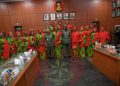
The interactive session was attended by INEC National Commissioners, Osun State Resident Electoral Commissioner Barrister Oluwatoyin Babalola, leaders of the Nigeria Union of Journalists (NUJ), the Broadcasting Organisations of Nigeria (BON), and other senior officials of the Commission.