

By Nkechi Eze
The Chief of Army Staff (COAS), Lt.-Gen. Waidi Shaibu, has declared that the Nigerian Army is undergoing a deliberate transformation into a more technologically-driven, combat-ready, adaptive, and resilient force capable of effectively confronting the nation’s evolving security threats.
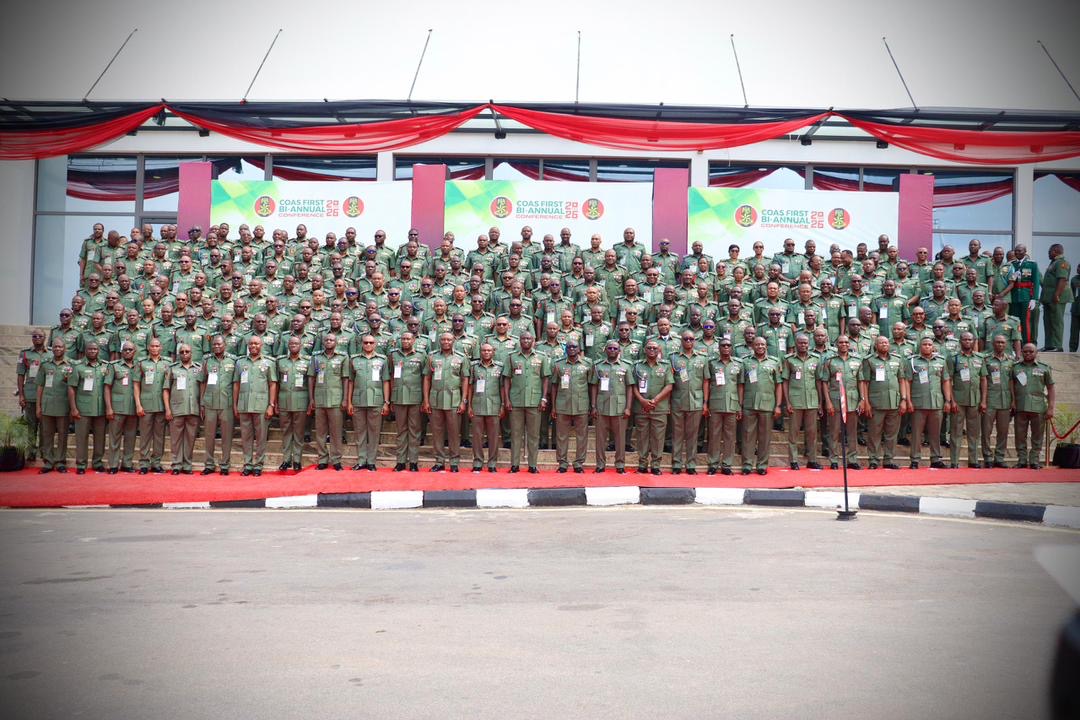
The Army Chief made the declaration on Monday while delivering his opening remarks at the Chief of Army Staff First Bi-Annual Conference 2026 held at the Nigerian Army Resource Centre, Abuja, where he charged commanders at all levels to remain mission-focused, proactive, and operationally effective in addressing contemporary security challenges confronting the country.
Lt.-Gen. Shaibu described the conference as a critical strategic and professional decision-making platform that provides Army leadership the opportunity to review ongoing operations, evaluate achievements recorded during the first half of the year, and articulate operational priorities for the remaining part of 2026.
According to him, the conference also serves as an important forum for assessing the preparedness of the Nigerian Army in tackling prevailing and emerging threats while collectively developing practical strategies capable of improving operational effectiveness across all theatres of operation.
The COAS commended officers and soldiers for what he described as their exceptional resilience, sacrifice, professionalism, and unwavering commitment despite the increasingly complex security environment facing the nation.
“Our troops continue to demonstrate exceptional professionalism, courage, and determination in the conduct of operations despite numerous operational challenges,” he stated.
Shaibu, however, acknowledged that the Nigerian Army had also suffered painful losses in the course of ongoing military operations, stressing that the sacrifices of fallen personnel would never be forgotten.
He assured that the Nigerian Army remained committed to supporting the families of deceased personnel who paid the supreme sacrifice in defence of the nation’s territorial integrity and sovereignty.
The Army Chief disclosed that his leadership philosophy remained focused on creating a conducive operational environment while sustaining professional and administrative excellence within the Nigerian Army.
According to him, troops welfare, operational empowerment, combat readiness, and capacity development remain central pillars of his leadership approach.
He therefore urged commanders to maintain close engagement with troops under their command in order to sustain morale, professionalism, and operational focus across formations and units.
Shaibu emphasised that leadership remains the most decisive factor in military operations, calling on commanders to lead by example through resilience, discipline, empathy, determination, and total commitment to mission accomplishment.
Speaking extensively on the country’s security situation, the COAS said the contemporary security environment remains dynamic, complex, and increasingly sophisticated.
He noted that remnants of Boko Haram and Islamic State West Africa Province (ISWAP) terrorists in the North-East had continued to deploy asymmetric warfare tactics, including the use of Improvised Explosive Devices and attacks on isolated communities and security personnel.
The Army Chief further observed that insecurity in the North-West and North-Central remained characterised by banditry, kidnapping, and communal violence, stressing that the threats require intelligence-driven and context-specific operational responses.
He also identified activities of criminal groups in the South-East as continuing sources of concern that require sustained vigilance and proactive security measures.
In response to the evolving threats, Shaibu disclosed that the Nigerian Army had continued to strengthen its operational posture through sustained troop deployments, enhanced intelligence gathering, and the establishment of additional operational bases and formations in critical areas across the country.
According to him, these measures have significantly improved operational response capabilities, force projection, and military presence in previously vulnerable areas.
The COAS revealed that one of the major drivers behind recent operational successes recorded by the Nigerian Army was the increasing integration of technology into military operations.
He said the deployment of additional combat enablers and surveillance assets had enabled troops to dominate difficult terrains, disrupt terrorist activities, and sustain pressure on criminal elements operating in remote locations.
“These developments clearly demonstrate our deliberate transition towards a more technologically-driven, mobile, and responsive force capable of effectively addressing contemporary security threats,” he declared.
Shaibu also disclosed that the establishment of new formations and operational units was in line with the directive of the Commander-in-Chief aimed at expanding the operational capacity of the Nigerian Army.
He noted that the initiatives had substantially improved operational reach, response time, and the overall effectiveness of military operations nationwide.
According to the COAS, the Nigerian Army had continued to dismantle terrorist and criminal networks while restoring stability in several troubled areas across the country, although he warned that emerging threats still require sustained vigilance and strategic adaptation.
He stressed the need for intelligence gathering, innovation, inter-agency cooperation, and strategic partnerships to remain central to the Nigerian Army’s operational approach.
The Army Chief explained that his Command Philosophy was specifically introduced to transform the Nigerian Army into a more professional, resilient, and operationally effective force capable of discharging its constitutional responsibilities within a joint and multi-agency environment.
He stated that the philosophy is anchored on professionalism, institutional continuity, operational excellence, troop welfare, and capacity development while ensuring alignment between military doctrine, training, administration, and contemporary security realities.
Shaibu also highlighted the importance of strategic international collaboration in combating terrorism and transnational crimes, noting that no nation can effectively confront modern security threats in isolation.
He cited recent collaborative offensive operations involving Nigerian forces and international partners which led to the neutralisation of a globally-ranked senior commander of the Islamic State terrorist network as a major milestone in ongoing counter-terrorism efforts.
According to him, the success underscored the importance of intelligence sharing, precision operations, and sustained strategic cooperation in enhancing both regional and global security.
The COAS therefore directed commanders to continue strengthening inter-agency cooperation and strategic partnerships in order to sustain operational gains against terrorists and criminal groups.
Shaibu expressed profound appreciation to President and Commander-in-Chief of the Armed Forces for his continued support to the Nigerian Army through the acquisition of modern military platforms, enhanced operational logistics, infrastructural development, and improved troop welfare.
He stated that the Federal Government’s support had significantly enhanced the operational capacity and professional efficiency of the Nigerian Army.
The Army Chief further disclosed that deliberate efforts had also been made to improve accommodation, medical services, educational facilities, and welfare programmes for officers, soldiers, and their families.
He urged commanders to continue prioritising troop welfare, discipline, maintenance of facilities, and operational readiness within their respective commands.
Shaibu added that the Nigerian Army would continue strengthening civil-military cooperation initiatives aimed at promoting peace, supporting local communities, and enhancing public confidence in military operations.
He noted that the progress recorded by the Nigerian Army would not have been possible without the collaboration of sister security agencies, Ministries, Departments and Agencies, as well as the dedication and sacrifices of officers and soldiers across operational theatres.
The COAS charged participants at the conference to engage in objective, constructive, and professional deliberations capable of preparing the Nigerian Army for both current and future security realities.
He expressed confidence that discussions and recommendations from the conference would further strengthen the operational effectiveness and professional capacity of the Nigerian Army before formally declaring the conference open.
Earlier in his welcome address, the Chief of Policy and Plans (Army), Major General Bamidele Alabi, described the conference as a critical platform for evaluating operational engagements, reviewing achievements, identifying operational gaps, and developing practical strategies aimed at enhancing military effectiveness.
Maj.-Gen. Alabi noted that the transition from quarterly and annual conferences to a bi-annual arrangement since 2025 had significantly improved the implementation of operational directives and enhanced operational impact across various theatres.
He commended the leadership of the COAS, stating that Lt.-Gen. Shaibu’s strategic foresight, professionalism, and visionary leadership had inspired officers and soldiers while consolidating operational gains across the country.
The senior officer further stated that despite existing operational challenges, the Nigerian Army had remained disciplined, resilient, and committed to professionalism, adherence to rules of engagement, and respect for human rights.
He urged participants to contribute meaningful ideas and practical recommendations capable of repositioning the Nigerian Army for greater operational success and stronger contributions to national security.
One of the major highlights of the event was the presentation of financial support cheques to families of fallen personnel and soldiers who sustained injuries during operations.