

By Nkechi Eze
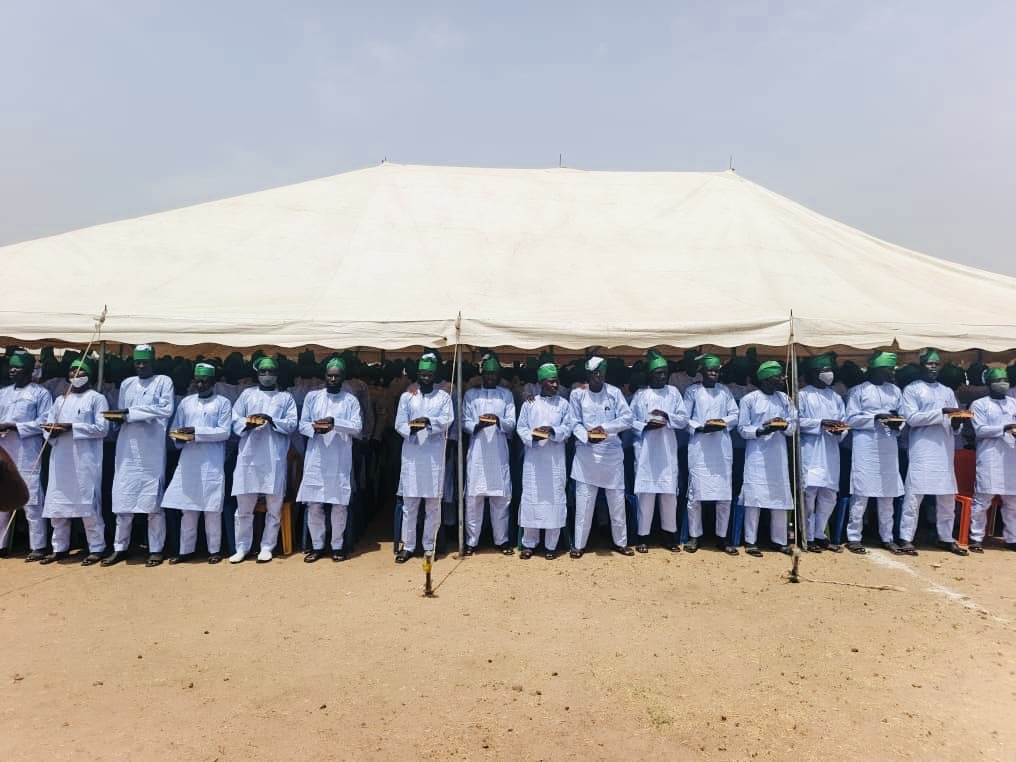
Nigeria’s non-kinetic strategy for tackling violent extremism recorded another significant milestone as 744 clients of Operation Safe Corridor, who once stood on the margins of violent extremism, graduated from the De-radicalisation, Rehabilitation and Reintegration (DRR) Camp in Mallam Sidi, Gombe.
The graduating clients comprised participants from Special Batch 7/2024, Special Batch 8/2025, and Sulhu Batch 8/2025, marking the successful completion of another phase of the Federal Government’s deradicalisation, rehabilitation and reintegration programme.
For security authorities, community leaders and development partners present at the ceremony, the moment symbolised more than the completion of a rehabilitation programme. It represented Nigeria’s continuing effort to confront insurgency not only through military force but also through carefully structured rehabilitation, reintegration and reconciliation initiatives.
The event also highlighted the growing role of non-kinetic strategies in Nigeria’s counter-terrorism framework, recognising that addressing the ideological, psychological and social dimensions of violent extremism is critical to achieving sustainable peace.
Delivering the remarks of the Chief of Defence Staff, General Olufemi Oluyede, the Director of Special Operations at Defence Headquarters, Rear Admiral Kabir Tanimu, said the graduation ceremony represented a profound milestone in Nigeria’s efforts to restore stability in conflict-affected communities.
Addressing the gathering, he noted that the ceremony was both symbolic and deeply reflective.
“This moment is not just a ceremony; it is nostalgic and a statement of progress, a demonstration of national resolve and a testimony to the power of strategic thinking in addressing the human dimensions of conflict,” he said.
He noted that Operation Safe Corridor reflects Nigeria’s conviction that while military operations are essential for neutralising threats, sustainable peace can only be achieved by addressing the deeper causes of radicalisation and creating structured opportunities for disengagement and reintegration.
“Today we are witnessing the outcome of that belief as 744 individuals who once stood on the fringes of conflict are now being given a structured pathway back into society.”
The CDS emphasised that the programme should not be misunderstood as an amnesty initiative.
“This is not a reward but a deliberate strategy to reduce violence, weaken extremist recruitment and promote long-term stability,” he stated.
He urged the graduating clients to embrace the opportunity offered to them and return to their communities with a renewed commitment to peaceful living.
“This programme has given you an opportunity for reflection, for change and for a new beginning. You are returning not just to your communities but to a responsibility to live peacefully, to contribute meaningfully and to reject all forms of violence and extremism. Nigeria is giving you a second chance, do not waste it.”
The defence chief commended the multi-agency structure supporting the programme, noting that the Armed Forces, security agencies, ministries and civil institutions have worked collaboratively to implement the initiative.
He also acknowledged the support of international partners including the International Organization for Migration, European Union, Foreign, Commonwealth & Development Office, Centre for Democracy and Development, the Embassy of Switzerland in Nigeria, and the International Committee of the Red Cross.
According to him, the contributions of these partners have strengthened programme delivery and reinforced Nigeria’s commitment to non-kinetic approaches to conflict resolution.
A key highlight of the ceremony was the commissioning of a de-radicalisation studio, which the CDS described as a strategic innovation aimed at strengthening ideological reorientation through digital engagement and structured messaging.
He further stressed that Operation Safe Corridor complements military operations by addressing the human dimension of conflict, reducing the likelihood of relapse into criminal activity and weakening the ideological foundations of violent extremism.
“As we move forward, the responsibility now extends to state governments, communities and all stakeholders involved in this reintegration. Reception, monitoring and community acceptance remain critical to sustaining the gains achieved today,” he said.
Earlier, the Coordinator of Operation Safe Corridor, Brigadier General Yusuf Ali, described the programme as a strategic national response to the human dimensions of insurgency.
He noted that while military operations continue to degrade insurgent capabilities, lasting peace requires deliberate mechanisms for disengagement, rehabilitation and reintegration.
Ali explained that the clients who graduated had undergone months of structured rehabilitation that included psychosocial support, vocational training, religious reorientation, educational reform, civic education and behavioural transformation.
“This process is not merely about disengagement; it is about rebuilding identity, restoring values and preparing individuals to return to society as responsible citizens,” he said.
According to him, many of the clients had once lived normal lives with aspirations and dreams before being drawn into conflict due to circumstances beyond their control.
“Some were abducted, others were coerced, while many were victims of manipulation or difficult circumstances,” he said.
“But today marks a turning point. From this moment they have been given the opportunity to reclaim their identity, rebuild their lives and pursue a future defined not by conflict but by purpose, responsibility and national development.”
The coordinator also commended the leadership of the Chief of Defence Staff, who also serves as Chairman of the National Security Committee for Operation Safe Corridor, for strengthening the structure and credibility of the programme.
He reiterated the importance of the newly established de-radicalisation studio, explaining that operational experience had shown that the standard duration of the programme alone might not be sufficient to achieve the desired depth of ideological transformation.
According to him, the studio will provide a platform for continuous engagement through structured digital content, targeted messaging and sustained reorientation programmes aimed at reinforcing positive behavioural change.
Ali urged the graduating clients to make the right choices as they reintegrate into their communities.
“You are returning to your communities not as the same individuals who came here but as people who have been prepared for a different and positive path,” he said.
He also emphasised that the success of the programme depends on collective responsibility.
“State governments, community leaders, families and institutions all have critical roles to play in ensuring that these individuals are accepted, monitored and supported.”
Providing a detailed review of the programme, the Camp Commandant of the DRR Camp, Colonel Mohammed Bello, said the ceremony represented another important milestone for Operation Safe Corridor.
He noted that the event coincided with the tenth anniversary of the programme, which was established in 2016 as part of Nigeria’s non-kinetic response to insurgency.
According to him, 3,325 clients have successfully graduated from the programme since its inception, including the current set.
The commandant explained that the graduating clients comprised 396 from Special Batch 7/2024, 200 from Special Batch 8/2025 and 31 from Sulhu Batch 8/2025, who arrived at the camp for rehabilitation between 14 October 2024 and 31 May 2025.
Upon arrival at the camp, the clients underwent comprehensive medical and physical examinations conducted by medical experts to determine their health status and ensure adequate care throughout the training cycle.
Their biometrics were captured by representatives of the National Identity Management Commission, enabling them to receive National Identity Cards after completing the programme.
The intelligence detachment of Operation Safe Corridor also conducted screening, profiling and documentation of the clients to obtain background information necessary for programme planning and monitoring.
During the rehabilitation period, the clients participated in various therapeutic interventions designed to counter extremist narratives and support psychological recovery.
Psycho-spiritual counsellors engaged the clients in religious reorientation sessions aimed at correcting distorted interpretations of Christian and Islamic teachings previously used to justify extremist activities.
Psychologists also conducted behavioural therapy sessions and identified clients suffering from anxiety disorders, stress conditions and anger-related issues.
Clients who required medical attention received treatment at the camp medical centre, while more complex cases were referred to the Federal Teaching Hospital Gombe.
Additional interventions included psychosocial therapy, drug abuse counselling, recreational activities and exposure to Western education.
According to Bello, the results of the therapeutic interventions showed that the clients responded positively to the programme and demonstrated enthusiasm toward reintegration.
Vocational training formed a central component of the rehabilitation programme, equipping the clients with practical skills necessary for self-reliance after reintegration.
The commandant revealed that 35 clients chose barbing, 39 selected shoe making, 142 specialised in welding and 107 trained in tailoring.
Other vocational skills included carpentry, bakery, electrical repairs, vulcanising and laundry services, while 175 clients participated in integrated farming involving crop production, poultry and fish farming.
A demographic breakdown showed that 477 clients were from Borno State, while others came from Abia, Adamawa, Akwa Ibom, Anambra, Bauchi, Ebonyi, Enugu, Gombe, Jigawa, Kaduna, Kano, Katsina, Kebbi, Kogi, Nasarawa, Niger, Plateau, Sokoto and Yobe states.
The programme also accommodated foreign clients including individuals from Burkina Faso, Cameroon, Chad and Niger Republic.
The commandant further disclosed that 11 of the clients were Christians while 616 were Muslims, information that helped programme managers design targeted counselling and rehabilitation interventions.
As part of preparations for reintegration, the clients participated in transitional justice activities including organised phone calls and stakeholder visitation programmes aimed at fostering reconciliation and rebuilding trust with their communities.
A critical requirement for graduation was the administration of the Oath of Allegiance to the Federal Republic of Nigeria, conducted on April 8, 2026 before an oath commissioner representing the Federal High Court in Gombe.
During the process, the clients publicly denounced their former affiliation with insurgent groups and pledged to remain loyal, obedient and law-abiding citizens.
Based on the outcome of therapeutic interventions and psychological assessments conducted by the Local Treatment Team, the commandant declared the clients fit for graduation and reintegration.
In his vote of thanks, traditional leader Aminu Abdullahi, the Agiya of Gombe emphasized the importance of cultural heritage and traditional institutions in maintaining social order and promoting peace.
He reflected on the historical evolution of traditional leadership structures dating back to earlier centuries and highlighted the role of established dynasties and traditional authorities in shaping governance and social organisation across the region.
According to him, Nigeria’s diverse communities historically relied on structured leadership systems that fostered stability and social harmony.
He therefore called for stronger collaboration between government institutions and traditional authorities in addressing social challenges and preventing violence.
Abdullahi noted that emphasising cultural heritage and strengthening traditional institutions would help reinforce social values and promote peaceful coexistence in communities affected by conflict.
Delivering a goodwill message on behalf of the graduating clients, Basil Anetochukwu expressed gratitude to the Federal Government, the Armed Forces, the judiciary, administrators of Operation Safe Corridor, non-governmental partners and members of the media for supporting the programme.
He recalled that many participants initially arrived at the camp with fear and uncertainty but later realised that the programme was designed to transform their lives.
According to him, the clients embraced the opportunity to learn vocational skills and change their ideological perspectives in line with national values.
Anetochukwu also called on individuals still involved in violent or criminal activities to abandon such paths and embrace peace.
He further emphasised the spirit of unity that developed among the clients during the programme despite differences in religion and cultural background.
“We lived together as one people, One Nigeria,” he said.
He urged his fellow graduates to maintain that unity as they reintegrate into society and begin a new chapter in their lives.
With the graduation ceremony concluded, Operation Safe Corridor once again demonstrated Nigeria’s commitment to addressing violent extremism through both military operations and carefully structured rehabilitation initiatives.
For the 744 graduates returning to their communities, the ceremony marked not only the end of a programme but the beginning of a renewed journey toward responsible citizenship, reconciliation and national development.