By Nkechi Eze
Nigeria has continued to explore innovative, non-kinetic strategies to address the root causes of insecurity, particularly the economic vulnerabilities that make young people and women susceptible to recruitment by extremist groups. Against this backdrop, the National Counter Terrorism Centre (NCTC), operating under the Office of the National Security Adviser (ONSA), has launched a new initiative aimed at strengthening community resilience through livelihood support and economic empowerment.
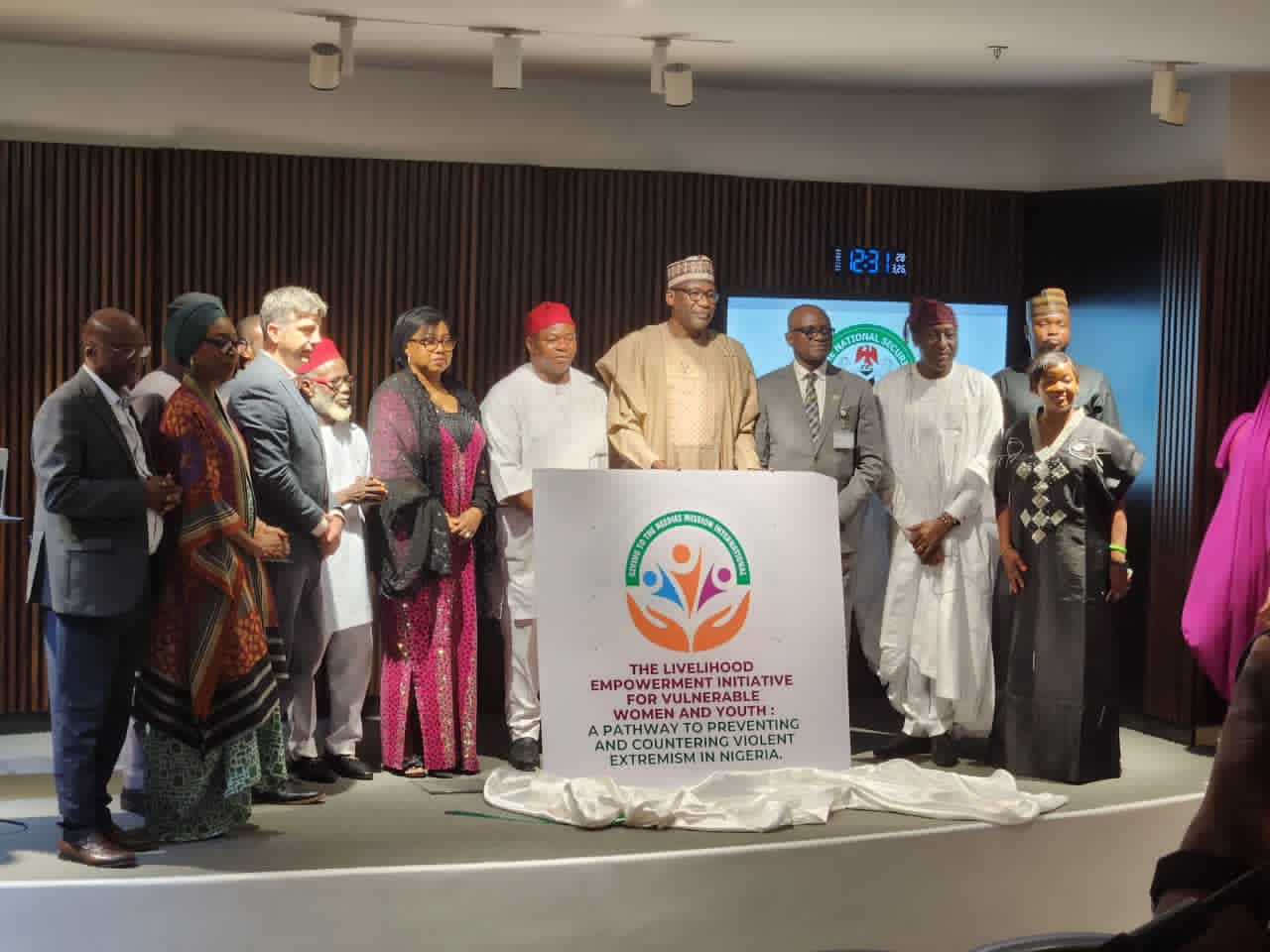
The programme, known as the Livelihood Empowerment Initiative (LEI) for vulnerable youth and women, was formally unveiled at the NCTC headquarters in Abuja as part of Nigeria’s broader efforts to integrate development strategies into its counter-terrorism framework.
Speaking on behalf of the National Security Adviser, Nuhu Ribadu, the National Coordinator of the NCTC Major General Adamu Laka, represented by Ambassador Abimbola Wonosiku, Director of Preventing and Countering Violent Extremism at the Centre, described the initiative as a critical step in addressing the deeper drivers of instability.
He explained that while military operations remain necessary in confronting terrorism, sustainable security requires tackling structural issues such as poverty, unemployment and social exclusion that often create fertile ground for radicalisation.
According to him, the Livelihood Empowerment Initiative represents a strategic shift toward preventive security, stressing that “sustainable security goes beyond kinetic responses and must address the underlying drivers of vulnerability and instability.”
He noted that Nigeria currently faces the intersection of economic hardship and insecurity across several communities, leading to displacement, fear, unemployment and limited economic opportunities, conditions that extremist and criminal groups often exploit.
By launching the initiative, he said, the government aims not only to provide livelihoods but to reduce the risks that push vulnerable populations toward violent networks.
“This initiative is more than a livelihood programme; it is a strategic security intervention designed to replace vulnerability with capability and despair with opportunity,” he said.
The project is designed to empower about 10,000 vulnerable youth and women through skills acquisition, agricultural value chain development, start-up resources and guaranteed market linkages, thereby improving household incomes while strengthening community resilience against extremist recruitment.
He added that the programme aligns strongly with Nigeria’s Preventing and Countering Violent Extremism framework by promoting economic inclusion, strengthening community-based prevention mechanisms and supporting at-risk populations.
The NCTC official further emphasised that agriculture was deliberately selected as the core sector for the intervention because it remains the backbone of Nigeria’s economy and a major source of sustainable livelihoods.
He commended Giving to the Needy Mission International (GINMI) for conceptualising the project and pledged continued support from the NCTC in coordinating preventive initiatives that strengthen national security.
In his opening remarks, the Board Chairman of GINMI, Dr. Reuben Uche Egwu, described the launch of the initiative as the culmination of a vision built on hope, partnership and the belief that sustainable peace can only be achieved when the material conditions of citizens are improved.
He noted that Nigeria’s security challenges from terrorism in the North-East to banditry in the North-West and resource-based conflicts in the North-Central require a holistic and people-centred response that tackles the economic realities driving insecurity.
According to him, economic hardship remains one of the most significant factors pushing young people toward extremist groups, making economic empowerment a critical component of national security.
“The Livelihood Empowerment Initiative is a proactive, non-kinetic security strategy that addresses these economic drivers head-on,” Egwu said.
He explained that the programme will run between 2026 and 2028 and will provide intensive training in best agronomic practices while supporting beneficiaries with high-quality agricultural inputs, start-up grants and guaranteed access to markets.
The initiative will focus on key agricultural value chains including cassava processing, rice and maize cultivation, poultry farming and fish production.
To ensure sustainability, Egwu disclosed that the programme has already established clusters of off-takers and purchase agreements with major agro-processing companies such as Olam Nigeria and Dangote Rice.
Through these partnerships, he said, the initiative aims to eliminate post-harvest losses and create both direct and indirect employment opportunities, projecting about 20,000 jobs as the programme progresses.
The implementation of the initiative will follow a phased rollout across twelve states and the Federal Capital Territory, beginning with Ebonyi State before expanding to Nasarawa, the FCT, Adamawa, Akwa Ibom, Kaduna, Borno, Gombe, Enugu, Niger, Lagos and Plateau states.
Also speaking at the event, Dr. Iyke Ezeugo, Chief Operating Officer of the DoGood Foundation for the Needy in the United States, delivered a goodwill message on behalf of the organisation’s founder, Major Iheanyichukwu Sunday of the United States Army.
He described the initiative as a strategic shift in counter-terrorism thinking, noting that violent extremist groups often weaponise poverty, unemployment and marginalisation to recruit vulnerable individuals.
According to him, providing skills, enterprise support and market access is one of the most effective ways to dismantle the structures of despair that sustain extremism.
“When we invest in the livelihoods of youth and women, we are not just supporting economic development; we are strengthening communities and fortifying them against extremist ideologies,” he said.
In his goodwill message, the representative of the Borno State Government and Commissioner for Information and Internal Security, Prof. Usman Tar, also emphasised the strong link between poverty, lack of education and insecurity.
He welcomed the initiative as a critical non-kinetic intervention that complements military operations in addressing the root causes of terrorism and banditry.
Former Director-General of the National Orientation Agency, Dr. Mike Omeri, also highlighted the importance of adopting a whole-of-society approach in addressing violent extremism.
He noted that individuals often join extremist groups due to a combination of ideological, social and economic factors, stressing the need for broader interventions beyond agriculture to address identity crises, social exclusion and the search for purpose among young people.
Delivering the closing remarks, Ambassador Wonosiku reiterated that the Livelihood Empowerment Initiative represents a strategic response to one of the most critical drivers of insecurity in Nigeria, economic vulnerability.
He emphasised that preventing violent extremism requires moving beyond reactionary measures toward building resilience, inclusion and opportunity within communities.
He also urged stakeholders including government institutions, development partners, civil society organisations and the private sector to sustain their collaboration and support for the successful implementation of the programme.
Highlights of the event included the official launch of the national LEI programme, a presentation on the collaboration between the NCTC and GINMI delivered by Mrs. Amakor Justina, Principal Staff Officer for Humanitarian and Gender Mainstreaming at the NCTC, as well as a group photograph of participants.