By Nkechi Eze
The Federal Government has reaffirmed its commitment to transparency, accountability, and institutional reform with the presentation of the report of an independent investigative panel on alleged misconduct within the Nigerian Correctional Service.
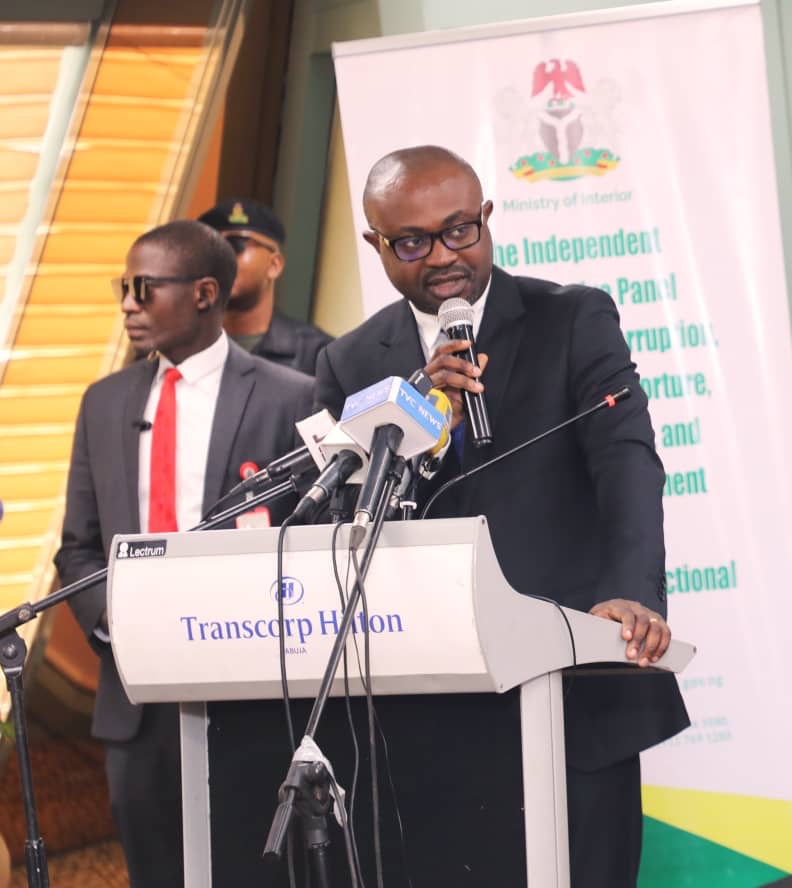
The report was unveiled at a high-level stakeholders’ engagement convened by the Ministry of Interior in Abuja, bringing together key actors from across government, the justice sector, security agencies, civil society, and development partners.
Speaking at the event, the Minister of Interior, Olubunmi Tunji-Ojo, said the establishment of the panel reflected the government’s resolve to confront systemic challenges within the correctional system through a thorough and transparent process.
“The work of this panel represents a significant step toward strengthening transparency, accountability, and institutional integrity within our correctional system. We chose to confront the problem directly because we believe that every challenge presents an opportunity for lasting reform,” he said.
The panel, inaugurated on November 24, 2024, completed its assignment after 16 months of investigation, stakeholder consultations, and detailed analysis. It was set up in response to allegations of corruption, abuse of authority, and human rights violations within correctional facilities.
Findings from the report, according to the minister, highlight the urgent need to reposition correctional centres from mere custodial institutions to facilities focused on reformation, rehabilitation, and reintegration.
Tunji-Ojo noted that the outcome of the investigation would guide comprehensive reforms aimed at strengthening institutional capacity, improving staff welfare, and enhancing service delivery standards. He called on stakeholders to support the reform process, stressing that sustainable change requires collective responsibility.
In his remarks, the Attorney-General of the Federation and Minister of Justice, Lateef Olasunkanmi Fagbemi, commended the Interior Minister for his leadership, describing the initiative as a milestone in restoring public trust and strengthening accountability in the justice system.
He reiterated the Federal Government’s commitment to upholding human rights through strengthened institutional frameworks, including oversight by the National Human Rights Commission. He also pointed to the Nigerian Correctional Service Act, 2019, as a key reform instrument that shifted the system from a punitive model to one centred on rehabilitation and respect for human dignity.
Earlier, the Permanent Secretary in the Ministry of Interior and Chairperson of the investigative panel, Magdalene Ajani, described the engagement as a platform for dialogue, reflection, and shared ownership of reform outcomes.
She said the panel’s work was guided by principles of fairness, independence, and public interest, in line with the Federal Government’s broader reform agenda.
Goodwill messages were delivered by stakeholders, including the President of the Nigerian Bar Association, Afam Osigwe, and representatives of key institutions such as the Legal Aid Council of Nigeria and UNICEF. They collectively stressed that the report must translate into measurable action to build a humane, transparent, and efficient correctional system.
Participants also highlighted persistent challenges such as overcrowding, prolonged pre-trial detention, and gaps in the implementation of legal frameworks, calling for sustained and collaborative reforms.
Key recommendations from the engagement included expanding non-custodial measures, improving access to justice, protecting vulnerable groups especially children, strengthening oversight mechanisms, and enhancing the welfare and working conditions of correctional personnel.
The event concluded with a renewed commitment by stakeholders to work together in transforming Nigeria’s correctional system into one that aligns with both national priorities and international human rights standards.