

By Nkechi Eze
Amid sweeping infrastructure reforms and a determined push to modernise Nigeria’s road network, the Federal Government has intensified efforts to safeguard projects against vandalism while restructuring inherited contracts worth trillions of naira.
Minister of Works, Engr. David Umahi, on Thursday mounted a vigorous defence of President Bola Ahmed Tinubu’s road transformation agenda, detailing widespread sabotage of federal assets, the termination of a ₦1.5 trillion contract renegotiation, and fresh presidential approvals extending strategic corridors nationwide.
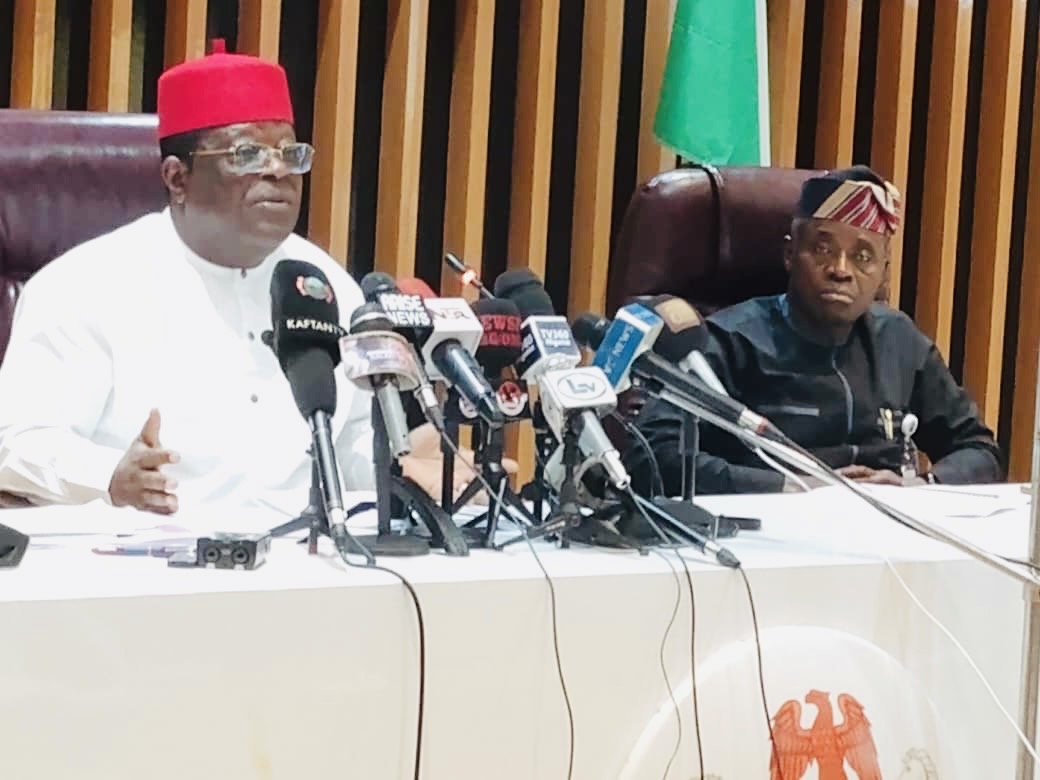
Speaking at an extensive ministerial briefing, Umahi described the ministry’s task as a “daily battle” to protect and deliver critical infrastructure under intense fiscal pressure and security challenges.
He disclosed that repeated acts of vandalism, particularly along the Lagos–Calabar Coastal Highway and major bridge corridors, have posed serious setbacks to ongoing projects.
“We have drawn the attention of Nigerians to the massive vandalisation of our critical infrastructure across the country,” the Minister said. “If we do not protect what we are building, repairs will continue endlessly, and that is not healthy for our society.”
According to him, security agencies in Lagos have ramped up surveillance and deployments along the coastal highway after incidents involving cable theft, destruction of protective installations, and deliberate obstruction of underground drainage channels.
“I was in Lagos two weeks ago. The governor, the Commissioner of Police, and the good people of Lagos have massively deployed along that corridor to check vandalisation,” he said.
Umahi revealed that flooding recorded along portions of the Coastal Highway was traced to intentional blockage of underground drainage systems during break-ins. In the Shagamu axis, he said vandals have been cutting reinforcement components and removing protective materials installed to strengthen road shoulders.
“They cut the wires. They remove elements meant to protect the beauty and structural strength of the roads. These illegalities have consequences,” he warned.
The Minister also raised alarm over structural threats to key bridges, including the Koton Karfe Bridge and another major corridor, attributing the deterioration to illegal sand mining activities and the parking of heavily loaded trucks on bridge decks.
“Bridges are not designed to carry static loads. When you park heavy trucks on them, you are inviting structural failure,” he cautioned.
Following expert reviews and stakeholder engagements, the ministry concluded that one of the compromised bridges may require demolition. However, interim engineering interventions are being explored to extend its lifespan by about three years pending full reconstruction.
He further disclosed that illegal miners have damaged pipelines and removed expansion joints for scrap, while security operatives recently apprehended vandals dismantling “cat eyes” and electrical fittings from bridge decks.
To stem the tide, President Tinubu has directed the installation of CCTV surveillance systems on federal highways. Umahi confirmed that cameras mounted on the Third Mainland Bridge have already facilitated arrests.
Beyond security concerns, the Minister painted a sobering financial picture of inherited liabilities.
He revealed that upon assumption of office, the ministry inherited 2,064 ongoing projects valued at roughly ₦13 trillion, with total exposure now standing at ₦16.9 trillion.
A significant portion of these projects had been funded under the Nigeria National Petroleum Company (NNPC) infrastructure tax credit scheme established by Executive Order 007. However, following presidential directives, NNPC will no longer make direct payments to contractors.
“The President directed that the Ministry of Works should assume full responsibility. The projects are not dead, but we must prioritise and restructure them,” Umahi explained.
He estimated that completing all inherited NNPC-funded projects would require about ₦7 trillion. Of the ₦263 billion in outstanding liabilities, ₦127 billion has been released on presidential directive, while documentation reviews and scope adjustments continue.
Addressing the controversial Abuja–Kaduna–Zaria–Kano highway rehabilitation, Umahi disclosed that the project had already gulped ₦739 billion before his tenure, with approximately 240 kilometres completed out of about 350 kilometres.
In the wake of subsidy removal and the floating of the naira, the contractor requested ₦1.5 trillion to complete the remaining sections. The ministry counter-offered ₦1.1 trillion, but after 14 months of negotiations involving the Chief of Staff to the President and the National Security Adviser, the contract was terminated in line with due process.
“We simply could not afford ₦1.5 trillion. There is a clear procedure for termination, and we followed it strictly,” he said.
Umahi disclosed that reconciliation of financial claims exposed discrepancies, with the ministry approving only a portion of additional demands while insisting on recoveries owed to the Federal Government.
“If I am invited by the EFCC, I will testify. I studied the entire file. There is nothing about that project I cannot explain,” he declared.
The Minister strongly defended the administration’s policy shift from asphalt to reinforced concrete pavement, arguing that previous road designs rarely lasted beyond a decade.
“Show me any road constructed before now that lasted ten years,” he challenged. “With reinforced concrete at 18-inch thickness and Grade 40 strength, we are designing roads to last between 50 and 100 years.”
He urged critics to conduct non-destructive testing at project sites before questioning quality standards.
In a major announcement, Umahi revealed that President Tinubu has approved an 8.7-kilometre reinforced concrete extension of the Bodo–Bonny Road in Rivers State, linking it to the East–West Road. The project, scheduled to commence in March, will feature two flyovers.
“For the first time since the creation of Bonny, there will be a direct road connection to the mainland,” he said.
He also outlined expansion plans for the Akwanga–Jos–Gombe–Maiduguri corridor, with simultaneous construction from multiple ends to accelerate delivery across the North-East.
Responding to criticisms surrounding Public-Private Partnership (PPP) financing models and allegations of pension fund involvement, Umahi maintained that infrastructure investment is consistent with global best practices.
“Pension funds are not meant to lie idle in banks. Infrastructure investment is standard practice worldwide,” he said, while emphasising that contractors must still meet strict quality benchmarks.
Throughout the briefing, the Minister dismissed allegations of favouritism in contract awards, clarifying ownership structures of companies cited in public discourse and urging critics to verify facts before publication.
“We will not succumb to blackmail. My duty is to ensure quality work and value for money,” he said.
He commended President Tinubu for sustaining inherited projects despite fiscal constraints, pointing to improved macroeconomic indicators and more balanced regional distribution of infrastructure.
With reinforced concrete corridors stretching from Lagos to Calabar, Abuja to Kano, and Bodo to Bonny, the Ministry of Works is simultaneously battling vandalism, restructuring legacy contracts, and managing a multi-trillion-naira infrastructure portfolio.
Umahi’s central message was unmistakable: building roads is only half the task, protecting them is equally critical.
“If we do not safeguard this infrastructure, we will keep repeating repairs,” he said. “This ministry is doing everything within its conscience and capacity to deliver value for money.”