

By Nkechi Eze
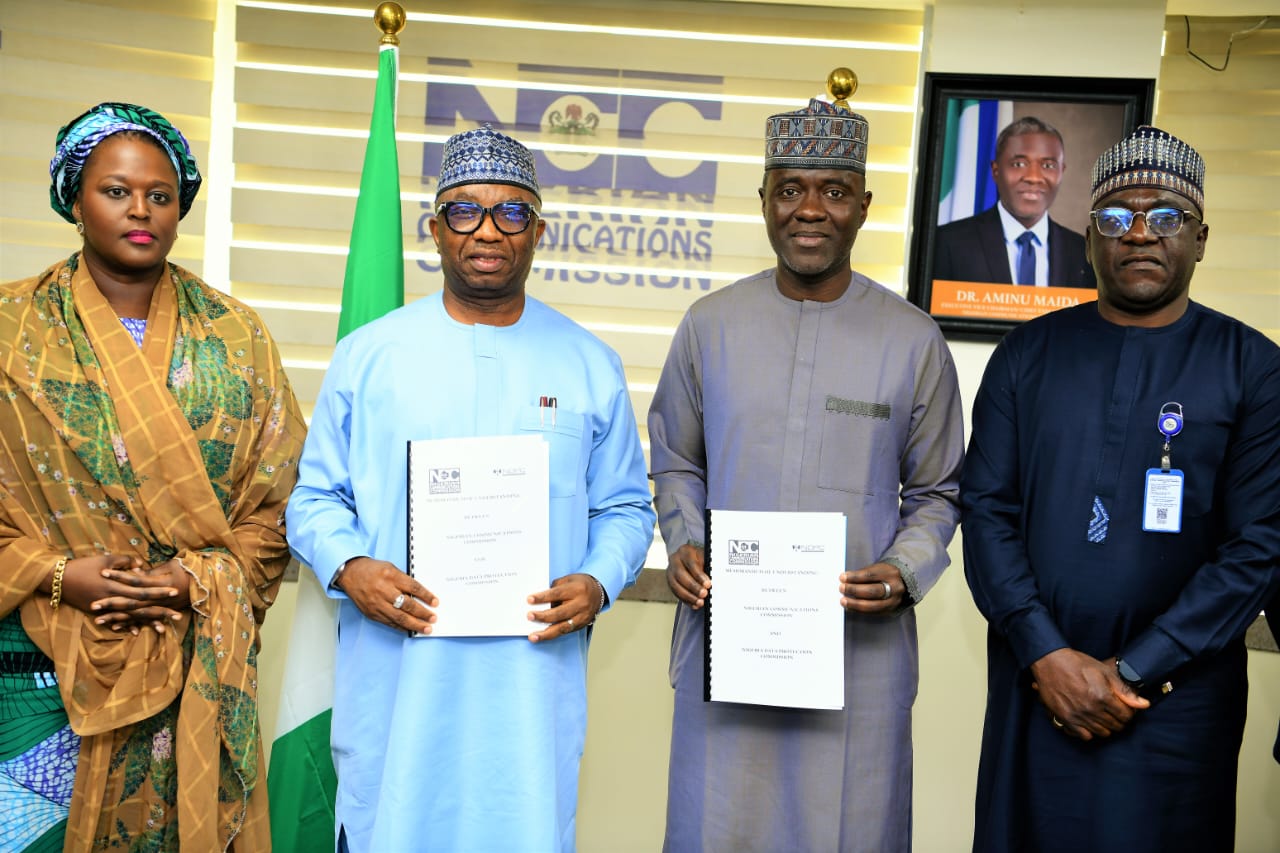
In a decisive move to deepen data privacy, strengthen regulatory cooperation, and safeguard the rights of Nigerians in the rapidly expanding digital space, the Nigerian Communications Commission (NCC) and the Nigerian Data Protection Commission (NDPC) have signed a Memorandum of Understanding (MoU) aimed at advancing data protection and regulatory synergy within Nigeria’s telecommunications industry.
The agreement, which provides a structured framework for collaboration between both institutions, reflects a shared commitment to ensuring that Nigeria’s digital ecosystem is underpinned by robust data governance, effective enforcement mechanisms, and a clear alignment of regulatory responsibilities.
Speaking at the signing ceremony, the Executive Vice Chairman and Chief Executive Officer of the NCC, Dr. Aminu Maida, underscored the growing importance of data protection and privacy regulations to the future of the communications industry, describing effective data regulation as critical to sustaining trust, innovation, and long-term sectoral growth, especially as Nigeria moves deeper into the digital and artificial intelligence era.
Dr. Maida reaffirmed the Commission’s commitment to working closely with the NDPC to ensure that the privacy rights of Nigerians are adequately protected, while also maintaining a resilient, secure, and forward-looking communications network capable of supporting the country’s development aspirations.
He highlighted the remarkable evolution of Nigeria’s telecommunications sector, noting that the country has grown from about 500,000 connected telephone lines to over 170 million active connections, a transformation that reflects the NCC’s mandate not only to connect Nigerians, but also to enable businesses, drive innovation, and support national development.
According to him, the next phase of sectoral growth will be driven largely by emerging technologies such as artificial intelligence, which depend fundamentally on data generated by users of digital platforms. He stressed that data is produced by people, belongs to people, and that citizens must be aware of the data they generate and the rights attached to it, warning that lack of awareness exposes individuals to the risk of having their data monetised without their consent or benefit.
“People need to be aware of the data they are generating, and they need to know their rights around that data. If they don’t know it, somebody will monetise it. When platforms are said to be free, they are not really free. Somebody is using your data. The future is data. If we do not get the principles of how we govern it right, even our national sovereignty could be undermined,” Dr. Maida said.
He further described data as a strategic national asset and a critical component of sovereignty, noting that for artificial intelligence to remain relevant and beneficial to Nigeria, the country must continue to generate fresh, locally relevant data within a trusted, transparent, and well-regulated environment.
In his remarks, the National Commissioner of the NDPC, Dr. Vincent Olatunji, described the MoU as a vital step toward protecting the personal data of Nigerians, emphasising that effective regulation within any sector is difficult without close collaboration with the sector regulator.
“It is always difficult to go into a sector and implement your mandate effectively without involving the regulator of that sector. We are not taking over the mandate of the telecom regulator. We are adding value to what you are doing, and you add value to what we are doing. We do not want this MoU signed and kept on the shelf. We want to sign and commence implementation immediately to ensure that the privacy and protection of Nigerians’ data is properly taken care of,” he said.
Dr. Olatunji noted that coordination and collaboration remain core pillars of the NDPC’s regulatory philosophy, expressing confidence that the partnership with the NCC would significantly enhance data governance in the communications sector. He added that both agencies would share knowledge, exchange expertise, and jointly build capacity in areas of mutual regulatory interest, thereby strengthening Nigeria’s overall data protection ecosystem.
Given the overlapping responsibilities of the NCC, as the regulator of telecommunications, and the NDPC, as the national authority on data protection, both Commissions acknowledged the importance of streamlining regulatory processes, avoiding duplication of roles, and ensuring clarity in the regulation of data within the communications sector, in line with their respective statutory mandates.
The MoU is expected to pave the way for closer institutional collaboration, more coherent regulation, and stronger enforcement, ultimately reinforcing public confidence in Nigeria’s digital economy and laying a solid foundation for the responsible use of data in the country’s fast-evolving technological landscape.